Showing posts with label combat. Show all posts

Friday, July 10, 2026

2W2P: combat, injury and recovery

Being an elaboration and expansion on my previous post synthesizing Marcia's B's thoughts on worker placement and the dice assignment mechanic of GHOST/echo.

general skill

This section supersedes the relevant parts of the original post. When counting the people participating in a task, consider their skill. The levels of skill are unskilled, competent (counts as one), experienced (counts as two) and specialized (counts as 4). At the GM's discretion, any character may be considered competent in a task that does not require special training.

Generally, competency requires a season's supervised practice, experience requires a year's practice and specialization requires four years' practice. Up to half of these requirements may be replaced by two times as much formal instruction. Self-study and unsupervised practice takes three times as long as supervised practice, if the information is available to the character.

A competent character may supervise one student, an experienced one three and a specialized one six. While supervising, a character may handle on only as much work on their own as the least-skilled of their students. However, for each period of work, a supervisor may add one die to any one roll made by one of their students. 

fighting skill 

Fighting skill is tracked more closely than other kinds. Each fighter is categorized by the number of life-or-death fights they have participated in; do not count drunken brawls, angry punching matches or sport fights; only fights where at least one side is trying to kill or maim.

  • Green (none): 2 per 3 fighters + 1 for 2 remaining.
  • Fresh (1-2 fights): 1 per fighter
  • Tested (3-5 fights): 3 per 2 fighters + 1 for 1 remaining.
  • Seasoned (6-9 fights): 2 per fighter
  • Veteran (10-14 fights): 3 per fighter
  • Hero (15+ fights): 4 per fighter 

illustration (from osprey publishing) of a viking era melee

melee

In hand to hand fighting, group fighters into "fronts" based on whether they are separated from or able to help one another. Each fighter contributes dice to their side of a front. Every 5 or 6 rolled is a felling hit and every 3 or 4 is a wounding hit. The other side decides which fighters take them.

A side may choose (before rolling) to roll some of their dice defensively; each 5 or 6 stops one hit of any kind and each 3 or 4 either stops a wounding hit or turns a felling hit into a wounding one. The side rolls an additional 1-2 dice for defense if everyone on the front has effective body and/or head protection.

For those in their physical prime, the third wounding blow is a felling blow. For everyone else, the second wounding blow is a felling blow. 

injury

A character who takes a felling blow cannot fight or move quickly. A character who takes one or more wounding blows fights one category worse than their experience level for each one.

Felling wounds and one out of every three other wounds must be re-set before they can be recovered; the GM should determine this secretly for non-felling wounds. Examination by an experienced surgeon or any specialized healer is needed to tell if a non-felling wound needs re-set. After a failed roll to recover a wound, any competent healer can identify that it needs re-set.

On the day that they took a blow, a character (and anyone treating them) rolls against the risk of infection; each wound has a separate risk. Beginning on the following day, each infection is a risk of dying. Examination by an experienced physician or any specialized healer can identify an infection the day after it sets in; any competent healer can identify one two days afterwards.  

recovery

A felled character (and anyone treating them) must roll against the risk of dying on the day they are wounded and each day until the risk is removed. Each infection is a separate risk of dying.

A character with wounds (and anyone treating them) rolls with the goal of recovering from a wound after each day without even light activity or after three days without strenuous activity. Recovering from each wound is a separate goal; however, if fewer dice are rolled than there are goals, the opportunity to recover from any leftover wounds is not lost. 

an engraving of a seated man having some sort of chest injury treated by a surgeon

healers

To contribute even 'inexperienced' treatment, one must have a month of supervised practice or a season of instruction. 'Experienced' healers have two seasons of supervised practice or two years of instruction, and specialized healers have at least three years of supervised practice and two of instruction.

While some healers practice several, nursing, physic and surgery (these terms are going to be inaccurate, just relax about it please) are distinct skills: 

  • Someone who is personally present with a patient while they recover is a nurse.
    A competent nurse may care for three patients at a time, an experienced one five and a specialized one eight. 
  • Someone who binds wounds and sets bones is a surgeon (bone-setter, medic).
    A competent surgeon may treat two wounds or examine three patients in an hour. An experienced one may do three and a specialized one five.
  • Someone who treats infections and non-traumatic ills is a physician (herbal, pharmacist).
    A competent physician may examine three patients or compound medicines for two patients in an hour. An experienced one may do three, and a specialized one five.

If a nurse is practicing other healing skills, they cannot at the same time give patients the benefit of their nursing but they may still supervise other nurses.

Sunday, January 7, 2024

3eish: combat

Blogger ate a draft of this post and I'm not pleased about it. I realize I've posted ideas along these lines before, but here are the versions I like the best now.

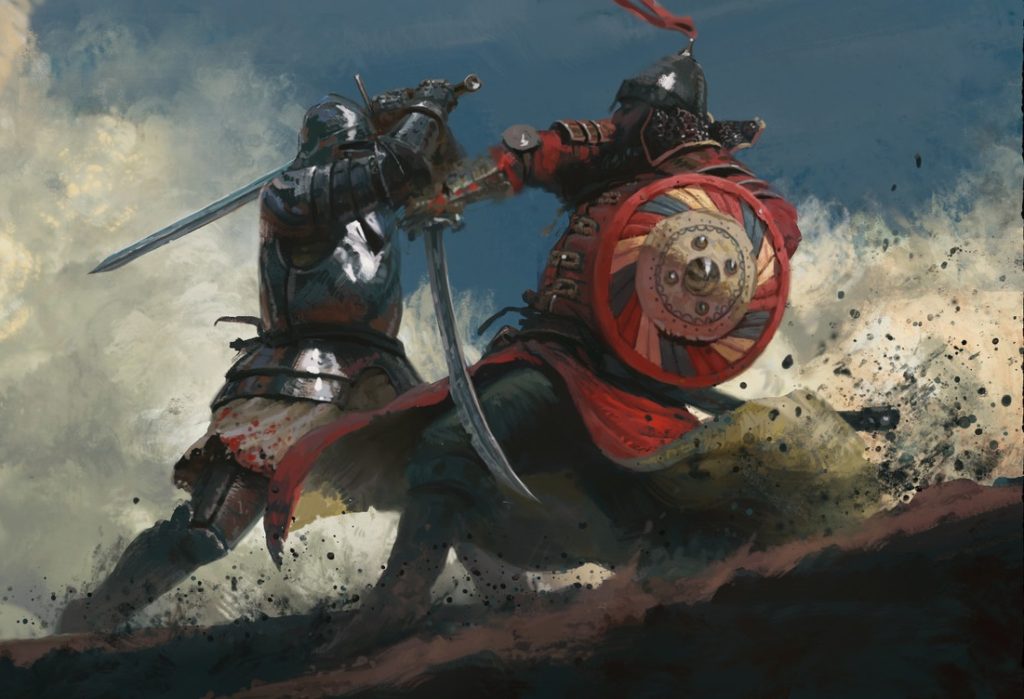
two warriors in armor fighting
Artist: Simon Gocal

Action

Surprised figures do not move or act during the first round that they join combat. Otherwise, the adventurers and their enemies move and act in alternate phases:

  1. Enemies move
  2. Adventurers move & act
  3. Enemies act
  4. Attacks are resolved

A figure's movement ends if they enter the reach of a foe that can act. If they start within its reach, their movement is limited to one inch.

A figure's movement depends on the load they are carrying. A burdened figure may move twice their Size (in inches, scale TBD), one in heavy kit may move three times their Size and one in light kit may move four times their Size. If a burdened figure moves more than their Size, on an unburdened one twice their Size, they may not act.

A figure may drop what they are holding, or drop into a kneel (-1 Size) or to the ground (-2 Size) freely. Instead of movement, a figure may:

  • Concentrate on magic
  • Draw or stow an item
  • Open or close a door
  • Stand from a kneel
  • Take aim

Or similar things; otherwise, these are all actions. Standing from the ground allows only one inch of movement and no other actions.

Attacking

An attacker states their aim, for example, draw out, disarm, push back, restrain, seize, throw or wound. Then, they make their roll and add +1 for every 4HP they currently have. Subtract 4 if they are fighting in an awkward or unfamiliar manner. Then apply situational modifiers:

  • In hand-to-hand, apply the attacker's Strength modifier. Add +2 if the target was attacked by another this round.
  • Fighting at reach, apply the attacker's Dexterity modifier. Add +2 if the target entered the attacker's reach this round.
  • Shooting at range, apply the attacker's Intelligence modifier. Add +2 if the target has not moved this round.

Attacks at range are resolved first, followed by attacks at reach in descending order of reach and finally by hand-to-hand attacks.

An attack succeeds if the modified roll is at least equal to the target's defense. This has two components. A figure's dodge is 3 plus their Wisdom modifier. A figure's protection is 3, plus one for every layers of armor, source of cover or increment of the target's Size (in inches) between the attacker and target.

  • When taking cover or other defensive action, defense is dodge + three times protection.
  • Otherwise, when able to act, defense is dodge + two times protection.
  • Otherwise, defense is two times protection.

If the attack is successful, the attacker rolls damage based on their own Size. 

Example Size Die Type
cat 0 d2
fairy, monkey 1 d2
dog, elf 2 d4
deer, man 3 d6
horse, thark 4 d8
ogre, rhinoceros 5 d10
elephant, giant 6 d12
dragon 7 d20

The target may choose to either lose that many HP (if they have that many) or accept the aim of the attack.

Odd attack rolls fail against targets that are concealed from their attackers. If the target is totally concealed, the attacker must have some way of discerning their exact position before attempting an attack in the first place.

Wounding

When a figure is wounded, the severity of the wound depends on how much the damage exceeds their current HP. For these purposes, subtract 2 from the damage of bare fists or feet. A wounded figure makes a saving throw, adding their Constitution modifier.

Excess Wound DC Success Failure
2 or less Light 12 Fine Unconscious
3 to 5 Serious 15 Unconscious Dying
6 or more Critical 18 Dying Dead

A dying character will die if their wound is not treated within a few minutes. An unconscious character may make another save within a few minutes to come to, otherwise they remain out for a few hours.

Monday, December 18, 2023

talent, time and tools

Being a universal 2d6 resolution mechanic and some extra bits.

An attempt succeeds if a roll of 2d6 is at least equal to the required target number:

  • You have an appropriate talent, time and tool: 5
  • You are missing one of those: 6
  • You are missing two of those: 7
  • You have none of those: 8

A roll of 10+ (regardless of target number) is a clean success. A particularly stressful situation may require a clean success to avoid costs or complications.

Talents

Create a character by giving them 2-3 traits or skills and however many talents your Referee finds appropriate. 

If you don't start with a talent you must:

  • Practice for a season with a skilled teacher or three seasons on your own for the archery, climbing, thievery or any weaponry talents.
  • Slay three armed foes by your own hand for the fighting talent.
  • Become initiated into the inner mysteries of a cult for its ritual talent.
  • Survive ten days in the bush without aid or supplies for the wilderness talent for those environs.

Combat

Talent. The fighting talent is for hand-to-hand or hand weapons and the archery talent for bows. No talent is required for crossbows or guns. Weaponry talents do not affect the target number of attacks, but they allow the attacker to use any special properties of the weapon.

Time. You have time if the target is surprised. 

Tools. Close weapons for hand-to-hand and non-close weapons otherwise.

An armed attacker gets +1 to their roll if their target is unarmed. A character with a longer weapon than their opponent starts with a +1 advantage to their attacks, but a clean success seizes the advantage from one's target (or seizes it back).

In hand-to-hand, a clean success damages, disarms, pins or throws one's target. Otherwise, success merely holds them. A held character may do any of those to their opponent with a clean success. Otherwise, success reverses the hold. Any success by the holding character may damage, disarm, pin or throw the other.

Magic Rituals

Magic rituals are done with one roll but involve a sequence of steps. Some might require all of the following, and some only one or two:

  1. Guarding the space
  2. Guarding the magician
  3. Opening the way
  4. Fixing the terms
  5. Closing the way
  6. Purifying the magician
  7. Purifying the space

Talent. Each cult has its own path of rituals, any its ritual magic talent counts for any ritual on that path. Anyone with such a talent is aware of the presence of other talented magicians and of powerful spirits, and may address them mind-to-mind.

Time. Rituals of 1-2 steps take 10 minutes, minus one for every time the size of the group of magicians doubles. Each additional step doubles the time required.

Tools. Guarding or purifying magicians requires oils or potions for each. Guarding or purifying the space require candles, diagrams or smoke to fill it. Opening the way requires an arcane connection to the recipient of the power. Fixing the terms requires a symbol of what is to be done. Closing the way requires a symbolic weapon.

If the power invoked by a ritual is an intelligent spirit, a clean success is needed to avoid some additional price being demanded. Offering a sacrifice adds +1 to a ritual roll to deal with a spirit, or +2 if the sacrifice is extremely dear.


Tuesday, December 6, 2022

3eish draft - action sequences

My 3eish concept has been through a lot of drafts, but I recently arrived at the following rules for action sequences (combat) and I think they're quite close to what I'll use in the final thing. Who knows, maybe I'll even use the same words.

A group of peasants fight with hand tools against the theft of their crop.

rule

Encounters take place over rounds, representing a few seconds each.

Actions

Each character may act once per round. Characters act in order from highest initiative (aka adrenaline) to lowest and then from highest Wisdom to lowest. Changes to initiative affect the next round's sequence, not the current round.

A character may make only one reaction between one action and the next. They may only react a second time by forfeiting their next action.

Actions that take a few seconds require a character to commit to them; a committed character can't react until after their next action.

Movement

A character may move up to their Move score as part of their action; if they take no action, they may move twice that amount.

Careful movement---such as balancing or leaping---requires a check; a failed check occupies the character's action. A failure by 5 or more means they fall.

Contested movement---such as climbing, parting tangles or swimming---requires an action, at least one free hand and a check; a failed check takes a few seconds (committing the character). A failure by 5 or more means they fall, become entangled or sink. 

Wednesday, December 15, 2021

HP as adrenaline (also initiative, I guess)

rule

In the general course of events, characters have Stamina which is depleted by strenous activity or injury. Every time they become injured, roll (an appropriate type of roll) under your stamina or take Critical Damage. However, when a crisis that needs to be resolved moment-to-moment breaks out, they can rely on a Rush of strength and agility to protect them instead.

a truly incredible diagram of a woman leaping through the air, annotated with all the 'adrenaline superpowers' that she benefits from

Once a character becomes aware of danger, the player may spend points of their stamina up to your level (if your game has variable hit dice per class, two-thirds level for clerics/thieves and one-third level for mages [rounded up]) and roll that many dice. The total is your Rush, which is used for several things:

  • Each round, action proceeds from highest Rush to lowest Rush and then from highest Stamina to lowest Stamina for characters that do not have the benefit of a Rush.
  • When a character takes damage, they may spend points of Rush to reduce the damage by that amount (to a minimum of zero).
  • If you have a Rush, taking any careful or deliberate action while being menaced by a danger (for example, within reach of a foe) costs 1 point of Rush.

A player may only roll for a Rush when their character becomes aware of a new source of danger. An encumbered character can't roll up a Rush.

If they have a chance to rest after a crisis is resolved, characters may exchange Rush for Stamina at a rate of three to one. If there is no opportunity to rest, or if there are excess points of Rush after exchanging the rest for Stamina, they are lost.

why?

Joke: everyone can backstab.
Woke: everyone can rage.

Listen, there are a lot of different interpretations of HP. This is another one, clearly. Probably someone's thought of it before. A lot of different ideas are coming together to form this: hit dice as a resource to replenish hit point pools (sort of reversed), hit dice being rolled at the start of an encounter, Into the Odd-style critical damage rolls, and (weirdly enough) an example consequence for failing a 4e-style Skill Challenge being the loss of a healing surge (out of combat) or damage (in combat).

Oh, and the rule about spending Rush to take actions while you're being menaced is taken from the Pressure mechanic from OLOG, an extremely cool replacement for Attacks of Opportunity which is (as far as I know) only described in the parenthetical note to the Arsenal ability of the Marine class in this post.

One thing I like about this is that the consequences of surprise/backstabbing sort of comes for free. I also think the Electric Bastionland rule about burdened characters having zero HP fits in very naturally. Not sure what else to say, I just kind of like it.

Sunday, September 5, 2021

towards a 3e hack

The third edition of D&D was my first exposure to it and to roleplaying games in general. Although I haven't played it in years and it does a thousand things I find frustrating, but it retains a draw for me. The more I learn about other editions of the game, earlier and later, the more I find myself appreciating parts of the vision for 3e. It's a design itch I don't feel that I've fully scratched yet, so here is some work I've done in various areas towards a 3e-based hack. The one sentence pitch is like: what if third edition was more like into the odd, but it also only used d20s and d6s for some reason.

This post is not going to go into any character creation mechanics (classes, templates, feats, etc) because it's still pretty unclear to me how I'd like those to work.

woodcut of an angel and a skeleton, both holding downward-pointing arrows

Monday, July 19, 2021

more flip weapons

Three more flip weapons, in order from least to most cursed.
  1. The SAW // BILL
    • SAW. A circular saw-blade, fixed to a length of chain that can be whipped as a thrown axe, out to spear range, and pulled back at the end of your action. When you deal minimum damage, the chain locks into a bar, flipping the weapon to BILL.
    • BILL. A polearm with a surprising light, hollow steel haft, ending in a cruelly serrated blade. As pike. When a foe misses you with a hand-to-hand attack that does not have a long reach, you may immediately make a backstab attack against them and flip the weapon to SAW.
  2. The PIPE // WRENCH
    • PIPE. A large, silver musician's pipe (only an awkward weapon). When you play it, any creature that can hear the music but does not understand speech must save or fall into a sleep. If any creature makes its save, flip the weapon to WRENCH.
    • WRENCH. A silver wrench, as a silver mace. When you next walk in the moonlight with the weapon, flip it to PIPE.
  3. The BLADE // WRAITH 
    • BLADE. A long, thin thrusting sword. As a rapier, but those wounded roll a d6 for every wound at the end of their actions. On 5-6, the wound stops bleeding, but otherwise each bleeding wound deals an additional point of damage. When you kill a living person with it they and the weapon are consumed in a crimson flash, flipping the weapon to WRAITH.
    • WRAITH. An indistinct pale figure, cloaked in a once-fine pall, now faded and stained. They obey any command you give, and otherwise follow you, lurking nearby. The WRAITH will not do violence, but anyone who locks eyes with it must save against fear. When you reach beneath the cloak, seize the hilt and pull the BLADE free, all that is left of the menacing figure are some burnt bones.

Friday, April 23, 2021

fakemon

There's currently a buzz in the blogging scene for legallydistinctemon aka legamon or fakemon, and despite trying to stay out of it I could not help writing a fakemon battle system that is incompatible with most of the existing prior art. Some links to that other, better prior art: deus's generator tables, Phlox's automation of same, another generator on liches get stitches and, perhaps most prominently, Lexi's You Must Acquire Them.

As a disclaimer, I don't really think fakemon battles, even the streamlined version that I've written here, fits particularly well into existing structures of TTRPG play. Stopping everything to do tactically intensive 1-on-1 fights just doesn't gel very well with any sort of party play and I'm not sure that one should really try. This post certainly doesn't, it's just fakemon battle rules.

The math of pokemon games is trivial for computers to do but monstrous for humans, so we're not going to try to replicate their level of crunch. In particular, level grinding isn't a part of the game I think it's particularly worth imitating so we're dropping level from the game's math entirely. Fakemon have four stats: Attack, Defense, Speed and Special all rated 1-5. Max HP is equal to Defense times 3, plus the sum of the other stats. There's no leveling up, evolving to a new form should probably increase its stats.

Every round, both sides choose moves in secret. Unless otherwise noted, fakemon know a normal move and a special move of their type, which corresponds to a particular biome. Then, roll two dice and determine if either fakemon wins the initiative based on their speed (this table is equivalent to a Speed-in-12 chance to win the initiative on each side, if you're the sort of weirdo who has a d12.):

Speed Home team first Away team first
1 2,3 11,12
2 2,3,4 10,11,12
3 3,4,5 9,10,11
4 2,3,5,6 8,9,11,12
5 2,3,4,5,6 8,9,10,11,12

Whoever wins the initiative gets to use their move first. If no one wins initiative, moves get resolved simultaneously, which can cause mutual knockouts.

Fakemon have dice for normal moves equal to their Attack stat and dice for special moves equal to their Special stat. Unless otherwise noted for a move roll as many dice as you choose, discard any 6s and deal [sum] damage, minus opponent's Defense for normal moves and Special for special moves. Fakemon deal an extra [dice] of damage when using special moves of their own type. Discarded dice can't be used again until your fakemon can rest. If damage reduces a fakemon to 0 HP they faint and can't fight anymore.

Types have vulnerabilities and resistances. Fakemon take double damage from moves their type is vulnerable to and half damage from moves their type is resistant to:

Type vulnerable to resistant to
ROCK CITY, WATER, VENOM GRASS, SKY
GRASS ROCK, VENOM WOOD
WOOD GRASS, VENOM SHORE
SHORE WOOD, SKY, VENOM CITY, WATER
CITY SHORE, VENOM ROCK, SKY
SKY CITY normal*
WATER CITY normal*
VENOM SKY, WATER VENOM

There are no normal type fakemon, that would be boring.

Fakemon can only use special SKY moves if they are able to fly about; if a SKY-type fakemon does not have room to fly, they lose their resistance to normal moves. Similarly, fakemon can only use special WATER moves if they are swimming and WATER-type fakemon lose their resistance to normal moves on land.

If you use an item in battle your side can't use a move that turn. Some classic fakemon items:

  • Antidote ($10): makes a fakemon resistant to VENOM moves for a few hours, but reduces their max HP by 1 for every previous day they've taken antidotes.
  • Elixir ($120): restore all discarded dice for a fakemon.
  • Fake ball ($12): captures a wild fakemon if a roll of 2d6 is greater than their current HP.
  • Potion ($30): restores a fakemon to max HP.
  • Revive ($200): restores a fainted fakemon to half their maximum HP.

Monday, March 15, 2021

"correcting" weapon vs armor type from chainmail

Delta recently wrote an excellent post analyzing the origin of the Greyhawk/AD&D weapon vs armor type table and concluding (rightly, in my view) that it is fundamentally flawed. I just wanted to offer a few follow-up analyses of ways that one could try to "correct" the modifiers in there.

Putting the tables below the break.