Showing posts with label fantasy. Show all posts

Wednesday, November 26, 2025

an agricultural procedure

Everyone must eat. Settled peoples get the majority of their sustenance from crops they grow.

Twelve bushels of grain and pulse (supplemented by animal products and foraged or garden vegetables) sustains a working or pregnant adult for a year. Ten bushels sustains a child or idler.

On up to two fewer bushels per year, or without supplemental foods, one must make a DC 15 roll or lose a random month of work to illness. For every six points the roll fails by, another month is lost.  

Thursday, March 27, 2025

a small parcel of wizardries

It's long been a contention of mine that D&D has too many spells. One responsible factor is that there is a need for every school of magic to have a meaningful choice of spells at every level, of which there are probably too many.

Abandoning that pattern, I set myself some constraints. First, there would be five orders of magic. Second, each order would contain fewer spells than the one before it. Third, the first order should have a number of spells it is easy to roll on a random table for.

One 5th-level spell being a natural minimum, I settled on thirty-five spells in total, eleven of which (entries on a 2d6 table) would be first level. To achieve this compression, I also used up-casting for more powerful effects and the splitting out of certain effects into feats or properties of items only.

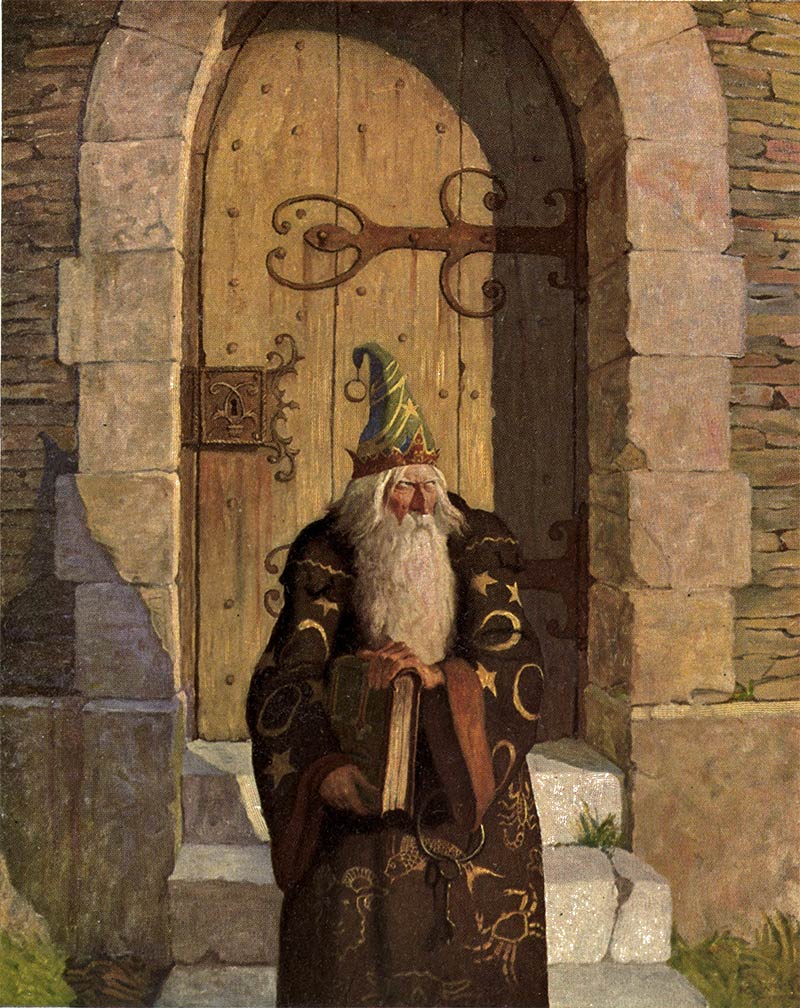
On the Fourth Day Comes the Astrologer from His Crumbling Old Tower

Sunday, July 7, 2024

stop me if you've heard this before

Sometimes, the Ref may ask for a roll of the dice. The most common type of roll is a d20 roll.
The \gm sets a difficulty class (DC) and whoever is making the choice rolls the die and adds a modifier. If the total is at least equal to the DC, the actor gets what they want. Otherwise, they may fail or need to pay some price to succeed.

If a roll is a contest between two characters, the DC is equal 9+ the total modifier of the target. Otherwise, see below for guidelines on setting DCs.


What is this?

Basically I'm pretty set on a lot of the specific mechanics for my 3e-derived game. Here I'm trying to stretch myself and present only the stuff that's not about character creation, on account of that being the section of the ruleset I have a tendency to work too hard on without drawing the rest of the owl.

The form of what follows, presenting DCs by task rather than by skill (haven't included a skill list in here, but it will be much less granular than these categories) follows the first D&D Next playtest packet. The actual numbers are largely based on a d20ification of this analysis of the hidden d6 skill system of OSE/BX.

Tuesday, January 2, 2024

the great humanoid relative size survey

comparative height chart of 5e races
Artist: Jay Robinson

There has been some interest in the purple OSR discord about what the relative sizes of various fantasy humanoids should be. I decided to make a quick survey asking people to size them on a scale from 0-10 with humans at 5 and send it around, and managed to collect 79 responses at the time of writing (though I exclude the response at 12/12/2023 14:44:45 from analysis as an outlier).

I'm just gonna do what seems most obvious to me and look at numerical averages, plus or minus one standard deviation:

Name Avg Stdev Minus Plus Dev Geq Man
Hobbit 2.68 0.64 2.04 3.32 -3.63
Fairy 0.76 1.19 -0.43 1.95 -3.56
Goblin 2.76 0.7 2.06 3.46 -3.2
Gnome 2.25 1.01 1.24 3.26 -2.72
Dwarf 3.5 0.71 2.79 4.21 -2.11
Kobold 2.58 1.25 1.33 3.83 -1.94
Ratfolk 3.26 1.07 2.19 4.33 -1.63
Faun 3.99 1.15 2.84 5.14 -0.88
Nymph 4.36 1.21 3.15 5.57 -0.53
Morlock 4.43 1.14 3.29 5.57 -0.5
Hobgoblin 4.72 1.2 3.52 5.92 -0.23
Half-elf 5 0.37 4.63 5.37 0
Human 5 0 5 5 0
Different Elf 5.11 1.66 3.45 6.77 0.07
Elf 5.16 0.97 4.19 6.13 0.16
Gnoll 5.43 1.33 4.1 6.76 0.32
Merfolk 5.33 0.78 4.55 6.11 0.42
Lizardfolk 5.5 0.93 4.57 6.43 0.54
Half-orc 5.54 0.65 4.89 6.19 0.83
Orc 5.94 0.72 5.22 6.66 1.31
Wolfman 6.05 0.78 5.27 6.83 1.35
Bugbear 6.65 1.22 5.43 7.87 1.35
Troll 7.64 0.86 6.78 8.5 3.07
Ogre 7.8 0.82 6.98 8.62 3.41
Ent 9.17 0.88 8.29 10.05 4.74

Dev Geq Man means the number of standard deviations between the average response and 5, the size of a human being. Now, let's just make a couple of observations:

  • About 72% of respondents indicated that Elves are human-sized or larger.
  • Trolls, Ogres and Ents are very large, three or four standard deviations above puny humans. Orcs, Wolfmen and Bugbears are somewhat large, at least one standard deviation above man.
  • Hobbits, Fairies and Goblins are very small, three standard deviations below humans. Note that there's also a strong consensus that fairies are smaller, but goblins are about the same size as hobbits. Gnomes, Dwarves, Kobolds and Ratfolk are also small, one or two standard deviations below humans.
  • Fauns, Nymphs, Morlocks, Hobgoblins, Half-elves, Elves, Different Elves, Gnolls, Merfolk, Lizardfolk and Half-orcs are all on average within one standard deviation of humans.
  • There is the least consensus on the size of Different Elves, which is unsurprising as that category is kind of just a joke about how many kinds of elves there are. Seventy-five percent of they 68 respondents who gave a size for "Elf, but Different (TM)" gave a size equal to or greater than they gave for Elf. They are followed, in uncertainty, by Kobolds, Bugbears, Nymphs, Fauns, Morlocks and Ratfolk.

Now, there is considerable overlap between most of these categories if standard deviations are included. Some of the categories that do not overlap (that is, their averages differ by at least the sum of their standard deviations) are:

  • Fairies are smaller than all but Gnomes and Kobolds.
  • Goblins are smaller than Hobgoblins.
  • Orcs are smaller than Trolls, but not necessarily smaller than Bugbears.
  • Ogres and Ents are larger than all but Bugbears and Trolls.

I don't think there are any great mysteries being revealed here, but I hope you enjoyed reading it. Please note that while I may have majored in math, I never took a statistics class. If you have a better handle on analyzing this kind of data, please try your hand at it.

Friday, December 22, 2023

spirit masters

Being psionics rules, because I've been reading the Saga of the Pliocene Exile and realized some specific debts that the 3e Psionics Handbook owes to it.

These assume you're using a standard six-attribute score array and that modifiers are on the "one-third score minus 3" schedule, and might need adjusted if you're using the WotC "half score minus 5" schedule.

a smiling man's face surrounded by a glowing halo in front of a starfield
Artist: Stephen Fabian, cover of The Adversary by Julian May

The human spirit is capable of marvelous things when properly disciplined. Masters speak of five awakened faculties, each of which has several modes.

  • Spirit Manifestation of energy, illusions and even substance. Associated with Dexterity.
  • Spirit Transportation of creatures and objects. Associated with Constitution.
  • Spirit Probing of other minds and spirits. Associated with Intelligence.
  • Spirit Discernment beings, surroundings or thoughts without the use of the senses. Associated with Wisdom.
  • Spirit Binding the bodily and spiritual faculties of others. Associated with Charisma.

Spirit Masters (HP, saves & advancement as magic-users) are always awakened, but any character has a chance to be equal to the sum of their attribute penalties in 20. Awakened characters start with two modes they are able to use. Masters learn an additional mode for every odd-numbered level they have.

Using spirit powers is taxing. Each use of a power costs energy (= encumbrance slots until next night's rest, or 1d4HP if no slots remain); however Spirit Masters have reserves of energy equal to their level to use each day without fatiguing themselves. Characters can only use modes in faculties if they have a positive bonus in its associated attribute. Furthermore, they cannot spend more energy in any mode than their their bonus in its associated attribute or half their Spirit Master level, whichever is higher.

Mental Contact

A spirit or awakened character can make mental contact with an intelligent being by touching it, making eye contact or speaking its name in its hearing. Characters in mental contact may bespeak one another, mind-to-mind, even if they do not share a language. Most creatures cannot bespeak anything that they believe to be false.

Being in mental contact is not without risks. All binding and probing modes require mental contact. Awakened characters with these modes are aware of all attempts to make contact with them while they are conscious, and can use them to refuse contact. 

To force contact, an awakened character must roll 1d20 + the attribute bonus of their mode + energy used on it and reach a target number based on the type of mode they are using and the mode of defense chosen:

  • Defensive binding walls off the mind behind a fortress-like wall. A probe must beat a 9, binding a 12 and discernment a 15.
  • Defensive discernment allows the mind to drift on the wind, evading contact. A binding must beat a 9, discernment a 12 and probe a 15.
  • Defensive probing leaves nothing to hold on to in an empty mind. A discernment must beat a 9, probe a 12 and binding a 15.

The aggressor always spends their energy, but the defender only does if they repel contact. 

If contact is made, characters still get a will save (vs spells) to resist the effect of a hostile mode. Awakened characters who make the roll may break contact.

Mode Descriptions

Unless otherwise noted, modes last for minutes equal to the associated attribute.

Binding Modes

  • Disable (1) — target cannot use a language, limb or sense of your choice for a few minutes.
  • Coerce (2, requires Disable) — target cannot take any action or speak any words (your choice which) except the one you designate as long as you maintain concentration. They may choose to remain still/silent.
  • Lock (2, requires Disable) — target cannot use any awakened faculties.
  • Puppet (2/3, requires Coerce) — your spirit enters an otherwise inanimate/living body which you control as if it were your own. Until you return to your own body by touching it, it will lose 1HP every sunset or sunrise.
  • Drain (*) — the target loses 2d4 HP and you gain the total, minus one, in energy until sunset or sunrise. If the target saves or fends off contact, you lose 2 energy instead.

Discernment Modes

  • Mass Sense (1) — extends through a few dozen yards through open air, a yard of earth a or an inch of stone or wood. As long as you concentrate, you are aware of the placement, shapes and sizes of all solid bodies therein.
    • Every additional point of energy you are able to spend on discernment powers doubles these ranges.
  • Mind Sense (1) — as mass sense, but instead gives awareness of minds and whatever most occupies their attention. Mental contact may be made with all, some or none of them, at your discretion.
  • Project (1/2/3, requires Mass or Mind Sense) — your sense of presence travels from your body as a disembodied spirit, up to 2/5/18 miles. Until you find and return to your body, you may travel through open air at the speed of thought, but 
    • your body lies unconscious at takes 1 point of damage with every sunrise and sunset.
    • you do not regain any energy.
    • may only pass a threshold if the house is abandoned or you have slept within.
  • Consult (2) — you reveal whether a single question can be definitely answered. 
  • Divine (2d4) — finds a short, true answer to a single question. If the question has no definite answer, you instead take the energy cost in damage.

Manifestation Modes 

  • Bolt (1+) — throws an arc of energy at one nearby target, dealing 2d6 damage for each point of energy. A reflex save [vs breath] halves the damage.
  • Glamor (1) — creates sense-displays for anyone in mental contact with you. While you concentrate, these otherworldly sensations are limited only by your imagination.
  • Radiance (1/2/3) — a soft glow provides light (as twilight) and heat for 5/10/20 nearby people until the next sunrise or sunset. You may gather it together into a bright blaze that cooks food for (or deals 1d6 damage/round to) that many people over 2d4 rounds, though this ends the effect.
  • Figment (2, requires Glamor) — creates an independent phantom for any two senses of your choice. Unlike a Glamor, this mode does not require mental contact or concentration, and the phantom can be detected by ordinary recording equipment.
  • Substance (3+, requires Figment and a transport mode) — creates up to sixteen pounds of earth, stone or water, four pounds of horn, leather or wood, one pound of base metal or four ounces of precious metal for every point of energy spent, which evaporates with sunrise or sunset. Creatures who consume the substance take no ill effect but their hunger or thirst returns when it disappears.
  • Construct (3, requires Figment and a probing mode) — you create a phantom, perceptible to all senses and recording devices. Until sunrise or sunset, it will follow up to three instructions you give it, which can be conditional or to be carried out in sequence. The phantom can move as fast as a bird through the open air, but cannot cross a threshold unless the house is abandoned or you have slept therein. 
a woman stands with a spear, eyes glowing as a implike shape takes form in the air before her
Artist: Sam Wood, Manifesting a Metacreativity Power

Probing Modes

  • Search (1/2) — if a a particular conscious/unconscious memory that you describe exists within the target's mind, you may re-experience it together.
  • Publish (1) — you place a memory or set of memories at the forefront of your mind, so that anyone who could make mental contact with you (even if they have not) can examine it.
  • Redact (2, requires Search) — submerges a conscious memory into the target's unconscious. When given a strong trigger of the memory, they may make a will save (vs spells) to regain it.
  • Balance (1/2/3) — neutralizes one emotion/wound/disease affecting the character. Balancing emotions calms the target and may allow a reaction to be rerolled. Balancing a wound or disease allows recovery as an additional day of rest would.
  • Program (+1 to any a binding mode) — you program up to three triggering situations to activate in those situations. For a number of days equal to your Intelligence, if those situations occur, the target is affected by the mode.
  • Subtlety (+1) — the target of your mode believes its effects are natural or come from within, rather than being a foreign influence, if they fail their save.

Transportation Modes

  • Float (1+) — makes a total mass you designate of about your bodyweight float lazily through the air at your command within a few dozen yards as long as you concentrate on it. Each additional point of energy doubles the range and increases the mass eightfold.
  • Impulse (1+) — something up to an eighth of your bodyweight a few dozen yards (and half as high into the air). Each additional point of energy increases the mass you can move eightfold; smaller masses fly commensurately farther, but take (and deal, to whatever they strike) damage as from a Bolt of the excess energy.
  • Atmosphere (1/2) — stills/creates winds for a few dozen yards around you as long as you concentrate on it. Keeps the rain off, if you wish to.
    • As with Mass/Mind Sense, every additional point of energy that you are able to spend on this power doubles its range for the same cost.
  • Support (Float +1) — rather than floating through the air, creatures in mental contact with you can run through the air as though solid ground existed wherever they wished to step.
  • Forceful (+1) — the target loses 1 (more) energy whether or not they make their save or fend off contact.

a golden figure levitates over an army of fantastically armored warriors
Artist: Michael Whelan, cover of The Golden Torc by Julian May
Mental Concert

Awakened characters may pool their faculties and act in concert. To form a concert, the characters must between them use the Mind Sense discernment, Drain binding and Balance probing modes. Everyone in mental contact with them may pool all the energy they have to contribute and place it in the hands of one character who acts as conductor. Then increase that pool by one-third. After the concert, reduce the pool by a quarter and redistribute remaining energy to the characters as the conductor wishes.

Total up the maximum energy each character in the concert could spend on each faculty; for every time that this doubles the conductor's allowance (or if the conductor has none for that faculty), increase their allowance by 1 for the duration of the concert.

three adventurers stand, manifesting a swirling vortex of colorful energy above their heads
Artist: Wayne Reynolds, Metaconcert

Friday, December 9, 2022

digression: ICBWS

I have a bee in my bonnet to run a kind of high school isekai game, and this set of rules just kind of came together. The HD/saving throw rules, if you're interested, are based on this thread speculating about the combat system used in the original Blackmoor game.

A brick school in the woods with vines and such growing all over it.

Working Title: I Can't Believe My Whole School Got Transported to a Fantasy Dimension Just Before Summer Break

Just assume that anything not covered here you don't have to worry about until I say you do.

Character Creation

The stats represent what kind of high school kid you are. For each, roll 3d. Half that roll, rounded down, is your Defense for things related to that stat. You have one-third the roll, rounded down, advances to divide between its skills:

  • ARTS, craftiness and matters of taste. Skills: cooking, mending, nuts-and-bolts, taste.
  • GOTH, self-reliance and dedication to the bit. Skills: animals, literature, mending, stealth.
  • JOCK, morale and physical condition. Skills: animals, cooking, scouting, sports.
  • NERD, analysis and specialized knowledge. Skills: book smarts, literature, nuts-and-bolts, scouting.

Skills with no advance have no rating. One advance for a 5th-Rate, two for a 4th-Rate, three for a 3rd-Rate, four for a 2nd-Rate and five for a 1st-Rate skill.

Then, give your character

  • A name and class year.
  • One or more named people you care about at school. These can be other players' characters but don't have to be.
  • What they have on their person and in their bag. This can be whatever you want, within the bounds of teen stuff.

Harm and Saves

In circumstances of peril, roll harm dice (HD) appropriate to the danger. A normal adult trying to do you harm is 1HD, while you'd roll 2HD for every 3 normal teens.

When rolling HD, discard all 6s and add up the other dice to determine the harm. Teens are taken out if they take 3 points of harm, and adults if they take 4.

When the character is able to do something to defend themselves, make a saving roll of 2d; if the roll is less than the appropriate Defense, reduce the harm taken by up to the amount rolled. Protective gear improve a Defense by 1 or 2, but the gear is damaged if that difference saves you. A risky plan and space to try it can also add 1 to Defense.

Skill Checks

When presented with a challenge, a skilled character may make a skill check. Their chance of failure is their Rate in the skill plus 1-3 if they lack each of information, time or tools. If this chance is 1-5, they pass if a roll of 1d is greater than it.

An unskilled character doesn't usually get to make a check. A lack of the appropriate information, time or tools can each increase the chance of failure.

If the chance of failure is 6 or higher, the roll fails unless a roll of 2d is 12 or higher. A character with a stat of 6+ adds 1 to this roll, and one with a stat of 8+ adds 2.

  • Animals. Check to calm or handle an animal.
  • Book Smarts. Check to diagnose a problem or follow a procedure.
  • Cooking. Check to preserve or stretch supplies.
  • Literature. Check to find or know relevant information.
  • Mending. Check to repair clothing or gear.
  • Nuts and Bolts. Check to make or repair simple structures and machines.. 
  • Scouting. Check to find food, paths, shelter or water.
  • Sports. Check to perform athletic feats.
  • Stealth. Check to avoid notice or hide something.
  • Taste. Check to color reactions to your art, music or presence with a feeling.

Sunday, September 4, 2022

Feel The Knives...Flowing Through You (GLOG Class: Psychic Rogue)

(I posted something rather like this in the GLOG discord but here it is in a less ephemeral format. "Skill" is here, what most GLOGs call "template." Characters start with two skills and learn one per level.)

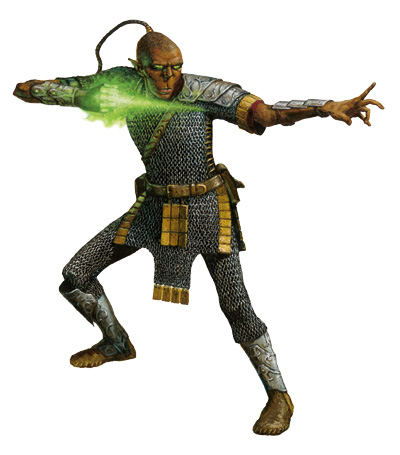
a soulknife with a glowing green mind blade


The Soulknife

The initiates of Soulknife orders hone their mental and physical talents until they become uncanny masters of intrigue and infiltration. Soulknife skills have the are psychic and rogue types.

Psychic — when you make a bad impression you may make a psychic roll ([psychic skills]-in-6 chance to succeed; if the roll is 1 you may not make another psychic roll until you collect your thoughts) to reroll the reaction roll.

Rogue — whenever you fail an ability check/saving throw to do sneaky stuff, you have a [rogue skills]-in-6 chance to succeed anyway.

Soulknife skills:

  • Can instantly create a knife in your hand, any time your psychic roll is not spent, which fades to nothing a few seconds after it leaves your person.
  • You may make a psychic roll to make an implausibly long or high jump. On a failure you know better than to attempt it.
  • You may make a psychic roll to make one creature who noticed you forget about you. When next they notice you, they remember the first time.
  • You you hit someone with a hand-to-hand attack but deal [psychic skills] damage or less, you stun them.
Related skills:
  • (Psychic, requires 2 psychic skills.) You can collect your thoughts in a few minutes instead of a few hours.
  • (Rogue) Whenever you hit an enemy who is surprised, deal a minimum of [rogue skills]d6 damage.

Monday, May 16, 2022

it's a small (domain level) world

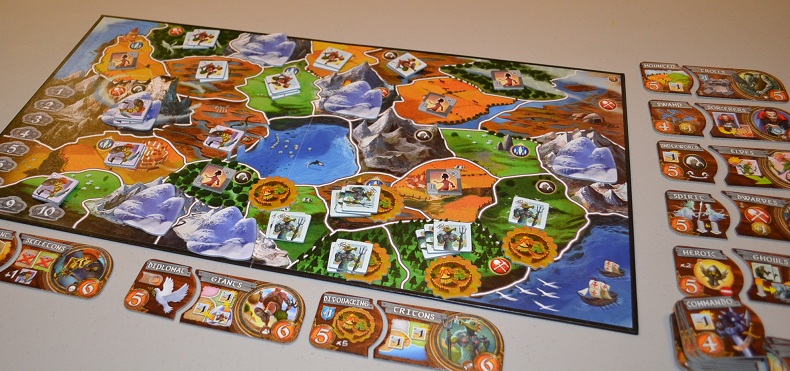
So, domain play rules tend to turn games into different games. I like playing Smallworld, so here's campaign rules that kind of turna campaign into that.

A picture of a set-up board for the game Smallworld.

Friday, November 5, 2021

the straight road through the seas of night

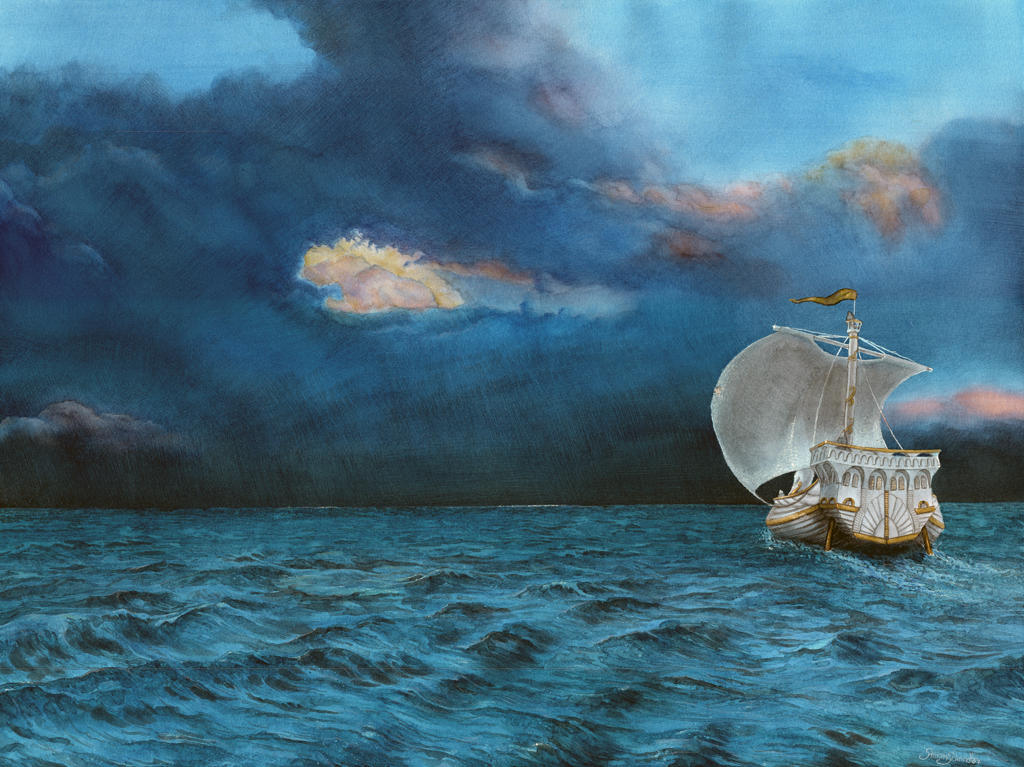
Though the voyage is not easy, it is known that a mariner who can find the Straight Road can sail beyond the edges of the world and reach the stars, islands of bright light studded into a silent, dark, astral sea, colder than the grave and vaster than imagination.

A white ship on a blue sea, sailing toward a darkening horizon.

The first thing an astral sailor must know is that one may not sail to any star at any moment. The Straight Road leads away only to the West, and one may find it only when sun and moon set as one. The astronaut sets their course only by the star that rises opposite the setting of the Sun. They will know their course is true if the heavens cease to turn, their guide-star rising no higher than a beacon from an impossible shore.

Sunday, September 5, 2021

towards a 3e hack

The third edition of D&D was my first exposure to it and to roleplaying games in general. Although I haven't played it in years and it does a thousand things I find frustrating, but it retains a draw for me. The more I learn about other editions of the game, earlier and later, the more I find myself appreciating parts of the vision for 3e. It's a design itch I don't feel that I've fully scratched yet, so here is some work I've done in various areas towards a 3e-based hack. The one sentence pitch is like: what if third edition was more like into the odd, but it also only used d20s and d6s for some reason.

This post is not going to go into any character creation mechanics (classes, templates, feats, etc) because it's still pretty unclear to me how I'd like those to work.

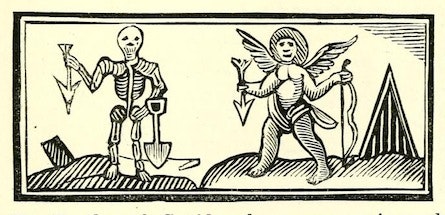
woodcut of an angel and a skeleton, both holding downward-pointing arrows

Tuesday, July 27, 2021

I Just Mopped In There (GLOG Class: Specialist)

Filth, miasmas and general grime; every human society oozes these evils, more baneful than bassilisks or boggles. Fortunately, every society also produces stalwart defenders against grease and slime: the cleaners.

The Cleaner

Start with: broomstick, three leather bottles (1/3 slot empty, 1 slot full) and a bundle of rags. With every draught from a full bottle, roll a d6; on a 1 there is only one draught remaining.

  1. Alkhestry. If you have access to three or more good solvents (f.e. water, liquor, vinegar, oil, resin spirits, alkali...) you can strip away any grease, grime, paint or other buildup from a surface by using a draught of one.
    Homemaker. Anyone who rests uninterupted in a space you have thoroughly cleaned gets the full benefits of resting in a home.
  2. I've Seen Worse. You take half damage from environmental diseases and poisons or can go twice as long before showing ill effects.
  3. Bath Bomb. You can mix up a nasty coctail with a draught of two distinct solvents. When splashed, deals 2d6 (sixes explode) damage to any animate slime, ooze, corpse or any monster with a disease attack, and turns any of those creatures who smell it.
  4. Whirlwind of Activity. Whenever you are focused on a concrete task and moving, things just fall into place around you. This allows you to clean any space as though you were three people, and lets you move freely through space occupied by others; all creatures not actively hostile are brushed or shuffled to the side as you pass, and hostile ones must save to resist this.

Thursday, May 27, 2021

Come Out // Fight Me

This one's kind of a snippet, but I wanted to write a class that uses the flip mechanic before the rest of the gretchsphere moves on from the idea.

Come Out // Fight Me: The Monster Slayer (GLOG Class: Fighter)

Monsters can't be fought with ordinary weapons. Well, I mean, they can, but it's a mistake. Monsters don't fight in ordinary ways, and if you want to match them you can't either.

+1 HP and Save per template.

  1. You have a flip weapon of some kind (such as the CRASH // LASH, below), are proficient with it. You can use the abilities that cause it to flip from one state to another.
  2. You never mistake the signs of a monster's presence for something a natural creature would leave.
  3. You can rescue someone within reach from an attack by throwing yourself in its way. You always take half damage (no roll or save) from the attack and can't do this again until after you flip your weapon.
  4. Whenever you're fighting a creature that will hurt someone else if you don't stop it, your weapon damage explodes.

The CRASH // LASH

  • CRASH. An iron rod with an iron fist at the end. As a mace, but when you deal maximum damage your foe is knocked down or back a few steps (their choice) and the weapon flips to LASH.
  • LASH. A chain whip ending in an iron claw shaped like a human hand. As a whip (an awkward weapon), but if you successfully disarm, entangle or trip a foe with it you pull them to you or you to them (their choice), deal the higher of two d6s of damage, and the weapon flips to CRASH.

Wednesday, March 31, 2021

a linguistic anthropology of fantasy folk

The nice thing about fantasy races is that they give character creation choices with a good degree of granularity and comprehensibility and are a neat way to pull folkloric material into your game. The bad thing about them is that they mean that race science (that is, the false belief that races as understood by society correspond to biologically distinct types of human beings) is true in your fantasy world.

Honestly, the bad part is bad enough to completely sink the goodness of the good part.

This is another in my ongoing struggle to formulate different fantasy folk in a way that isn't race science, but emphasizing the ways that real people saw themselves and others, particularly before the race-scientific idea became prominent in the modern era.

The problem with making things nuanced is that also makes them complicated; race science is conceptually pretty straightforward, which makes it very game-able. Trying to embed fantasy folk in a realistically nuanced web of relationships with each other also buries the conceptual clarity of a player looking at the list of options and saying, "I'm going to play an elf, that means I live in the woods and don't particularly like dwarfs." One runs the risk of overloading the player with world-building, particularly if one chooses to foreground linguistic groups which are among the more salient in-universe distinctions between peoples.

I'm far from a solution to this, but my current idea is to use somewhat-transparent names for languages (or groups of languages) wherever possible, and doing as little "hard" worldbuilding as possible to keep things relatively setting-neutral, while still keeping things complex enough to stop collapsing into the fail state of race science. It's a tall order, let's see how I do.

When making a character, you must choose a people for them to belong to (or at least stem from). A people is defined by a language, a way of life and an alignment, all of which affect how they see themselves and the world.

To make this your own, you only have to identify the peoples in your setting, their languages, ways of life and alignments. You may choose to give every people a distinct ethnonym; I'm not doing this so as not to overload a player with unfamiliar names. Instead, I'm going to organize peoples by language family, grouping setting languages together into four groups (middling, rhuno-buggish, sylvene and foreigner), the first three of which correspond to actual language families. Each family contains a number of peoples with different ways of life and dramatically different outlooks on the world and their place in it.

Friday, March 12, 2021

some game economics for the ancient world

Before launching into a long post about economics of the ancient world, let's put the exciting part at the top, the random treasure hoard generator. These are going to be significantly smaller than typical fantasy adventure hoards, but I've tried to callibrate them to generate the kidns of hoards people actually find from the bronze and iron ages:

Now, for the less flashy stuff. Before we can really talk about economics, let's establish some units of measurement. These are going to be largely based on historical units of mesopotamia and the eastern mediterannean in antiquity. My sources are kind of all over the place on these so I'm not going to be citing much, but the system I'm giving here hews pretty close to the coins and measures used in Talmudic literature.

A talent (kikar, if you prefer) weighs sixty pounds (maneh), each of which is fifty weights (shekel) of about eight and a half grams; this makes a pound of about 425 grams rather than the 453.59 of the avoirdupois pound, but that's close enough to use the familiar word in my book. A wet measure or dry measure are both a unit of capacity approximately equal to 144 medium-sized eggs (about nine quarts).

goods and their prices

The basic unit of money is a weight of silver. Although actual prices vary by place and season, most people will say that a silverweight should buy:

Wednesday, February 24, 2021

the earthwife and the termagant

Continuing to muck about with my GLOG/echo, I wrote two classes that tie in with the fair and fell ancestries. Gaining lots as an earthwife represents growing closer to the elemental world to the exclusiong of the civilized one, while gaining lots as a termagant represents gaining magical power at the cost of your social graces.

Both are three-level classes, and both have decreasing-dice mechanics inspired by The Oblidisideryptch's excellent druid. The termagant's abilities were lifted from Rise Up Comus's Dwarf class.

  • Earthwife (fair ancestral class)
    1. You cannot tolerate anything of base metal upon your person, but can speak heart-to-heart with any living thing. Plants and animals will attempt to do as you bid, though not contrarily to their natures. This roll has no goals; the dangers are not reaching what you cannot touch with your limbs, not reaching more than you could bear on your shoulders and not conveying more than flashes of raw sense information.
    2. You cannot tolerate spun fibers upon your person, but may speak heart-to-heart with earth and stone, which tell you what they know of old or bestir and rearrange themselves for you. When you speak with living things you may disregard one danger.
    3. You cannot use common nouns; though you may use or give proper nouns to specific things, you must otherwise describe whatever you refer to obliquely. You may speak heart-to-heart with bodies of water to learn nearly anything you wish to know or ask them to bar your enemies or save your friends. When you speak to earth and stone you may disregard one danger, and when you speak to living things you may disregard two.
  • Termagant (fell ancestral class)
    1. You gain two useful magic items chosen by the Referee. When slighted or wronged at all, you roll for the goals of not complaining, not demanding recompense and not holding a grudge. Keep a list of every grudge and strike names from the list only if they suffer a greater loss.
    2. Once in your life, you may withdraw from worldly affairs for a time and emerge with a powerful magic item you wrought. Work with the Referee to determine the nature of this item. When slighted or wronged, you may only roll for two goals.
    3. Magic, friendly or malign, can no longer affect you. If any of your hair is cut or dressed, you lose this protection until it grows knotted and tangled again. When slighted or wronged, you may only roll for one goal.

Monday, February 22, 2021

unified levels

In my opinion, one of the more interesting things D&D 3e did was treat monster HD/type somewhat like the classes for player characters. Understandably, this was closest to the surface when discussing the possibility of adventuring as a monster. Level adjustment meant that a monstrous character was treated as one or more levels higher than their class level for the purpose of how much experience they needed to reach the next level.

When Savage Species was written, that concept got significantly expanded by the inclusion of monster classes. One could start your career as a stripped-down version of a monster on par (in theory) with other level 1 characters, and gradually gain their more powerful and iconic abilities. However, this still needed a separate class for each monster type and it didn't expose the mechanical guts of how monsters and characters ticked.

What follows is an attempt to do unify monster and character building by giving each an "ordinary track" that governs more mundane advancement, here Nerve (aka Hit) Dice, and optional multi-classing into "extraordinary tracks" that grant special abilities.

A lizardman engaged in combat with a human warrior. David Sutherland (1977).

Wednesday, February 10, 2021

a matrix of interconnected rooms

 In the essay "Figures, Doors and Passages," Robin Evans contrasts the Classical and Renaissance approach to dividing rooms into spaces with the Modern (post-19th century) ideas about the same. As the main example of the former, he discusses the Villa Madama: A floor plan and side view of the Villa Madama.

The first difference he points out from modern plans is that:

...the rooms have more than one door - some have two doors, many have three, others four - a feature which, since the early years of the nineteenth century, has been regarded as a fault in domestic buildings of whatever kind or size. Why? the answer was given at great length by Robert Kerr. In a characteristic warning he reminded readers of The Gentleman's House (1864) of the wretched inconvenience of thoroughfare rooms, which made domesticity and retirement unobtainable. The favored alternative was the terminal room, with only one strategically placed door into the rest of the house.

Yet exactly the opposite advice had been furnished by the Italian theorists who, following ancient precedent, thought that more doors in a room were preferable to fewer. Alberti, for instance, after drawing attention to the great variety and number of doors in Roman buildings, said, 'It is is also convenient to place the doors in such a Manner that they may lead to as many parts of the edifice as possible.' This was specifically recommended for public buildings, but applied also to domestic arrangements. It generally meant that there was a door wherever there was an adjoining room, making the house a matrix of discrete but thoroughly interconnected chambers. Raphael's plan [of the Villa Madama] exemplifies this, though it was in fact no more than ordinary practice at the time.

In modern design, enclosed spaces are distinguished between access spaces to be moved through but not occupied (elevators, passages, stairs) and those that are meant to be occupied but not moved through (rooms). However in earlier eras, even buildings large enough to be subdivided into many rooms (it is worth remembering that most buildings would contain few rooms; even a king might have no more than a hall, a private chamber for his family and a kitchen in his castle) would generally favor what Evans calls the "matrix of interconnected rooms."

This contrasts markedly with the kind of dungeon plan perhaps best exemplified by Castle Geryhawk, in which mostly-empty passages serve isolated terminal rooms to be stocked with various monsters or treasures:

A photograph of a hand-drawn map on grid paper. It is a maze of passages and rooms, but the doors almost entirely exist to link rooms with the passages that snake through the whole map, not rooms with one another.

The Greyhawk map is quite interesting because it demonstrates an extremely modern layout sensibility in an ostensibly medieval complex. The language Evans applies to William Morris's plan for the Red House at Bexley Heath applies perhaps more directly this dungeon than the house itself:

Yet his commitment to past practice only went so far. The morality of craft and beauty might transform the procedures of building and the appearance of the finished work, but medievalism did not percolat into the plan, which was categorically Victorian and utterly unlike anything built in the fourteenth or fifteenth centuries. Indeed the Red House illustrates the principles laid down by the bourgeois Robert Kerr better than Kerr's own plans: rooms never interconnect, never have more than one door and circulation is unified and distinct.

That may have been said to Morris's shame, but I don't mean it to shame the Castle or its designer. If anything, its plan is less typical of modern dungeons than the kind of dungeon plan perhaps best exemplified by (my beloved) Nethack, wherein corridors lead from specific rooms to specific other rooms, rather than forming a network of circulation for the whole level:

A screenshot of a Nethack dungeon level, showing a handful of rectangular rooms scattered about and connected by corridors.

However, I think embracing the matrix of interconnected rooms is a useful tool to keep in mind when designing dungeons or other structures because it naturally introduces a high degree of interconnectivity and makes chance encounters with the inhabitants of the dungeon likely throughout, not simply in their designated areas or when they take to wandering the halls. Here are a last few thoughts in the form of suggestions when drawing a dungeon plan:

  • When possible, place rooms that connect next to one another without an adjoining corridor.
  • Don't put an isolated room at the end of a corridor unless there's a particular reason for it to be separated from the others.
  • If many rooms lie on a single passage, consider making it a courtyard or loggia (above ground) or an atrium or other vertical space, perhaps with access to other levels (if below).

Tuesday, February 9, 2021

GLOG/echo

This is a GLOGhack, I guess, or the first part of one. The original GLOG is from Arnold K but it seems that the real GLOG is the GLOG you had inside you all along.

The most gloggy feature of this is the class structure, since rather than more traditional dice mechanics, this uses the an only slightly modiefied version of ghost/echo. I drew from a lot of GLOG classes from different bloggers, but particularly from Finders Keepers for the backgrounds and Vain the Sword for a couple of the classes.

Dice

Before rolling dice, identify dangers, edges and goals. Roll one die for each and assign one roll to each danger and one to each goal (discarding any left overs):

RollDangerGoal
1-2Comes true.Failed, opportunity may be lost.
3-4Mixed, danger remains.Mixed, opportunity remains.
5-6Avoided.Achieved.

Nothing extremely good or bad should happen on a mixed result, but it may make those outcomes more likely; mixed results should maintain or increase tension, not resolve it.

Roll dice in the following situations and pick the appropriate goals (including ones not listed) and use the given danger (in addition to others the situation may call for).

  • Act under pressure. Goals: complete a task, get out of harm's way, rescue someone in peril. Danger: you suffer harm.
  • Sneak. Goals: move without being noticed, plant an item, remove and item, defeat a lock. Danger: you are caught in the act.
  • Close combat. Goals: cut down a foe, dodge past a foe. Danger: you suffer harm.
  • Fire missiles. Goals: stop a foe short, cover an ally, destroy something. Dangers: you cause unwanted harm or get unwanted attention.
  • Suffer harm. Goals: shake it off, fight through the pain, impress with your toughness. Danger: you are incapacitated.
  • Make an impression. Goals: they believe your story, they remember you later, they answer your question, they agree to a bargain. Danger: they distrust or dismiss you.

Characters

Characters are defined by lots ("templates" if you prefer). You set out with four lots: the Adventurer rank, two backgrounds, and the first of a class of your choice. 

Monday, February 8, 2021

de modulii magicii

This is a thinky post and modest proposal about modularity in TTRPG design.

Since modularity can mean a lot of things to a lot of people, I'll be specific. I am not talking (at least not directly) about the role that discrete packages play in character customization; I am talking about the more general organizational principle of giving a unique name to a particular rule and referring to it at need elsewhere in the text.

When a rulebook describes a number of statuses that can affect a character's combat options: blinded, dazed, deafened, prone, surprised, stunned and so on, and then elsewhere gives players and enemies the option to blind, daze, deafen, knock prone, surprise and stun one another, that's an example of modularity. Modularity is a strategy for sacrificing some amount of clarity (the consequences of stunning a foe may not be explained in the same place in the text as the source of the condition) for to make the rules more consistent (all abilities that stun foes achieve the same effect) and concise (it is not necessary to quote a modular rule everywhere it is referenced). The cost in clarity can be offset by choosing descriptive names for the modular rules so that readers' expectations about what applies to stunned characters map well onto what the actual rules provide for those situations.

A place where modularity is particularly useful is in magical effects. By nature, magical affects are at least somewhat contrary to the readers' expectations and, if precise boundaries of the effect are needed, a lot of text may be the result. Delta has a whole series of posts analyzing the rules texts of spells from Chainmail through 3E; it's evident at a glance that spells have accumulated more and more text as time goes on and the attempt is made to nail down exactly what such and such a piece of magic can do.

Whether you like detailed spells descriptions or vague ones, is not practical to quote the full text of a spell description every time it is referenced. As such, the rules are full of effects defined in reference to specific spells. An unscientific survey of a pretty orthodox old school magic item list had 10-40% (depending on category) of magic item listings specifically referencing a spell effect. Excluding scrolls (which are mostly spell scrolls), potions are next most likely to reference spell effects, followed by wands, miscellaneous items and finally rings. Monster abilities in early editions and their imitators seem much less likely to reference spell effects; however 3/3.5E can't get enough of monster abilities directly referencing spell effects, between traditional spellcasting, spell-like abilities and the very confusing situation of "supernatural" (and sometimes "extraordinary") abilities that duplicate spell effects without certain features of spells such as the possibility to be interrupted or dispelled.

Honestly, I think 3/3.5E is pushing in the right design direction there, even if they did it in the messiest possible way. Nevertheless, I'd wager few people have the system mastery to accurately tell you off hand the differences between a spell, spell-like ability, supernatural ability and an extraordinary ability. And even fewer would be able to accurately guess the effects of an unfamiliar spell from its name. In 4E, the designers pulled hard in the opposite direction by removing the modularity from spells (and prayers and maneuvers and psionic powers) entirely: all abilities got siloed to the class or monster type that granted them where they are described in full. In particular, this means that while the information is conveniently organized for the DM running the encounter, the economics of space and how many unique abilities a DM can actually keep in mind while running the encounter suddenly place pretty hard limits on how intricate monsters can be.

Rather than continue talking about the historical vicissitudes of spell modularity, I will instead make a modest proposal:

Modest Proposal

Keep magical causes and magical effects separate:

  • A magical effect (wonder) should be listed under a descriptive name and any limitations that are not obvious spelled out (for example, that the wonder of move earth can shift loose earth and its vegetation, but not stone).
  • A magical cause could be a spell that can be learned, a consumable preparation, an artifact or a natural ability of a magical creature. The description of a cause should name the wonder should spell out any important limitations on its use (costs, concentration, durations, number of targets, ranges, time to activate and so forth).

Different ways of working the same wonder can be made to feel very different if, for example, different costs are demanded from a holy person and a necromancer to bring about the same healing of a broken body. The details of the wonder equip a ref to rule on its applications and edge cases, while the details of the causes are able to be more diegetic and flavorful without sacrificing modularity for that.

A book of wonders could be used by a referee both as an at-the-table reference for whatever magic is in play but also as a source for describing new wizarding traditions (by selecting a set of wonders and describing that tradition's means of causing each), artifacts or creatures. If the rules texts were sufficiently concise, a deck of cards bearing wonder descriptions could be physically handed out to players when they become able to use them.

Monday, February 1, 2021

alignments and way of life

Characters have to come from peoples, and those peoples have ways of life. Where is home for your people, and how do they see themselves?

  • The boats or carts you travel from place to place, plying your trades and peddling your wares. Alignment: civil.
  • Grand cities rising from the plain or shore. Alignment: civil.
  • Ancient holds cut into the deep earth. Alignment: goodwright.
  • Rough warrens in the clefts of hillsides. Alignment: goodwright.
  • Sound houses of timber or stone. Alignment: civil.
  • Beneath the open sky. Alignment: free.
  • Under canopy of thick woods. Alignment: moonfolk.

Alignment describes how a people sees themselves and how they divide up the rest of the world. Some see themselves as worldly and do not share the alignment of their folk. Even those who share an alignment do not necessarily like each other or agree about where one another fit into the order of things.

Civil

A civilized fellow knows that without the nameless gods of heaven to teach mortals the arts of civilization, we would be naked heathens all. Elders who still name the gods of the earth may know no better, but the barbarian who call on demons from behind the sky and beneath the sea. A heaven-fearing fellow knows a 'worldly' one for what they really are: a scoffer not to be trusted.

Civil folk all see the peoples of cities and houses as civil (though they may war with one another just the same), woods-dwellers as elders and nomads under the open sky as barbarians. However, they differ on a few points:

  • Boat and cart-folk have a dread of the barbarians of the deep earth but call the herders and traders of the hillsides elders.
  • City people consider the half-settled lives of boats and carts or hillsides to be fit only for scoffers, but consider deep earth-delvers old-fashioned elders.
  • Dwellers in stout houses see travelers by boat and cart and miners in deep earth both as elders, and raiders from the hillsides as barbarians.

Free

Freedom is especially treasured by those who live under the open sky, viewing the labors of settled peoples as a kind of thralldom. They honor their beloved dead and all the spirits of the air and earth that touch their lives, chanting their names and deeds for later generations. The 'worldly' fellow who scorns these gods is a lonesome one, a tiny fellow adrift without ancestor to guide their feet or shelter them from the cruel winds.

Those of cities, the deep earth and houses are seen as thralls, while those who range in boats and carts, from the hillsides, or in the deep woods are seen as half-thralls. A free neck does not bend to the yoke of a thrall, and a warrior certainly does not fear one.

Goodwright

Goodwrights have learned the secrets of craft from the earth itself. They celebrate the good earth with the work of skilled hands. Though a goodwright will take spoil from war, they detest nothing as much as a thief. And what is a 'worldly' creature who pays no mind to their mother earth but a thief of her gifts?

All outsiders are seen with a measure of suspicion, but wrights of the deep earth and of the hillsides revile one another as thieves nearly without exception. Hillside wrights will treat with most other outsiders, but those of the deep earth consider the folk of boats and carts or the woods as thieves as bad as hated hill-wrights.

Moonfolk

The day is for the sun, the night for the stars, but the moon wanders through day and night in its turnings. Moonfolk chase the balance of the moon, honoring the earth in all its seasons. Moonfolk cultivate the woods around them with a gardener's care and live from the game and fruits thereof.

The enemies of the moonfolk are the nightfolk who harry them from the deep earth and open sky, while city and house dwellers are dayfolk and useful allies against the nightfolk when they can be roused to it. Those of boats and carts or hillsides or 'worldly' folks who think themselves wiser than everyone are smallfolk and not worth serious consideration.

Worldly

The worldly are not many, and they are called lonesome, scoffer, smallfolk, thief or worse where they go. Nevertheless, a worldly fellow hates to suffer fools and sees no reason to give up the better parts of life to distant gods. They can't abide the small-mindedness of boat and cart travelers, the cruelty and hypocrisy of the cities, the incurious provincialism of the deep earth, the baseless boasting of hillside folk, the credulous superstition of house holders and open sky nomads both or the sanctimonious mysticism of the woods.