Showing posts with label stats. Show all posts

Tuesday, January 2, 2024

the great humanoid relative size survey

comparative height chart of 5e races
Artist: Jay Robinson

There has been some interest in the purple OSR discord about what the relative sizes of various fantasy humanoids should be. I decided to make a quick survey asking people to size them on a scale from 0-10 with humans at 5 and send it around, and managed to collect 79 responses at the time of writing (though I exclude the response at 12/12/2023 14:44:45 from analysis as an outlier).

I'm just gonna do what seems most obvious to me and look at numerical averages, plus or minus one standard deviation:

Name Avg Stdev Minus Plus Dev Geq Man
Hobbit 2.68 0.64 2.04 3.32 -3.63
Fairy 0.76 1.19 -0.43 1.95 -3.56
Goblin 2.76 0.7 2.06 3.46 -3.2
Gnome 2.25 1.01 1.24 3.26 -2.72
Dwarf 3.5 0.71 2.79 4.21 -2.11
Kobold 2.58 1.25 1.33 3.83 -1.94
Ratfolk 3.26 1.07 2.19 4.33 -1.63
Faun 3.99 1.15 2.84 5.14 -0.88
Nymph 4.36 1.21 3.15 5.57 -0.53
Morlock 4.43 1.14 3.29 5.57 -0.5
Hobgoblin 4.72 1.2 3.52 5.92 -0.23
Half-elf 5 0.37 4.63 5.37 0
Human 5 0 5 5 0
Different Elf 5.11 1.66 3.45 6.77 0.07
Elf 5.16 0.97 4.19 6.13 0.16
Gnoll 5.43 1.33 4.1 6.76 0.32
Merfolk 5.33 0.78 4.55 6.11 0.42
Lizardfolk 5.5 0.93 4.57 6.43 0.54
Half-orc 5.54 0.65 4.89 6.19 0.83
Orc 5.94 0.72 5.22 6.66 1.31
Wolfman 6.05 0.78 5.27 6.83 1.35
Bugbear 6.65 1.22 5.43 7.87 1.35
Troll 7.64 0.86 6.78 8.5 3.07
Ogre 7.8 0.82 6.98 8.62 3.41
Ent 9.17 0.88 8.29 10.05 4.74

Dev Geq Man means the number of standard deviations between the average response and 5, the size of a human being. Now, let's just make a couple of observations:

  • About 72% of respondents indicated that Elves are human-sized or larger.
  • Trolls, Ogres and Ents are very large, three or four standard deviations above puny humans. Orcs, Wolfmen and Bugbears are somewhat large, at least one standard deviation above man.
  • Hobbits, Fairies and Goblins are very small, three standard deviations below humans. Note that there's also a strong consensus that fairies are smaller, but goblins are about the same size as hobbits. Gnomes, Dwarves, Kobolds and Ratfolk are also small, one or two standard deviations below humans.
  • Fauns, Nymphs, Morlocks, Hobgoblins, Half-elves, Elves, Different Elves, Gnolls, Merfolk, Lizardfolk and Half-orcs are all on average within one standard deviation of humans.
  • There is the least consensus on the size of Different Elves, which is unsurprising as that category is kind of just a joke about how many kinds of elves there are. Seventy-five percent of they 68 respondents who gave a size for "Elf, but Different (TM)" gave a size equal to or greater than they gave for Elf. They are followed, in uncertainty, by Kobolds, Bugbears, Nymphs, Fauns, Morlocks and Ratfolk.

Now, there is considerable overlap between most of these categories if standard deviations are included. Some of the categories that do not overlap (that is, their averages differ by at least the sum of their standard deviations) are:

  • Fairies are smaller than all but Gnomes and Kobolds.
  • Goblins are smaller than Hobgoblins.
  • Orcs are smaller than Trolls, but not necessarily smaller than Bugbears.
  • Ogres and Ents are larger than all but Bugbears and Trolls.

I don't think there are any great mysteries being revealed here, but I hope you enjoyed reading it. Please note that while I may have majored in math, I never took a statistics class. If you have a better handle on analyzing this kind of data, please try your hand at it.

Friday, December 9, 2022

digression: ICBWS

I have a bee in my bonnet to run a kind of high school isekai game, and this set of rules just kind of came together. The HD/saving throw rules, if you're interested, are based on this thread speculating about the combat system used in the original Blackmoor game.

A brick school in the woods with vines and such growing all over it.

Working Title: I Can't Believe My Whole School Got Transported to a Fantasy Dimension Just Before Summer Break

Just assume that anything not covered here you don't have to worry about until I say you do.

Character Creation

The stats represent what kind of high school kid you are. For each, roll 3d. Half that roll, rounded down, is your Defense for things related to that stat. You have one-third the roll, rounded down, advances to divide between its skills:

  • ARTS, craftiness and matters of taste. Skills: cooking, mending, nuts-and-bolts, taste.
  • GOTH, self-reliance and dedication to the bit. Skills: animals, literature, mending, stealth.
  • JOCK, morale and physical condition. Skills: animals, cooking, scouting, sports.
  • NERD, analysis and specialized knowledge. Skills: book smarts, literature, nuts-and-bolts, scouting.

Skills with no advance have no rating. One advance for a 5th-Rate, two for a 4th-Rate, three for a 3rd-Rate, four for a 2nd-Rate and five for a 1st-Rate skill.

Then, give your character

  • A name and class year.
  • One or more named people you care about at school. These can be other players' characters but don't have to be.
  • What they have on their person and in their bag. This can be whatever you want, within the bounds of teen stuff.

Harm and Saves

In circumstances of peril, roll harm dice (HD) appropriate to the danger. A normal adult trying to do you harm is 1HD, while you'd roll 2HD for every 3 normal teens.

When rolling HD, discard all 6s and add up the other dice to determine the harm. Teens are taken out if they take 3 points of harm, and adults if they take 4.

When the character is able to do something to defend themselves, make a saving roll of 2d; if the roll is less than the appropriate Defense, reduce the harm taken by up to the amount rolled. Protective gear improve a Defense by 1 or 2, but the gear is damaged if that difference saves you. A risky plan and space to try it can also add 1 to Defense.

Skill Checks

When presented with a challenge, a skilled character may make a skill check. Their chance of failure is their Rate in the skill plus 1-3 if they lack each of information, time or tools. If this chance is 1-5, they pass if a roll of 1d is greater than it.

An unskilled character doesn't usually get to make a check. A lack of the appropriate information, time or tools can each increase the chance of failure.

If the chance of failure is 6 or higher, the roll fails unless a roll of 2d is 12 or higher. A character with a stat of 6+ adds 1 to this roll, and one with a stat of 8+ adds 2.

  • Animals. Check to calm or handle an animal.
  • Book Smarts. Check to diagnose a problem or follow a procedure.
  • Cooking. Check to preserve or stretch supplies.
  • Literature. Check to find or know relevant information.
  • Mending. Check to repair clothing or gear.
  • Nuts and Bolts. Check to make or repair simple structures and machines.. 
  • Scouting. Check to find food, paths, shelter or water.
  • Sports. Check to perform athletic feats.
  • Stealth. Check to avoid notice or hide something.
  • Taste. Check to color reactions to your art, music or presence with a feeling.

Tuesday, May 24, 2022

3eish: bones

Alright, without further ado here is the mechanical skeleton of my 3eish rules. This does not include any character options or combat-specific rules, other than a brief description of how attacks work. It also doesn't include rules for equipment, adventuring hazards or any kind of magic or special abilities. It is literally just the resolution and injury/endurance parts of the system.

a skeleton. spooky!

Tuesday, May 3, 2022

3eish: a closer to 3e hack

Heaven help me, I'm about to make a "why I haven't been posting as much recently," post, aren't I.

I won't dwell on it because no one cares, but honestly the reason I haven't made many posts is that instead of rapidly flitting from idea to idea I stayed relatively focused on a couple of projects. For a while, this was hulk rats, which I just posted, and then I moved on to my current obsession which I am calling 3eish.

No, I won't be posting a draft (even an incomplete one) of a second whole-ass game today. I just want to talk about the project a little bit.

3eish

So, I've worked on hacks that have said they're based on 3e or d20 modern before but their relationship to those systems beyond my invocation of their names have been, uh, unclear. For Target 20 Modern, it was basically the names of the stats, and for my previous 3e-based hack it was basically just the words "Fortitude, Reflex and Will," which were used in totally different ways than before.

Having recently regained possession of my old 3e books, however, I was poring over them and realizing how much I genuinely do like about the first DnD I learned; especially knowing what I know now about the history and motivations of a lot of its pieces. And, inveterate tinkerer that I am, there are simply so many points of pain in the system that I can't help tearing it apart and rebuilding it.

This is not a small project; I'm basically rewriting the entire SRD from the ground up. I'm about thirteen thousand words deep already, big beefy chunks remain more or less unwritten (the arcane spell list, to name a big one). So like, watch this space? But don't hold your breath.

Nevertheless, I feel like I do have a distinct vision for the game, here's my attempt to articulate what I'm doing with it:

Sunday, September 5, 2021

towards a 3e hack

The third edition of D&D was my first exposure to it and to roleplaying games in general. Although I haven't played it in years and it does a thousand things I find frustrating, but it retains a draw for me. The more I learn about other editions of the game, earlier and later, the more I find myself appreciating parts of the vision for 3e. It's a design itch I don't feel that I've fully scratched yet, so here is some work I've done in various areas towards a 3e-based hack. The one sentence pitch is like: what if third edition was more like into the odd, but it also only used d20s and d6s for some reason.

This post is not going to go into any character creation mechanics (classes, templates, feats, etc) because it's still pretty unclear to me how I'd like those to work.

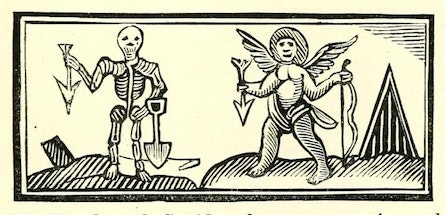
woodcut of an angel and a skeleton, both holding downward-pointing arrows

Friday, April 23, 2021

fakemon

There's currently a buzz in the blogging scene for legallydistinctemon aka legamon or fakemon, and despite trying to stay out of it I could not help writing a fakemon battle system that is incompatible with most of the existing prior art. Some links to that other, better prior art: deus's generator tables, Phlox's automation of same, another generator on liches get stitches and, perhaps most prominently, Lexi's You Must Acquire Them.

As a disclaimer, I don't really think fakemon battles, even the streamlined version that I've written here, fits particularly well into existing structures of TTRPG play. Stopping everything to do tactically intensive 1-on-1 fights just doesn't gel very well with any sort of party play and I'm not sure that one should really try. This post certainly doesn't, it's just fakemon battle rules.

The math of pokemon games is trivial for computers to do but monstrous for humans, so we're not going to try to replicate their level of crunch. In particular, level grinding isn't a part of the game I think it's particularly worth imitating so we're dropping level from the game's math entirely. Fakemon have four stats: Attack, Defense, Speed and Special all rated 1-5. Max HP is equal to Defense times 3, plus the sum of the other stats. There's no leveling up, evolving to a new form should probably increase its stats.

Every round, both sides choose moves in secret. Unless otherwise noted, fakemon know a normal move and a special move of their type, which corresponds to a particular biome. Then, roll two dice and determine if either fakemon wins the initiative based on their speed (this table is equivalent to a Speed-in-12 chance to win the initiative on each side, if you're the sort of weirdo who has a d12.):

Speed Home team first Away team first
1 2,3 11,12
2 2,3,4 10,11,12
3 3,4,5 9,10,11
4 2,3,5,6 8,9,11,12
5 2,3,4,5,6 8,9,10,11,12

Whoever wins the initiative gets to use their move first. If no one wins initiative, moves get resolved simultaneously, which can cause mutual knockouts.

Fakemon have dice for normal moves equal to their Attack stat and dice for special moves equal to their Special stat. Unless otherwise noted for a move roll as many dice as you choose, discard any 6s and deal [sum] damage, minus opponent's Defense for normal moves and Special for special moves. Fakemon deal an extra [dice] of damage when using special moves of their own type. Discarded dice can't be used again until your fakemon can rest. If damage reduces a fakemon to 0 HP they faint and can't fight anymore.

Types have vulnerabilities and resistances. Fakemon take double damage from moves their type is vulnerable to and half damage from moves their type is resistant to:

Type vulnerable to resistant to
ROCK CITY, WATER, VENOM GRASS, SKY
GRASS ROCK, VENOM WOOD
WOOD GRASS, VENOM SHORE
SHORE WOOD, SKY, VENOM CITY, WATER
CITY SHORE, VENOM ROCK, SKY
SKY CITY normal*
WATER CITY normal*
VENOM SKY, WATER VENOM

There are no normal type fakemon, that would be boring.

Fakemon can only use special SKY moves if they are able to fly about; if a SKY-type fakemon does not have room to fly, they lose their resistance to normal moves. Similarly, fakemon can only use special WATER moves if they are swimming and WATER-type fakemon lose their resistance to normal moves on land.

If you use an item in battle your side can't use a move that turn. Some classic fakemon items:

  • Antidote ($10): makes a fakemon resistant to VENOM moves for a few hours, but reduces their max HP by 1 for every previous day they've taken antidotes.
  • Elixir ($120): restore all discarded dice for a fakemon.
  • Fake ball ($12): captures a wild fakemon if a roll of 2d6 is greater than their current HP.
  • Potion ($30): restores a fakemon to max HP.
  • Revive ($200): restores a fainted fakemon to half their maximum HP.

Monday, March 15, 2021

"correcting" weapon vs armor type from chainmail

Delta recently wrote an excellent post analyzing the origin of the Greyhawk/AD&D weapon vs armor type table and concluding (rightly, in my view) that it is fundamentally flawed. I just wanted to offer a few follow-up analyses of ways that one could try to "correct" the modifiers in there.

Putting the tables below the break.

Friday, January 22, 2021

"target 20" modern

This is an idea I've had for some time. It's a silly idea, but that's rarely stopped me before. Back in high school I played a lot of d20 Modern, at least until my friends and I collectively realized that the game was kind of a mess and d20-system combat and character creation was majorly in the way of the way we actually wanted to play.

This is an attempt to strip as much of the cruft from that game while leaving parts of it recognizable. A lot of the mechanical inspiration here is due to the Target 20 system on the one hand and UVG's SEACAT system on the other. Revisiting d20 Modern I was struck by how many fiddly mechanical choices there are, in the forms of talents and feats and skills and advanced classes, and how little most of that stuff matters. Most abilities boil down to a small modifier on certain saving throws or skills checks. I only bothered importing interesting rules as Target 20 Modern's talents.

Thursday, January 21, 2021

exploding statline

rule

to generate a standard six-stat line with each stat ranging from 0 to 5:

  1. roll six d6; for each die that shows a 1, mark one stat down as 0 and set those dice aside.
  2. re-roll the remaining dice; for each die that shows a 1 or a 2, mark a remaining stat down as 1 and set those dice aside.
  3. re-roll the remaining dice; for each die that shows a 1, 2 or 3, mark a remaining stat down as 2 and set those dice aside.
  4. ...and so on.
repeat, increasing the threshold, until either no dice remain or it is impossible to keep going (that is, if you would have to roll higher than a 6).

why?

if bonuses from skill range from 0 (unskilled) to 5 (expert) and bonuses from circumstance range from 8 (easiest task that could be failed) to 0 (hardest task that could succeed), then a Target-20-style core mechanic of d20 + stat + skill + circumstance such that a roll of 1 always fails and a roll of 20 alwasy succeeds.

to my mind this is a pretty good balance of character ability and circumstance. also, this kind of exploding roll is fun.

but...what are the probabilities?

the most likely stat values to be generated are 1 or 2, followed by 3, 0, 4 and distantly by 5. the exact frequencies are:

016.67%
127.78%
227.78%
318.52%
415.43%
53.09%

75.5% of six-stat lines rolled with this method will total 9 or more, and 72% will total 12 or less. the probability that the highest score rolled will be the given number is given in the following table

046,656 to 1 ≈ 0%
10.77%
213.42%
341.63%
435.27%
58.91%

Friday, April 24, 2020

3d6 down the lifepath

the system presented here builds on this statline

rule

A background is something you could be raised to, while a career is a way to seek your fortune. Backgrounds have longer skill lists and careers have short ones. There is also a skill list for unfortunate wretches. All adventurers start with some basic adventuring skills (2 body, 2 verbal).
  1. Roll two distinct d6 three times. 
  2. One die increases your Condition and the other increases your Presence.
  3. Take verbal skills based on the CO die and body skills based on the PR one.
    Roll12,34,56
    Skills4321
  4. Until you roll doubles, take skills from the first background you rolled. After that, take skills from either the career matching that roll or from the wretched list.
Your Training is equal to your total number of body skills (2 + those you chose) and your Learning is equal to your total number of verbal skills (2 + those you chose).

build

To support this character creation system, one obviously has to provide setting-appropriate backgrounds and careers. How exactly a roll of two dice indicates one or the other is not specified. Here are some possibilities, given that indicate the fact that only non-doubles can be keyed to backgrounds.:
  • Difference: 5 backgrounds of descending probability or 6 careers of varying probabilities (0: 1/6, 1: 5/18, 2: 2/9, 3: 1/6, 4: 1/9, 5: 1/18).
  • Sum: 9 backgrounds or 11 careers with a curve:
    1. 1/36 career
    2. 1/15 background, 1/18 career
    3. 1/15 background, 1/12 career
    4. 2/15 background, 1/9 career
    5. 2/15 background, 5/36 career
    6. 1/5 background, 1/6 career
    7. 2/15 background, 5/36 career
    8. 2/15 background, 1/9 career
    9. 1/15 background, 1/12 career
    10. 1/15 background, 1/12 career
    11. 1/36 career
  • Combination: 15 equiprobable backgrounds, or 15 careers of 1/18 probability and 6 of 1/36.
  • Ordered pair: 30 equiprobable backgrounds or 36 equiprobable careers.
Regardless of how one orders the transitions, be aware that there's a 125/216 ~ 57.87% chance that a character will come through with no career. Of those that have a career, all of them will have rolled doubles for their first career, so doubles should be assigned to the sorts of careers that are commonly "open to all comers."

why?

I wanted something that was somewhat close to both 3d6 down the line and a lifepath system. This deviates from 3d6 down the line by having much more centrally-normalized TR and LE in the 5-14 range, but CO and PR are pure 3d6. The main thing I don't like about it is that it is fixed length. Ideally, I'd want a lifepath system that's purely random except for your choice to stay on for another round or get off. Well, one must compromise I suppose.

Wednesday, April 22, 2020

a statline

rule

There are four stats. Condition is to Training what Presence is to Learning. You can have:
  • no more things than your Condition
  • no more bodily skills than your Training.
  • no more bonds than your Presence 
  • no more verbal skills than your Learning.
Skills have a ceiling of 1, 2, or 3, which is the maximum number of that skill one may have. All throws are d20 + Condition/Presence + Skills. A 20 or better passes, but if d20 + Skills is 15 or less there may be some complication.

When you run out of Nerve (Not-Getting-Hit-Points), physical damage reduces your Condition and forces a saving throw to keep going. Emotional damage past your Nerve reduces your Presence forces a throw not to break down.

why?

The Fantasy Trip is my favorite game I've never played. Maybe I still will someday. But it emerged from Melee and Wizard, two tactical skirmish games. Melee introduced the Strength/Dexterity split, which is handled quite differently than in the grand Arneson-Gygax tradition. Strength is how tough a character is (how many hits they can take and, in Wizard, how many spells they can cast), while Dexterity governs how likely they are to hit in combat or pull off other maneuvers. The Fantasy Trip used Intelligence (introduced in Wizard) to govern how many skills a character could have, Dexterity to govern how good they were at pulling them off, and Strength how long they can last.

Perhaps I'm a fool for monkeying with such a delicate balance, though Steve Jackson did in GURPS. He split the endurance element out of Strength to make it Health and making Strength responsible for the outcomes (damage, jumping distance, lifting amount) of physical feats. It strikes me to monkey with it in the opposite direction: keep the endurance element of Strength but throw the chance-of-success element of Dexterity in with it and separate physical success and skill (Condition and Training) from psychosocial success and skill (Presence and Learning).

Additionally, this has the feature where every stat corresponds directly to a limit on your character record sheet, which I think is delightfully straightforward.

The damage and saving throw mechanic is straight out of Into the Odd, you can substitute that out with little difficulty and keep the statline mostly the same. I also like the trauma depriving you of the benefits of your relationships angle, but that's going to need to be meshed into a game where those relationships are significant.