Showing posts with label chargen. Show all posts

Friday, January 19, 2024

ADEPT: a modest proposal

Are you reinventing RuneQuest or Traveller this time? You fool. You rube. You absolute buffoon. I am reinventing HârnMaster.

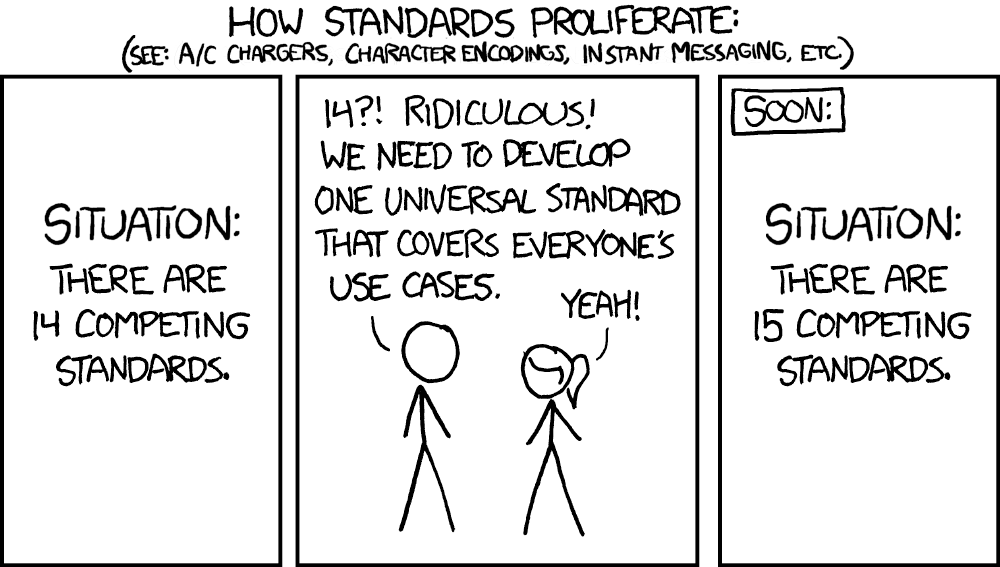
the xkcd comic about how standards proliferate
xkcd: Standards

Listen. Everyone hates the six-score array. It sucks, and the history of non-D&D RPGs is practically a history of variants of the array and its uses. There are plenty of theoretical issues to raise with the standard six. However, here are three problems only the worst pedant would have with it:

  • The canonical order of the abilities is not alphabetical.
  • Two abilities share an initial letter.
  • There is no mnemonic device for the abilities.

I propose to solve these (and really, only these) problems with the ADEPT array:

Saturday, January 6, 2024

3eish: what's a level

Theoryposting, maybe I'll get to the point of concrete details by the end of this post, maybe I won't.

Artist: Tennis Cramer

So, my goal of 3eish is to make something that feels like 3e to me, while also keeping it light enough to hold the whole thing in mind and play fast and easy. Can't get rid of levels without it starting to feel like something else entirely so it's worth asking: what's a level. In 3e there are a couple clear answers:

  • One HD.
  • 1, 3/4 or 1/2 a point of BAB
  • 8, 6, 4, 2 + Int skill points
  • 1/2 or 1/3 a point of each saving throw
  • 1/4 of an one-point improvement to an ability score (1/8 of a one-point improvement to its modifier)
  • 1/3 of a feat and some class features
  • various scaling on spells you cast

There are some rationalizations that suggest themselves, like making attack bonus or saving throws a part of the skill system, but I've been down most of those design roads at this point and most of them wind up reinventing RuneQuest. So instead I'm going to reinvent True20; a level is a feat and one HD and everything else falls out of that.

Let's nail that down somewhat:

  • As in the base rules, the benchmark for a boring feat is that it applies +2 on two different kinds of rolls. 
    • Boring feats (that only add bonuses to rolls) are now called skills and can be taken multiple times. This replace the skill list and save progressions; if a character does not have any skills that apply to a saving roll, they use 1/3 their level as a bonus.
    • Obviously not all feats are boring ones. The ones that grant more interesting abilities can generally only be taken once.
  • Each feat specifies an amount of HP (2, 3 or 4) gained when you take it. If you're proficient with it, add +1 to an attack roll for every 4HP you currently have. If you're not proficient, apply a -3 penalty.
    • Abilities for combat add 4HP.
    • Skills and miscellaneous abilities add 3HP.
    • Magic abilities adds 2HP.

You may notice there's no real purpose left for classes. That's probably for the best, let's lose them. Carve out their interesting bits into feats and leave the rest.

One-feat character creation is probably too bare to be fun. Instead we'll have two-feat character creation (truly, I have a dizzying intellect). There's a special set of feats called backgrounds, and you pick two of them to start. Your starting HP is 4 if both of them have experience with violence, 3 if one does and 2 otherwise.

The 3e PHB had 7 races and 11 classes, so for parity with its 77 combinations a pool of backgrounds would need...a pool of 14 backgrounds (14 choose 2 is 91, fourteen more combinations for a pool with three fewer elements). Now that's of course not the full range of customization of a 1st level 3e character but it's close enough for my purposes.

Friday, December 22, 2023

spirit masters

Being psionics rules, because I've been reading the Saga of the Pliocene Exile and realized some specific debts that the 3e Psionics Handbook owes to it.

These assume you're using a standard six-attribute score array and that modifiers are on the "one-third score minus 3" schedule, and might need adjusted if you're using the WotC "half score minus 5" schedule.

a smiling man's face surrounded by a glowing halo in front of a starfield
Artist: Stephen Fabian, cover of The Adversary by Julian May

The human spirit is capable of marvelous things when properly disciplined. Masters speak of five awakened faculties, each of which has several modes.

  • Spirit Manifestation of energy, illusions and even substance. Associated with Dexterity.
  • Spirit Transportation of creatures and objects. Associated with Constitution.
  • Spirit Probing of other minds and spirits. Associated with Intelligence.
  • Spirit Discernment beings, surroundings or thoughts without the use of the senses. Associated with Wisdom.
  • Spirit Binding the bodily and spiritual faculties of others. Associated with Charisma.

Spirit Masters (HP, saves & advancement as magic-users) are always awakened, but any character has a chance to be equal to the sum of their attribute penalties in 20. Awakened characters start with two modes they are able to use. Masters learn an additional mode for every odd-numbered level they have.

Using spirit powers is taxing. Each use of a power costs energy (= encumbrance slots until next night's rest, or 1d4HP if no slots remain); however Spirit Masters have reserves of energy equal to their level to use each day without fatiguing themselves. Characters can only use modes in faculties if they have a positive bonus in its associated attribute. Furthermore, they cannot spend more energy in any mode than their their bonus in its associated attribute or half their Spirit Master level, whichever is higher.

Mental Contact

A spirit or awakened character can make mental contact with an intelligent being by touching it, making eye contact or speaking its name in its hearing. Characters in mental contact may bespeak one another, mind-to-mind, even if they do not share a language. Most creatures cannot bespeak anything that they believe to be false.

Being in mental contact is not without risks. All binding and probing modes require mental contact. Awakened characters with these modes are aware of all attempts to make contact with them while they are conscious, and can use them to refuse contact. 

To force contact, an awakened character must roll 1d20 + the attribute bonus of their mode + energy used on it and reach a target number based on the type of mode they are using and the mode of defense chosen:

  • Defensive binding walls off the mind behind a fortress-like wall. A probe must beat a 9, binding a 12 and discernment a 15.
  • Defensive discernment allows the mind to drift on the wind, evading contact. A binding must beat a 9, discernment a 12 and probe a 15.
  • Defensive probing leaves nothing to hold on to in an empty mind. A discernment must beat a 9, probe a 12 and binding a 15.

The aggressor always spends their energy, but the defender only does if they repel contact. 

If contact is made, characters still get a will save (vs spells) to resist the effect of a hostile mode. Awakened characters who make the roll may break contact.

Mode Descriptions

Unless otherwise noted, modes last for minutes equal to the associated attribute.

Binding Modes

  • Disable (1) — target cannot use a language, limb or sense of your choice for a few minutes.
  • Coerce (2, requires Disable) — target cannot take any action or speak any words (your choice which) except the one you designate as long as you maintain concentration. They may choose to remain still/silent.
  • Lock (2, requires Disable) — target cannot use any awakened faculties.
  • Puppet (2/3, requires Coerce) — your spirit enters an otherwise inanimate/living body which you control as if it were your own. Until you return to your own body by touching it, it will lose 1HP every sunset or sunrise.
  • Drain (*) — the target loses 2d4 HP and you gain the total, minus one, in energy until sunset or sunrise. If the target saves or fends off contact, you lose 2 energy instead.

Discernment Modes

  • Mass Sense (1) — extends through a few dozen yards through open air, a yard of earth a or an inch of stone or wood. As long as you concentrate, you are aware of the placement, shapes and sizes of all solid bodies therein.
    • Every additional point of energy you are able to spend on discernment powers doubles these ranges.
  • Mind Sense (1) — as mass sense, but instead gives awareness of minds and whatever most occupies their attention. Mental contact may be made with all, some or none of them, at your discretion.
  • Project (1/2/3, requires Mass or Mind Sense) — your sense of presence travels from your body as a disembodied spirit, up to 2/5/18 miles. Until you find and return to your body, you may travel through open air at the speed of thought, but 
    • your body lies unconscious at takes 1 point of damage with every sunrise and sunset.
    • you do not regain any energy.
    • may only pass a threshold if the house is abandoned or you have slept within.
  • Consult (2) — you reveal whether a single question can be definitely answered. 
  • Divine (2d4) — finds a short, true answer to a single question. If the question has no definite answer, you instead take the energy cost in damage.

Manifestation Modes 

  • Bolt (1+) — throws an arc of energy at one nearby target, dealing 2d6 damage for each point of energy. A reflex save [vs breath] halves the damage.
  • Glamor (1) — creates sense-displays for anyone in mental contact with you. While you concentrate, these otherworldly sensations are limited only by your imagination.
  • Radiance (1/2/3) — a soft glow provides light (as twilight) and heat for 5/10/20 nearby people until the next sunrise or sunset. You may gather it together into a bright blaze that cooks food for (or deals 1d6 damage/round to) that many people over 2d4 rounds, though this ends the effect.
  • Figment (2, requires Glamor) — creates an independent phantom for any two senses of your choice. Unlike a Glamor, this mode does not require mental contact or concentration, and the phantom can be detected by ordinary recording equipment.
  • Substance (3+, requires Figment and a transport mode) — creates up to sixteen pounds of earth, stone or water, four pounds of horn, leather or wood, one pound of base metal or four ounces of precious metal for every point of energy spent, which evaporates with sunrise or sunset. Creatures who consume the substance take no ill effect but their hunger or thirst returns when it disappears.
  • Construct (3, requires Figment and a probing mode) — you create a phantom, perceptible to all senses and recording devices. Until sunrise or sunset, it will follow up to three instructions you give it, which can be conditional or to be carried out in sequence. The phantom can move as fast as a bird through the open air, but cannot cross a threshold unless the house is abandoned or you have slept therein. 
a woman stands with a spear, eyes glowing as a implike shape takes form in the air before her
Artist: Sam Wood, Manifesting a Metacreativity Power

Probing Modes

  • Search (1/2) — if a a particular conscious/unconscious memory that you describe exists within the target's mind, you may re-experience it together.
  • Publish (1) — you place a memory or set of memories at the forefront of your mind, so that anyone who could make mental contact with you (even if they have not) can examine it.
  • Redact (2, requires Search) — submerges a conscious memory into the target's unconscious. When given a strong trigger of the memory, they may make a will save (vs spells) to regain it.
  • Balance (1/2/3) — neutralizes one emotion/wound/disease affecting the character. Balancing emotions calms the target and may allow a reaction to be rerolled. Balancing a wound or disease allows recovery as an additional day of rest would.
  • Program (+1 to any a binding mode) — you program up to three triggering situations to activate in those situations. For a number of days equal to your Intelligence, if those situations occur, the target is affected by the mode.
  • Subtlety (+1) — the target of your mode believes its effects are natural or come from within, rather than being a foreign influence, if they fail their save.

Transportation Modes

  • Float (1+) — makes a total mass you designate of about your bodyweight float lazily through the air at your command within a few dozen yards as long as you concentrate on it. Each additional point of energy doubles the range and increases the mass eightfold.
  • Impulse (1+) — something up to an eighth of your bodyweight a few dozen yards (and half as high into the air). Each additional point of energy increases the mass you can move eightfold; smaller masses fly commensurately farther, but take (and deal, to whatever they strike) damage as from a Bolt of the excess energy.
  • Atmosphere (1/2) — stills/creates winds for a few dozen yards around you as long as you concentrate on it. Keeps the rain off, if you wish to.
    • As with Mass/Mind Sense, every additional point of energy that you are able to spend on this power doubles its range for the same cost.
  • Support (Float +1) — rather than floating through the air, creatures in mental contact with you can run through the air as though solid ground existed wherever they wished to step.
  • Forceful (+1) — the target loses 1 (more) energy whether or not they make their save or fend off contact.

a golden figure levitates over an army of fantastically armored warriors
Artist: Michael Whelan, cover of The Golden Torc by Julian May
Mental Concert

Awakened characters may pool their faculties and act in concert. To form a concert, the characters must between them use the Mind Sense discernment, Drain binding and Balance probing modes. Everyone in mental contact with them may pool all the energy they have to contribute and place it in the hands of one character who acts as conductor. Then increase that pool by one-third. After the concert, reduce the pool by a quarter and redistribute remaining energy to the characters as the conductor wishes.

Total up the maximum energy each character in the concert could spend on each faculty; for every time that this doubles the conductor's allowance (or if the conductor has none for that faculty), increase their allowance by 1 for the duration of the concert.

three adventurers stand, manifesting a swirling vortex of colorful energy above their heads
Artist: Wayne Reynolds, Metaconcert

Monday, December 18, 2023

talent, time and tools

Being a universal 2d6 resolution mechanic and some extra bits.

An attempt succeeds if a roll of 2d6 is at least equal to the required target number:

  • You have an appropriate talent, time and tool: 5
  • You are missing one of those: 6
  • You are missing two of those: 7
  • You have none of those: 8

A roll of 10+ (regardless of target number) is a clean success. A particularly stressful situation may require a clean success to avoid costs or complications.

Talents

Create a character by giving them 2-3 traits or skills and however many talents your Referee finds appropriate. 

If you don't start with a talent you must:

  • Practice for a season with a skilled teacher or three seasons on your own for the archery, climbing, thievery or any weaponry talents.
  • Slay three armed foes by your own hand for the fighting talent.
  • Become initiated into the inner mysteries of a cult for its ritual talent.
  • Survive ten days in the bush without aid or supplies for the wilderness talent for those environs.

Combat

Talent. The fighting talent is for hand-to-hand or hand weapons and the archery talent for bows. No talent is required for crossbows or guns. Weaponry talents do not affect the target number of attacks, but they allow the attacker to use any special properties of the weapon.

Time. You have time if the target is surprised. 

Tools. Close weapons for hand-to-hand and non-close weapons otherwise.

An armed attacker gets +1 to their roll if their target is unarmed. A character with a longer weapon than their opponent starts with a +1 advantage to their attacks, but a clean success seizes the advantage from one's target (or seizes it back).

In hand-to-hand, a clean success damages, disarms, pins or throws one's target. Otherwise, success merely holds them. A held character may do any of those to their opponent with a clean success. Otherwise, success reverses the hold. Any success by the holding character may damage, disarm, pin or throw the other.

Magic Rituals

Magic rituals are done with one roll but involve a sequence of steps. Some might require all of the following, and some only one or two:

  1. Guarding the space
  2. Guarding the magician
  3. Opening the way
  4. Fixing the terms
  5. Closing the way
  6. Purifying the magician
  7. Purifying the space

Talent. Each cult has its own path of rituals, any its ritual magic talent counts for any ritual on that path. Anyone with such a talent is aware of the presence of other talented magicians and of powerful spirits, and may address them mind-to-mind.

Time. Rituals of 1-2 steps take 10 minutes, minus one for every time the size of the group of magicians doubles. Each additional step doubles the time required.

Tools. Guarding or purifying magicians requires oils or potions for each. Guarding or purifying the space require candles, diagrams or smoke to fill it. Opening the way requires an arcane connection to the recipient of the power. Fixing the terms requires a symbol of what is to be done. Closing the way requires a symbolic weapon.

If the power invoked by a ritual is an intelligent spirit, a clean success is needed to avoid some additional price being demanded. Offering a sacrifice adds +1 to a ritual roll to deal with a spirit, or +2 if the sacrifice is extremely dear.


one roll, one choice

 FMC Basic does away with ability scores (quite rightly!), but you might still want something of the sort. But we're doing one roll, one choice. 

Roll 1d20:

  1. strong, fast, tough
  2. strong, fast, smart
  3. strong, fast, wise
  4. strong, fast, charming
  5. strong, tough, smart
  6. strong, tough, wise
  7. strong, tough, charming
  8. strong, smart, wise
  9. strong, smart, charming
  10. strong, wise, charming
  11. fast, tough, smart
  12. fast, tough, wise
  13. fast, tough, charming
  14. fast, smart, wise
  15. fast, smart, charming
  16. fast, wise, charming
  17. tough, smart, wise
  18. tough, smart, charming
  19. tough, wise, charming
  20. smart, wise, charming
Keep two; the other becomes a flaw. 
  • Strong characters deal +1 physical damage. Weak characters can't tempt fate to force doors, jump gaps, or the like.
  • Fast characters get +1 on attack rolls. Clumsy characters can't tempt fate to go before their foes.
  • Tough characters get +2 HP. Sickly characters can't tempt fate to resist poison, avoid disease or the like.
  • Smart characters get +1 capacity. Dull characters have -1 capacity.
  • Wise characters get +1 defense if they are not surprised. Foolish characters are still surprised if their party tempted fate to avoid it.
  • Charming characters can re-roll a negotiation roll; if it changes from negative to affirmative there will be some additional quid pro quo. Off-putting characters must tempt fate to avoid making a bad impression when meeting someone new.

Monday, February 6, 2023

towards a medieval "brown stone" game

Note: this is not an earnest attempt to recreate any game that was played in the Twin Cities in 1971. It is just something that I threw together based on one explanation I have seen of the (poor quality and contradictory) evidence of how combat in that game worked.

These are incomplete, I basically just wrote and edited until I ran out of steam but I think it'd be enough to start playing. 

I didn't include any Referee's guidance for timekeeping or reactions or things like that, just do your best I guess.

Rules Brief for Players

The game is about a companies of adventurers going on expeditions into strange mazes and uncanny places to find their secrets and treasures. These expeditions are dangerous; adventurers may well die. If they survive, however, their fame and power will grow...

Advice:

  • If you don't know what to do, ask questions.
  • Tell the others what you want to do.
  • The Referee won't lie to you, but they may not tell you everything.
  • There aren't rules for everything. If you make a good play, you won't need to roll any dice.
  • If you fight, someone will get hurt. It could very well be you.

Adventurers usually go on expedition in large companies, to have the advantage of numbers. Each player can have a few different characters in the company.

Friday, December 9, 2022

digression: ICBWS

I have a bee in my bonnet to run a kind of high school isekai game, and this set of rules just kind of came together. The HD/saving throw rules, if you're interested, are based on this thread speculating about the combat system used in the original Blackmoor game.

A brick school in the woods with vines and such growing all over it.

Working Title: I Can't Believe My Whole School Got Transported to a Fantasy Dimension Just Before Summer Break

Just assume that anything not covered here you don't have to worry about until I say you do.

Character Creation

The stats represent what kind of high school kid you are. For each, roll 3d. Half that roll, rounded down, is your Defense for things related to that stat. You have one-third the roll, rounded down, advances to divide between its skills:

  • ARTS, craftiness and matters of taste. Skills: cooking, mending, nuts-and-bolts, taste.
  • GOTH, self-reliance and dedication to the bit. Skills: animals, literature, mending, stealth.
  • JOCK, morale and physical condition. Skills: animals, cooking, scouting, sports.
  • NERD, analysis and specialized knowledge. Skills: book smarts, literature, nuts-and-bolts, scouting.

Skills with no advance have no rating. One advance for a 5th-Rate, two for a 4th-Rate, three for a 3rd-Rate, four for a 2nd-Rate and five for a 1st-Rate skill.

Then, give your character

  • A name and class year.
  • One or more named people you care about at school. These can be other players' characters but don't have to be.
  • What they have on their person and in their bag. This can be whatever you want, within the bounds of teen stuff.

Harm and Saves

In circumstances of peril, roll harm dice (HD) appropriate to the danger. A normal adult trying to do you harm is 1HD, while you'd roll 2HD for every 3 normal teens.

When rolling HD, discard all 6s and add up the other dice to determine the harm. Teens are taken out if they take 3 points of harm, and adults if they take 4.

When the character is able to do something to defend themselves, make a saving roll of 2d; if the roll is less than the appropriate Defense, reduce the harm taken by up to the amount rolled. Protective gear improve a Defense by 1 or 2, but the gear is damaged if that difference saves you. A risky plan and space to try it can also add 1 to Defense.

Skill Checks

When presented with a challenge, a skilled character may make a skill check. Their chance of failure is their Rate in the skill plus 1-3 if they lack each of information, time or tools. If this chance is 1-5, they pass if a roll of 1d is greater than it.

An unskilled character doesn't usually get to make a check. A lack of the appropriate information, time or tools can each increase the chance of failure.

If the chance of failure is 6 or higher, the roll fails unless a roll of 2d is 12 or higher. A character with a stat of 6+ adds 1 to this roll, and one with a stat of 8+ adds 2.

  • Animals. Check to calm or handle an animal.
  • Book Smarts. Check to diagnose a problem or follow a procedure.
  • Cooking. Check to preserve or stretch supplies.
  • Literature. Check to find or know relevant information.
  • Mending. Check to repair clothing or gear.
  • Nuts and Bolts. Check to make or repair simple structures and machines.. 
  • Scouting. Check to find food, paths, shelter or water.
  • Sports. Check to perform athletic feats.
  • Stealth. Check to avoid notice or hide something.
  • Taste. Check to color reactions to your art, music or presence with a feeling.

Monday, May 9, 2022

Tuesday, May 3, 2022

3eish: a closer to 3e hack

Heaven help me, I'm about to make a "why I haven't been posting as much recently," post, aren't I.

I won't dwell on it because no one cares, but honestly the reason I haven't made many posts is that instead of rapidly flitting from idea to idea I stayed relatively focused on a couple of projects. For a while, this was hulk rats, which I just posted, and then I moved on to my current obsession which I am calling 3eish.

No, I won't be posting a draft (even an incomplete one) of a second whole-ass game today. I just want to talk about the project a little bit.

3eish

So, I've worked on hacks that have said they're based on 3e or d20 modern before but their relationship to those systems beyond my invocation of their names have been, uh, unclear. For Target 20 Modern, it was basically the names of the stats, and for my previous 3e-based hack it was basically just the words "Fortitude, Reflex and Will," which were used in totally different ways than before.

Having recently regained possession of my old 3e books, however, I was poring over them and realizing how much I genuinely do like about the first DnD I learned; especially knowing what I know now about the history and motivations of a lot of its pieces. And, inveterate tinkerer that I am, there are simply so many points of pain in the system that I can't help tearing it apart and rebuilding it.

This is not a small project; I'm basically rewriting the entire SRD from the ground up. I'm about thirteen thousand words deep already, big beefy chunks remain more or less unwritten (the arcane spell list, to name a big one). So like, watch this space? But don't hold your breath.

Nevertheless, I feel like I do have a distinct vision for the game, here's my attempt to articulate what I'm doing with it:

Thursday, September 2, 2021

reverse dragonball stew

(With apologies and indeptedness to Spwack's Reverse Owlbear Stew and Phlox's Orbseeker.)

For each stat, roll 3d6 and write down half the total (rounded down) for the stat and the lowest die as the defense (using the highest lowest die for each pair of stats).

  • Strength and Constitution -> the FORT defense (blocking).
  • Dexterity and Wits -> the REF defense (dodging).
  • Intellect and Charm -> the WILL defense (resisting).

Your max HP is equal to the sum of your three defense ratings. Resting a few minutes and taking refreshment restores 1 lost HP after a fight. Taking a night's rest in a safe place restores 1d6 HP. Regular attacks do 1d6 damage, awkward or unarmed ones do the lower of two d6, dangerous ones do the higher of two d6 and things you wouldn't expect someone to survive do 2d6 or more.

To succeed on something that needs a roll, you must roll a d20 under or equal to the relevant stat (Ref's decision) plus all ranks in relevant skills. If this is a roll against an obstacle (like a foe's defense), your roll must be higher [not equal to] the relevant obstacle or defense rating. If this is an opposed roll and your opponent rolled under or equal to their total, you must roll under or equal to your total but higher than their roll.

When you create your character, split 10 ranks between the following skills. You may not start with more than 4 ranks in any skill.

  • Acrobatics
  • Attraction
  • Engineering
  • Fencing
  • Hypnosis
  • Intimidation
  • Medicine
  • Naturalism
  • Navigation
  • Physics
  • Riding
  • Skullduggery
  • Sailing
  • Shooting
  • Stealth
  • Striking
  • Swimming
  • Wrestling

After an adventure or a season of training, you may roll 2d6 for up to three different skills you exercised. If the result is more than your current ranks in the skill, gain a rank. You can never gain more than ten ranks in a skill.

Characters who carry more things than their Constitution can't have reduce all their defenses by the excess (gear never affects HP). Bulky items count as two things, thrown weapons and similar small stuff can be bundled.

Characters start as fighter B, orbseeker B or fighter A/orbseeker A.

Goku DBZ and Piccolo DBZ making fighting poses at an enemy not pictured.

fighter type characters

Fighters cultivate their qi in order to perform amazing martial arts. For each template, fighters increase one of their defenses (and therefore their max HP) by 1. Gain a fighter template whenever you defeat a foe that is stronger than you.

  • A Bronze Body. If you take no action other than resisting an attack, reduce damage you take from it by your relevant defense.
  • B Golden Core. You have a pool of qi dice (QD) equal to the number of fighter templates you have. You may roll any number of QD from your pool instead of normal damage dice for an attack. Whenever a 6 is rolled on a QD, add 5 to the sum of the dice and reroll the die (repeating this for subsequent 6s). After rolling QD, your pool is diminished by 1QD for every reroll. Your pool is restored by spending a suitable amount of time eating, resting or meditating.
  • C+. +1 technique.
A list of sample techniques follows. Don't roll QD for an attack unless it hits.
  1. One Hundred Blows. Deals [sum]x2 damage, divided between all the targets you can hit with (separate) Strength attacks. There is no upper limit on the number of targets.
  2. Concussion. A Constitution attack that deals [sum] damage to everyone within [dice]x2 paces of you and 1 damage to you.
  3. Monkey Arms. You may make up to [dice] Dexterity attacks at targets up to [sum] paces away.
  4. Owl Eyes. Whenever your REFLEX saves you from an attack, you may immediately use this technique to make a Wits attack dealing [sum] damage to your attacker.
  5. Feint. An Intellect attack that paralyzes the foe for [dice] turns (or until they take damage) instead of damaging them.
  6. Demon Beam. A Charm attack that deals [sum] damage that cannot be reduced to a target up to [dice]x5 paces away.
  7. Many Shadows. Creates [dice] duplicates of you, dividing your current HP between them (round down). Any duplicates that clasp hands re-unite add their HP together. Otherwise, all duplicates (and their HP) except your choice of one dissolve after 60 minus [sum] minutes.
  8. Light Body. You can fly, faster than anyone with a lower [sum].
  9. Iron Body. [sum] body parts become indestructible for [dice] rounds.
  10. Devil Feint. Calls for an opposed roll with one foe (you get +[dice] to your total), the loser of which takes [sum] damage.
  11. Fierce Aura. You glow brightly for [sum] minutes. During this time, your HP is increased by [dice]. When this ends, lose half your current HP (rounded down).
  12. Double Strength. For 30 minus [sum] turns, increase all your stats and defenses by [dice]. After the effect ends, lose half your maximum HP.
  13. Fusion. Using this technique requires two fighters who know it to each select the same number of QD (without consulting each other beforehand); if they fail to do so, the fusion fails.
    A fusion adds together the stats, defenses and HP of the fighters who formed it, uses the better of either of their skill ranks for each skill and has QD equal to however many dice were not exhausted in the fusion. After [the lower of the two sums] turns, the fusion ends and the two fighters each get half the fusion's HP, rounded down.
Bulma DBZ looking at the dragon radar.

orbseeker type characters

Orbseekers roam the earth, seeking communion with mystic orbs. For each template, orbseekers gain one rank in each of two different skills (no skill can have more than ten ranks). Gain an orbseeker template whenever you awaken a new orb.

  • A Orb Waker. You can smell dormant orbs when they are nearby. If you hold one in your hand, you can awaken it (roll for a random power below) or return it to dormancy.
  • B Domain. You may take a few minutes to commune with an awakened orb and ask it a question that can be answered in no more than three words. If the question is within the orb's domain, it will answer. There is a 1-in-20 chance of the orbseeker contracting Orb Madness (see below) from this consultation.
  • C+. Invention. Every week that you bear an awakened orb, you have a [orbseeker templates] plus [awakened orbs] minus [current inventions] in 20 chance to create a prototype of an invention (random arcanum). These all have a [uses] in 6 chance to stop working ofter each use.

Anyone who holds an awakened orb may invoke its power, although there is a 1-in-6 chance that an orb falls dormant for a week after being invoked in this way. Awakened orbs call their bearers to one another, even from far away. A list of some sample orbs follows.

  1. Orb of the Ram. The bearer of this orb may conjure a tremendous force that smashes a hole in barriers up to a foot thick. If it strikes a being, it deals damage like 2QD. Domain: anger, locks and keys, unexpected acts of violence.
  2. Orb of the Ox. The bearer of this orb may transform into a large, monstrous form that is inconveniently large and extremely strong. Double their Strength, Constitution, FORTITUDE and HP for 3d6 minutes, at the end of which they lose half their current HP. Domain: growth, strength, ironic reversals.
  3. Orb of the Twins. The bearer of this orb may cause two similar things to experience what the other experiences, with the potency of the effect increasing the more similar the things are. Domain: disguises, substitutions, things that come in pairs.
  4. Orb of the Crab. The bearer of this orb may surround it with a magical sphere shell up to ten paces in diameter. Though transparent, nothing can pass in or out of the boundary of the sphere until the bearer lets go of the orb or one hour passes, whichever comes first. Domain: shells, walls, things that are buried.
  5. Orb of the Lion. The bearer of this orb may create an unbearable thunder-like rumbling, making an Intellect attacks against anyone within shouting distance. Those successfully attacked take no damage but cannot approach the orb until the thundering subsides in thirty seconds. Domain: fears, thunder and lightning, things that are heard but not seen.
  6. Orb of the Maid. The bearer of this orb may, in any place where things are stored, retrieve any object other than another orb that they have stored away since they first awakened the orb. It does not matter how long ago they stored the object in question or how far away it is, but this effect will not retrieve anything that has been removed by another person since it was deposited. Domain: storage, neglect, things that have been kept safe.
  7. Orb of the Sting. The bearer of this orb may render any amount of food or drink in their presence poisonous, resolved as an Intellect attack dealing up to 7QD of damage, divided (before rolling) between all consumers. The names of any creature slain in this way become permanently tattooed on the body of the bearer. Domain: poisons and venoms, betrayal, things that creep upon the earth.
  8. Orb of the Scales. The bearer of this orb may solemnize any promise or agreement between at least two people. If any one of them breaks the agreement, the others may (at their option) either transport the offender to their presence or immediately transport themselves to the offender. Domain: agreements, punishments, things that are deserved.
  9. Orb of the Arrow. The bearer of this orb may name any thing other than another orb that has a name and know the direction and distance to that thing. Domain: weapons, targets, things that have missed the mark.
  10. Orb of the Crocodile. The bearer of this orb may call forth a tremendous terrifying beast from the shadows. It obeys your commands slowly but implacably for thirteen minutes, and can only be turned away or banished by extremely bright light. Domain: darkness, deep water, unusual hybrids.
  11. Orb of the Jar. The bearer of this orb may make Intellect attacks that, though they deal no damage, cause the being so attacked to become imprisoned within an available, prepared vessel if two such attacks are successful before the orb falls dormant. Anyone who either opens the vessel or invokes the orb to do so may free a prisoner. Domain: prisons, traps, the contents of containers.
  12. Orb of the Fish. The bearer of this or may, with a touch, cause an air-breathing creature immersed in water to become a water-breathing creature or a water-breathing creature on dry land to become an air-breathing creature. This transformation is permanent and also adapts the creatures skin and limbs to their new environment. Domain: abundance, migration, novelties.

Anyone who rests with more awakened orbs than they have orbseeker templates has an [orbs]-in-20 chance to contract Orb Madness from one of them. Only returning the orb that causes madness to dormancy will stop and Orb Madmen from raving portentious nonsense related to that orb's domain. They will fight without restraint to stop anyone who attempts to remove the orb from their possession.

Shenron DBZ appearing to grant a wish.

Anyone who gathers seven awakened orbs together and shouts, "eternal dragon, grant my wish!" Causes a terrifying mystical dragon to appear. The dragon will grant one wish (although it has been known to refuse wishes for seemingly arbitrary reasons) before disappearing. The orbs used to summon it fall dormant for one year and are scattered to the ends of the earth.

money and equipment

The various nations of the Major Continent all use the same currency, the zorkmid. It has many boring uses, but its interesting use is prize money. The All Earth Martial Arts Tournament is hosted once every four years. This is a double elimination tournament with sixteen competitors. A competitor loses their match if they concede, touch the ground outside the ring, lose consciousness or attempt to kill or permanently injure their opponent. The first place winner at the Continental Martial Arts Tournament takes home 7,500,000zm, the second place finisher, 2,500,000zm and anyone who wins three matches 1,000,000zm. At a local martial arts tournament, the prize money is usually much smaller.

Some boring things to spend money on:

ThingPrice (zm)
Candy99
Sunglasses199
Soft drink199
Fried snack249
Box lunch299
Sandals349
Liqour (glass)399
Colorful Hat499
ThingPrice (zm)
Hotel (hourly)699
Sit-down entree799
Liqour (bottle)999
Shirt1,499
Pants1,999
Shoes2,199
Hotel (nightly)2,499
Hotel (weekly)15,999

Ordinary clothes do not matter in combat. Here is some gear that does:

ThingPrice (zm)Effect
Martial arts uniform2,499Martial artists recognize your school.
Hard helmet4,499+1 defense against all physical attacks.
Gun9,999Damage die explodes like QD. Lose all martial arts credibility.
Body armor19,999Minimum defense 7 against physical attacks, reduce damage taken by 1.
Sword49,999Deal dangerous damage, look baddass.

Characters start with no more than 10,000 zorkmids worth of stuff, and one-tenth of the remainder in cash.

Tuesday, February 9, 2021

GLOG/echo

This is a GLOGhack, I guess, or the first part of one. The original GLOG is from Arnold K but it seems that the real GLOG is the GLOG you had inside you all along.

The most gloggy feature of this is the class structure, since rather than more traditional dice mechanics, this uses the an only slightly modiefied version of ghost/echo. I drew from a lot of GLOG classes from different bloggers, but particularly from Finders Keepers for the backgrounds and Vain the Sword for a couple of the classes.

Dice

Before rolling dice, identify dangers, edges and goals. Roll one die for each and assign one roll to each danger and one to each goal (discarding any left overs):

RollDangerGoal
1-2Comes true.Failed, opportunity may be lost.
3-4Mixed, danger remains.Mixed, opportunity remains.
5-6Avoided.Achieved.

Nothing extremely good or bad should happen on a mixed result, but it may make those outcomes more likely; mixed results should maintain or increase tension, not resolve it.

Roll dice in the following situations and pick the appropriate goals (including ones not listed) and use the given danger (in addition to others the situation may call for).

  • Act under pressure. Goals: complete a task, get out of harm's way, rescue someone in peril. Danger: you suffer harm.
  • Sneak. Goals: move without being noticed, plant an item, remove and item, defeat a lock. Danger: you are caught in the act.
  • Close combat. Goals: cut down a foe, dodge past a foe. Danger: you suffer harm.
  • Fire missiles. Goals: stop a foe short, cover an ally, destroy something. Dangers: you cause unwanted harm or get unwanted attention.
  • Suffer harm. Goals: shake it off, fight through the pain, impress with your toughness. Danger: you are incapacitated.
  • Make an impression. Goals: they believe your story, they remember you later, they answer your question, they agree to a bargain. Danger: they distrust or dismiss you.

Characters

Characters are defined by lots ("templates" if you prefer). You set out with four lots: the Adventurer rank, two backgrounds, and the first of a class of your choice. 

Friday, January 22, 2021

"target 20" modern

This is an idea I've had for some time. It's a silly idea, but that's rarely stopped me before. Back in high school I played a lot of d20 Modern, at least until my friends and I collectively realized that the game was kind of a mess and d20-system combat and character creation was majorly in the way of the way we actually wanted to play.

This is an attempt to strip as much of the cruft from that game while leaving parts of it recognizable. A lot of the mechanical inspiration here is due to the Target 20 system on the one hand and UVG's SEACAT system on the other. Revisiting d20 Modern I was struck by how many fiddly mechanical choices there are, in the forms of talents and feats and skills and advanced classes, and how little most of that stuff matters. Most abilities boil down to a small modifier on certain saving throws or skills checks. I only bothered importing interesting rules as Target 20 Modern's talents.

Thursday, January 21, 2021

exploding statline

rule

to generate a standard six-stat line with each stat ranging from 0 to 5:

  1. roll six d6; for each die that shows a 1, mark one stat down as 0 and set those dice aside.
  2. re-roll the remaining dice; for each die that shows a 1 or a 2, mark a remaining stat down as 1 and set those dice aside.
  3. re-roll the remaining dice; for each die that shows a 1, 2 or 3, mark a remaining stat down as 2 and set those dice aside.
  4. ...and so on.
repeat, increasing the threshold, until either no dice remain or it is impossible to keep going (that is, if you would have to roll higher than a 6).

why?

if bonuses from skill range from 0 (unskilled) to 5 (expert) and bonuses from circumstance range from 8 (easiest task that could be failed) to 0 (hardest task that could succeed), then a Target-20-style core mechanic of d20 + stat + skill + circumstance such that a roll of 1 always fails and a roll of 20 alwasy succeeds.

to my mind this is a pretty good balance of character ability and circumstance. also, this kind of exploding roll is fun.

but...what are the probabilities?

the most likely stat values to be generated are 1 or 2, followed by 3, 0, 4 and distantly by 5. the exact frequencies are:

016.67%
127.78%
227.78%
318.52%
415.43%
53.09%

75.5% of six-stat lines rolled with this method will total 9 or more, and 72% will total 12 or less. the probability that the highest score rolled will be the given number is given in the following table

046,656 to 1 ≈ 0%
10.77%
213.42%
341.63%
435.27%
58.91%

Tuesday, September 15, 2020

factoring ad&d classes: a modest proposal

This post is an attempt to sketch out a different way that the base book classes of AD&D 2e, an edition of the game I never directly experienced, could have been developed in another edition.

Obviously, now we have the benefit of three additional editions of official D&D and numerous offshoots and hacks widely available, so this isn't to say, "this is what 3e/4e/5e should have been" as much as, "this is another direction that could be explored," now that we've taken some probing steps in various directions.

So: classes in 2e AD&D were derived from the four types:

Warrior Wizard Priest Rogue
Fighter Mage Cleric Thief
Ranger Illusionist Druid Bard
Paladin      

Let me single out a feature that i rather like: only the four core classes are always available to players. From the DM's chair, I find this very appealing; it's a much lighter demand of a setting that it have fighters, mages, clerics (though clerics present some problems) and thieves than that it also have barbarians, bards, druids, monks, paladins, rangers and sorcerers (to say nothing of warlocks) as well. Bards, druids and monk are particularly egregious in terms of the amount of baggage that their inclusion brings. Although 4e and 5e took the step of distinguishing common and uncommon "races," they do not do the same for classes (which, for my money, do a lot more heavy lifting in terms of providing implied setting).

Another interesting thing about this grid is the idea that we could make the rows meaningful as well as the columns. for example, the Ranger and Druid do seem to have something in common, as do the Bard and Illusionist, suggesting:

Warrior Wizard Priest Rogue  
Fighter Mage Cleric Thief  
Ranger   Druid   Wilderness
  Illusionist   Bard Trickery
Paladin        

...hey, this looks a lot like:

Defender Controller Leader Striker  
Fighter   Warlord Rogue, Ranger
Martial
  Wizard   Warlock Arcane
Paladin   Cleric   Divine

I'll freely admit that this is a part of 4e's design that i genuinely do like. I think you could potentially communicate a lot of setting using a matrix like this, especially if your sources of power corresponded to diagetic factions. even the gaps in the table (though later books, of course, fill them) serve a purpose. It says something about what these sources of power are about that there would be no martial controller, arcane defender or divine striker, for example.

However, this tableau is of basically no use for restricting available classes, which was one of the things that the 2e one does so well. Furthermore, little enough is directly shared between classes of the same source of power that they feel, to me, a lot more like palette swaps on the same game math than genuinely distinct types of character. This is exacerbated by the insistence on filling in gaps in the source/class matrix

Returning to our spread of classes in 2e AD&D, let's use a different axis to split things. Instead of source of power, let's use (3 position) alignment:

Warrior Wizard Priest Rogue  
Ranger, Paladin   Cleric   Lawful
Fighter Mage Druid Bard, Thief Neutral
*Berserk     *Assassin Chaotic

Italicized classes are ones that we'd expect DM veto power on. I'm adding in a couple of thematic Chaotic classes, nothing to see here. there's a couple of things that i don't love about this. First, as in 4e there's no clear way to use this table to restrict available classes; the neutral classes don't correspond to the core classes (druids in particular probably should not be the core priest class). Second, i don't like the idea of the core classes being restricted to neutral alignment. i'd prefer something like this:

My proposal is to distinguish the alignment of druids and bards from 'neutrality' (probably replacing that with a better term). I'm merging paladins into rangers (as we don't necessarily need two distinct Lawful classes about defending the innocent), and making clerics no longer a core class but instead a Lawful-only specialty.

Warrior Wizard Priest Rogue  
Fighter Mage   Thief any
Ranger   Cleric   Lawful
    Druid Bard Old Believer
Berserk     Assassin Chaotic

This setup involves four alignments:

  • Worldly - occupied with the here and now, uninterested in bigger questions or grand conflicts. most scoundrels.
  • Lawful - follower of the nameless craft gods of the Heavens. most people, to some extent are Lawful.
  • Old Believer - keeps the old ways in the secret names of the old gods of the Earth. back-country folk, to some extent, are Old Believers.
  • Chaotic - traffics with the uncanny forces out of Deep Sea and Far Sky. most Chaotic characters will disguise their rites; wizards are always under great suspicion of being Chaos cultists.

This is better, in my book, but it can be further refined. Notice that there is no longer a core Priest class, and take the obvious step of collapsing that column with Wizard:

Warrior Wizard Rogue  
Fighter Mage Burglar any
  Druid Bard Old Believer
Ranger Cleric   Lawful
Berserk
Assassin Chaotic

This is approaching what I'd really like to see. We understand fighter, mage and thief to always be on offer. The specialty classes are all bound up with a diagetic alignment (in this case a mostly religious meaning). Any type is available to any alignment, but that doesn't mean that every alignment has a specialty in every type. Indeed, in the first draft of this post I had a Necromancer Chaotic wizard specialty rather than Berserk. While that could work, it seemed better to me to place all wizards under the suspicion of being Chaos magicians by associating wizardry and Chaos.

Available talents ("nonweapon proficiencies" need rebranded) would be chosen by combining the Warrior, Wizard or Rogue list with the appropriate alignment list. Other distinctions (say, what a cleric can do that a lawful mage cannot) would be as noted in the specialty class.

If one wished to customize the array of classes offered to a given setting, identifying alignments and their associated specialties seems like a natural way to do this; for example, someone could remove the Old Faith and add in something home-brewed.

In my dream vision of this, the core classes each get a spread to themselves. Each aligned pair of specialty classes could then be presented in a single spread, one on each facing page. Nine classes in twelve pages.
Friday, April 24, 2020

3d6 down the lifepath

the system presented here builds on this statline

rule

A background is something you could be raised to, while a career is a way to seek your fortune. Backgrounds have longer skill lists and careers have short ones. There is also a skill list for unfortunate wretches. All adventurers start with some basic adventuring skills (2 body, 2 verbal).
  1. Roll two distinct d6 three times. 
  2. One die increases your Condition and the other increases your Presence.
  3. Take verbal skills based on the CO die and body skills based on the PR one.
    Roll12,34,56
    Skills4321
  4. Until you roll doubles, take skills from the first background you rolled. After that, take skills from either the career matching that roll or from the wretched list.
Your Training is equal to your total number of body skills (2 + those you chose) and your Learning is equal to your total number of verbal skills (2 + those you chose).

build

To support this character creation system, one obviously has to provide setting-appropriate backgrounds and careers. How exactly a roll of two dice indicates one or the other is not specified. Here are some possibilities, given that indicate the fact that only non-doubles can be keyed to backgrounds.:
  • Difference: 5 backgrounds of descending probability or 6 careers of varying probabilities (0: 1/6, 1: 5/18, 2: 2/9, 3: 1/6, 4: 1/9, 5: 1/18).
  • Sum: 9 backgrounds or 11 careers with a curve:
    1. 1/36 career
    2. 1/15 background, 1/18 career
    3. 1/15 background, 1/12 career
    4. 2/15 background, 1/9 career
    5. 2/15 background, 5/36 career
    6. 1/5 background, 1/6 career
    7. 2/15 background, 5/36 career
    8. 2/15 background, 1/9 career
    9. 1/15 background, 1/12 career
    10. 1/15 background, 1/12 career
    11. 1/36 career
  • Combination: 15 equiprobable backgrounds, or 15 careers of 1/18 probability and 6 of 1/36.
  • Ordered pair: 30 equiprobable backgrounds or 36 equiprobable careers.
Regardless of how one orders the transitions, be aware that there's a 125/216 ~ 57.87% chance that a character will come through with no career. Of those that have a career, all of them will have rolled doubles for their first career, so doubles should be assigned to the sorts of careers that are commonly "open to all comers."

why?

I wanted something that was somewhat close to both 3d6 down the line and a lifepath system. This deviates from 3d6 down the line by having much more centrally-normalized TR and LE in the 5-14 range, but CO and PR are pure 3d6. The main thing I don't like about it is that it is fixed length. Ideally, I'd want a lifepath system that's purely random except for your choice to stay on for another round or get off. Well, one must compromise I suppose.