Showing posts with label dungeons. Show all posts

Wednesday, March 10, 2021

solo dungeoning experiment

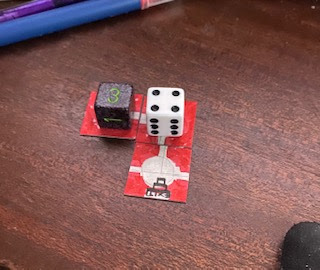
I have done very little actual dungeon crawling in my gaming career. I have also done basically no solo gaming, so I was inspired to try to get a feel for both things in a more practical and less theoretical way. So, I made myself some dungeon tiles:

I decided to fill in the empty spaces red after I took this. Passages (round) have about a 1 in four chance of traps and a 3-in-8 chance of being the sometime abode of monsters. Most of the treasure (triangles) is in the larger chambers (square) which are much more likely to contain monsters. And I adopted a probably absurdly basic dungeon crawling procedure:

  • For every new tile, roll two distinct dice. If there's a random chance of something bad, that's keyed off the darker die. If there's a random chance of something good, it's keyed off the lighter die. Doubles mean wandering monster.
  • If part of a larger chamber is drawn, draw more chamber pieces until the chamber is complete. If there are multiple keyed things in the chamber check separately for each.
  • When a monster is indicated, roll a die: 1-2, their strength is 1 per monster, 3-5 it's 2 per monster and 6 it's 3. Another die indicates number, divided by strength (round up).
  • In a fight, every 2 companions or 1 fighter adds a die. Monsters roll their total strength in dice. Every die hits on 2-in-6 and a hit figure can save on 2-in-6 or die. If you want to escape from the fight roll your opponent's strength or better on two dice.
  • A triggered trap hits one figure, who can save or die.
  • If you find the magic fountain, you can wish. Roll a game of craps; if you win, you get your wish and if you lose a water demon (1x4, takes two hits to kill) attacks you.

With that established, I set about dungeon crawling. We set out with two fighters and four companions. Not all of us would escape the dangers of the dungeon.

  1. From the exit we went North to an empty passage.
  2. West, we encountered wandering monsters (1x3) whom we defeated without a loss.

  3. North, the passage was trapped but we evaded it.
  4. North, an empty passage.
  5. North, a chamber opened before us with monsters (2x3) but no treasure.
    We fled (6+ on 2d6) and escaped back down the passage, evading the trap again.
  6. Returning to the exit, we struck East, where a chamber opened again containing monsters (2x3) but no treasure. We chose to fight, took down one of them but lost three of our companions, then fled (4+ on 2d6).
  7. West of the exit is the only way left, where we lost our last companion to a trap. Foolishly, we pressed on.
  8. South, there was a chance of a monster but none was present.
  9. East, an empty passage.
  10. East...a magic fountain! We chose to wish, and were immediately rewarded. Being sentimental, we wished our friends back to life. Then, feeling confident again, we pressed on.
  11. Returning West and then South, we found monsters (2x2) lying in wait.
    We dispatched them with no losses.
  12. East, more monsters (4x1).
    We fought and defeated them, but they killed all our companions (who had only just been returned to life).
  13. South, empty passages.
  14. East, more of the same.
  15. East...a trap! Which killed one of our fighters.
  16. North, nothing.
  17. East, we found an alcove with a bit of unguarded treasure!
    Now all that remained was to evade the two traps encountered on the way over (which our last fighter did) and finally to escape the dungeon with a bit of loot (but five dead friends...)

I'm not sure what my reflections on this experiment should be. It was pretty fun, but in the future I probably wouldn't document with photos since that took me out of the game a fair bit. 

  • The combat worked, I think, but monsters are probably a bit too strong, perhaps monsters with 1/2 (companion), 1 and 2 strength would even things out somewhat. Probably also include a wizard who can toss +2 dice onto a round a limited number of times.
  • Using some sort of reaction or negotiation options rather than automatic hostility would be good too. 
  • Traps felt...ok? I liked the danger of knowing we had to backtrack past them, but losing party members to traps felt kind of arbitrary.
  • I liked the wish, although I had not decided when I included it what things could be wished ofr. Having more random magic in the game would be fun.

Wednesday, February 10, 2021

a matrix of interconnected rooms

 In the essay "Figures, Doors and Passages," Robin Evans contrasts the Classical and Renaissance approach to dividing rooms into spaces with the Modern (post-19th century) ideas about the same. As the main example of the former, he discusses the Villa Madama: A floor plan and side view of the Villa Madama.

The first difference he points out from modern plans is that:

...the rooms have more than one door - some have two doors, many have three, others four - a feature which, since the early years of the nineteenth century, has been regarded as a fault in domestic buildings of whatever kind or size. Why? the answer was given at great length by Robert Kerr. In a characteristic warning he reminded readers of The Gentleman's House (1864) of the wretched inconvenience of thoroughfare rooms, which made domesticity and retirement unobtainable. The favored alternative was the terminal room, with only one strategically placed door into the rest of the house.

Yet exactly the opposite advice had been furnished by the Italian theorists who, following ancient precedent, thought that more doors in a room were preferable to fewer. Alberti, for instance, after drawing attention to the great variety and number of doors in Roman buildings, said, 'It is is also convenient to place the doors in such a Manner that they may lead to as many parts of the edifice as possible.' This was specifically recommended for public buildings, but applied also to domestic arrangements. It generally meant that there was a door wherever there was an adjoining room, making the house a matrix of discrete but thoroughly interconnected chambers. Raphael's plan [of the Villa Madama] exemplifies this, though it was in fact no more than ordinary practice at the time.

In modern design, enclosed spaces are distinguished between access spaces to be moved through but not occupied (elevators, passages, stairs) and those that are meant to be occupied but not moved through (rooms). However in earlier eras, even buildings large enough to be subdivided into many rooms (it is worth remembering that most buildings would contain few rooms; even a king might have no more than a hall, a private chamber for his family and a kitchen in his castle) would generally favor what Evans calls the "matrix of interconnected rooms."

This contrasts markedly with the kind of dungeon plan perhaps best exemplified by Castle Geryhawk, in which mostly-empty passages serve isolated terminal rooms to be stocked with various monsters or treasures:

A photograph of a hand-drawn map on grid paper. It is a maze of passages and rooms, but the doors almost entirely exist to link rooms with the passages that snake through the whole map, not rooms with one another.

The Greyhawk map is quite interesting because it demonstrates an extremely modern layout sensibility in an ostensibly medieval complex. The language Evans applies to William Morris's plan for the Red House at Bexley Heath applies perhaps more directly this dungeon than the house itself:

Yet his commitment to past practice only went so far. The morality of craft and beauty might transform the procedures of building and the appearance of the finished work, but medievalism did not percolat into the plan, which was categorically Victorian and utterly unlike anything built in the fourteenth or fifteenth centuries. Indeed the Red House illustrates the principles laid down by the bourgeois Robert Kerr better than Kerr's own plans: rooms never interconnect, never have more than one door and circulation is unified and distinct.

That may have been said to Morris's shame, but I don't mean it to shame the Castle or its designer. If anything, its plan is less typical of modern dungeons than the kind of dungeon plan perhaps best exemplified by (my beloved) Nethack, wherein corridors lead from specific rooms to specific other rooms, rather than forming a network of circulation for the whole level:

A screenshot of a Nethack dungeon level, showing a handful of rectangular rooms scattered about and connected by corridors.

However, I think embracing the matrix of interconnected rooms is a useful tool to keep in mind when designing dungeons or other structures because it naturally introduces a high degree of interconnectivity and makes chance encounters with the inhabitants of the dungeon likely throughout, not simply in their designated areas or when they take to wandering the halls. Here are a last few thoughts in the form of suggestions when drawing a dungeon plan:

  • When possible, place rooms that connect next to one another without an adjoining corridor.
  • Don't put an isolated room at the end of a corridor unless there's a particular reason for it to be separated from the others.
  • If many rooms lie on a single passage, consider making it a courtyard or loggia (above ground) or an atrium or other vertical space, perhaps with access to other levels (if below).