Showing posts with label skills. Show all posts

Friday, July 10, 2026

2W2P: combat, injury and recovery

Being an elaboration and expansion on my previous post synthesizing Marcia's B's thoughts on worker placement and the dice assignment mechanic of GHOST/echo.

general skill

This section supersedes the relevant parts of the original post. When counting the people participating in a task, consider their skill. The levels of skill are unskilled, competent (counts as one), experienced (counts as two) and specialized (counts as 4). At the GM's discretion, any character may be considered competent in a task that does not require special training.

Generally, competency requires a season's supervised practice, experience requires a year's practice and specialization requires four years' practice. Up to half of these requirements may be replaced by two times as much formal instruction. Self-study and unsupervised practice takes three times as long as supervised practice, if the information is available to the character.

A competent character may supervise one student, an experienced one three and a specialized one six. While supervising, a character may handle on only as much work on their own as the least-skilled of their students. However, for each period of work, a supervisor may add one die to any one roll made by one of their students. 

fighting skill 

Fighting skill is tracked more closely than other kinds. Each fighter is categorized by the number of life-or-death fights they have participated in; do not count drunken brawls, angry punching matches or sport fights; only fights where at least one side is trying to kill or maim.

  • Green (none): 2 per 3 fighters + 1 for 2 remaining.
  • Fresh (1-2 fights): 1 per fighter
  • Tested (3-5 fights): 3 per 2 fighters + 1 for 1 remaining.
  • Seasoned (6-9 fights): 2 per fighter
  • Veteran (10-14 fights): 3 per fighter
  • Hero (15+ fights): 4 per fighter 

illustration (from osprey publishing) of a viking era melee

melee

In hand to hand fighting, group fighters into "fronts" based on whether they are separated from or able to help one another. Each fighter contributes dice to their side of a front. Every 5 or 6 rolled is a felling hit and every 3 or 4 is a wounding hit. The other side decides which fighters take them.

A side may choose (before rolling) to roll some of their dice defensively; each 5 or 6 stops one hit of any kind and each 3 or 4 either stops a wounding hit or turns a felling hit into a wounding one. The side rolls an additional 1-2 dice for defense if everyone on the front has effective body and/or head protection.

For those in their physical prime, the third wounding blow is a felling blow. For everyone else, the second wounding blow is a felling blow. 

injury

A character who takes a felling blow cannot fight or move quickly. A character who takes one or more wounding blows fights one category worse than their experience level for each one.

Felling wounds and one out of every three other wounds must be re-set before they can be recovered; the GM should determine this secretly for non-felling wounds. Examination by an experienced surgeon or any specialized healer is needed to tell if a non-felling wound needs re-set. After a failed roll to recover a wound, any competent healer can identify that it needs re-set.

On the day that they took a blow, a character (and anyone treating them) rolls against the risk of infection; each wound has a separate risk. Beginning on the following day, each infection is a risk of dying. Examination by an experienced physician or any specialized healer can identify an infection the day after it sets in; any competent healer can identify one two days afterwards.  

recovery

A felled character (and anyone treating them) must roll against the risk of dying on the day they are wounded and each day until the risk is removed. Each infection is a separate risk of dying.

A character with wounds (and anyone treating them) rolls with the goal of recovering from a wound after each day without even light activity or after three days without strenuous activity. Recovering from each wound is a separate goal; however, if fewer dice are rolled than there are goals, the opportunity to recover from any leftover wounds is not lost. 

an engraving of a seated man having some sort of chest injury treated by a surgeon

healers

To contribute even 'inexperienced' treatment, one must have a month of supervised practice or a season of instruction. 'Experienced' healers have two seasons of supervised practice or two years of instruction, and specialized healers have at least three years of supervised practice and two of instruction.

While some healers practice several, nursing, physic and surgery (these terms are going to be inaccurate, just relax about it please) are distinct skills: 

  • Someone who is personally present with a patient while they recover is a nurse.
    A competent nurse may care for three patients at a time, an experienced one five and a specialized one eight. 
  • Someone who binds wounds and sets bones is a surgeon (bone-setter, medic).
    A competent surgeon may treat two wounds or examine three patients in an hour. An experienced one may do three and a specialized one five.
  • Someone who treats infections and non-traumatic ills is a physician (herbal, pharmacist).
    A competent physician may examine three patients or compound medicines for two patients in an hour. An experienced one may do three, and a specialized one five.

If a nurse is practicing other healing skills, they cannot at the same time give patients the benefit of their nursing but they may still supervise other nurses.

Friday, September 13, 2024

whither 3e's skills?

As the title may suggest, this is a weird companion piece to my earlier examination of the origins of the skill system in D&D 2000. Instead of looking backwards, I am now looking forward from D&D 2000 to how three iterations on it would attempt to lump and categorize the let's say 50ish individual skills they inherit from it and what I can possibly learn from them.

Ready? Too bad.

the iconic characters from d20 modern

Sunday, July 7, 2024

stop me if you've heard this before

Sometimes, the Ref may ask for a roll of the dice. The most common type of roll is a d20 roll.
The \gm sets a difficulty class (DC) and whoever is making the choice rolls the die and adds a modifier. If the total is at least equal to the DC, the actor gets what they want. Otherwise, they may fail or need to pay some price to succeed.

If a roll is a contest between two characters, the DC is equal 9+ the total modifier of the target. Otherwise, see below for guidelines on setting DCs.


What is this?

Basically I'm pretty set on a lot of the specific mechanics for my 3e-derived game. Here I'm trying to stretch myself and present only the stuff that's not about character creation, on account of that being the section of the ruleset I have a tendency to work too hard on without drawing the rest of the owl.

The form of what follows, presenting DCs by task rather than by skill (haven't included a skill list in here, but it will be much less granular than these categories) follows the first D&D Next playtest packet. The actual numbers are largely based on a d20ification of this analysis of the hidden d6 skill system of OSE/BX.

Friday, January 19, 2024

ADEPT: a modest proposal

Are you reinventing RuneQuest or Traveller this time? You fool. You rube. You absolute buffoon. I am reinventing HârnMaster.

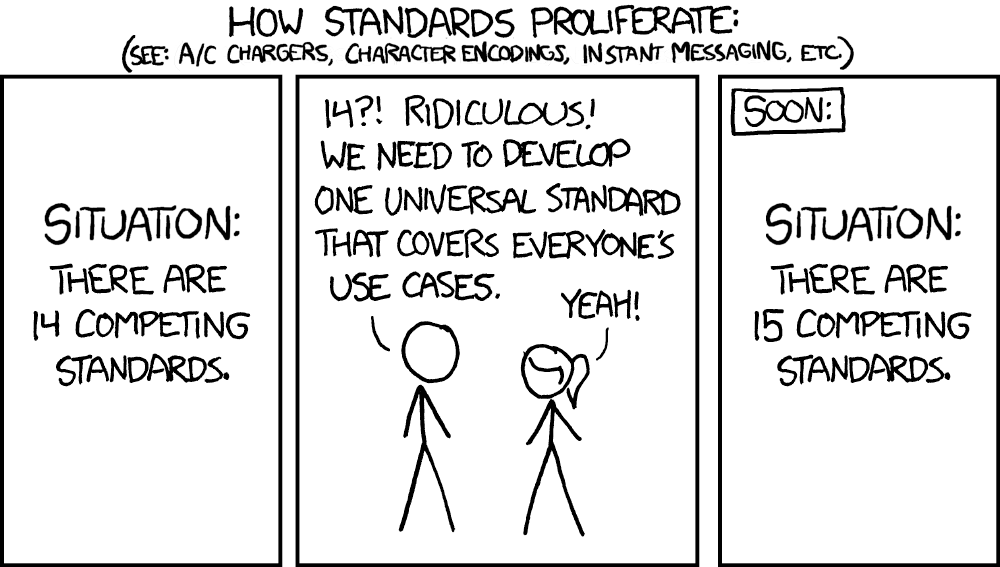
the xkcd comic about how standards proliferate
xkcd: Standards

Listen. Everyone hates the six-score array. It sucks, and the history of non-D&D RPGs is practically a history of variants of the array and its uses. There are plenty of theoretical issues to raise with the standard six. However, here are three problems only the worst pedant would have with it:

  • The canonical order of the abilities is not alphabetical.
  • Two abilities share an initial letter.
  • There is no mnemonic device for the abilities.

I propose to solve these (and really, only these) problems with the ADEPT array:

Saturday, January 6, 2024

3eish: what's a level

Theoryposting, maybe I'll get to the point of concrete details by the end of this post, maybe I won't.

Artist: Tennis Cramer

So, my goal of 3eish is to make something that feels like 3e to me, while also keeping it light enough to hold the whole thing in mind and play fast and easy. Can't get rid of levels without it starting to feel like something else entirely so it's worth asking: what's a level. In 3e there are a couple clear answers:

  • One HD.
  • 1, 3/4 or 1/2 a point of BAB
  • 8, 6, 4, 2 + Int skill points
  • 1/2 or 1/3 a point of each saving throw
  • 1/4 of an one-point improvement to an ability score (1/8 of a one-point improvement to its modifier)
  • 1/3 of a feat and some class features
  • various scaling on spells you cast

There are some rationalizations that suggest themselves, like making attack bonus or saving throws a part of the skill system, but I've been down most of those design roads at this point and most of them wind up reinventing RuneQuest. So instead I'm going to reinvent True20; a level is a feat and one HD and everything else falls out of that.

Let's nail that down somewhat:

  • As in the base rules, the benchmark for a boring feat is that it applies +2 on two different kinds of rolls. 
    • Boring feats (that only add bonuses to rolls) are now called skills and can be taken multiple times. This replace the skill list and save progressions; if a character does not have any skills that apply to a saving roll, they use 1/3 their level as a bonus.
    • Obviously not all feats are boring ones. The ones that grant more interesting abilities can generally only be taken once.
  • Each feat specifies an amount of HP (2, 3 or 4) gained when you take it. If you're proficient with it, add +1 to an attack roll for every 4HP you currently have. If you're not proficient, apply a -3 penalty.
    • Abilities for combat add 4HP.
    • Skills and miscellaneous abilities add 3HP.
    • Magic abilities adds 2HP.

You may notice there's no real purpose left for classes. That's probably for the best, let's lose them. Carve out their interesting bits into feats and leave the rest.

One-feat character creation is probably too bare to be fun. Instead we'll have two-feat character creation (truly, I have a dizzying intellect). There's a special set of feats called backgrounds, and you pick two of them to start. Your starting HP is 4 if both of them have experience with violence, 3 if one does and 2 otherwise.

The 3e PHB had 7 races and 11 classes, so for parity with its 77 combinations a pool of backgrounds would need...a pool of 14 backgrounds (14 choose 2 is 91, fourteen more combinations for a pool with three fewer elements). Now that's of course not the full range of customization of a 1st level 3e character but it's close enough for my purposes.

Friday, December 9, 2022

digression: ICBWS

I have a bee in my bonnet to run a kind of high school isekai game, and this set of rules just kind of came together. The HD/saving throw rules, if you're interested, are based on this thread speculating about the combat system used in the original Blackmoor game.

A brick school in the woods with vines and such growing all over it.

Working Title: I Can't Believe My Whole School Got Transported to a Fantasy Dimension Just Before Summer Break

Just assume that anything not covered here you don't have to worry about until I say you do.

Character Creation

The stats represent what kind of high school kid you are. For each, roll 3d. Half that roll, rounded down, is your Defense for things related to that stat. You have one-third the roll, rounded down, advances to divide between its skills:

  • ARTS, craftiness and matters of taste. Skills: cooking, mending, nuts-and-bolts, taste.
  • GOTH, self-reliance and dedication to the bit. Skills: animals, literature, mending, stealth.
  • JOCK, morale and physical condition. Skills: animals, cooking, scouting, sports.
  • NERD, analysis and specialized knowledge. Skills: book smarts, literature, nuts-and-bolts, scouting.

Skills with no advance have no rating. One advance for a 5th-Rate, two for a 4th-Rate, three for a 3rd-Rate, four for a 2nd-Rate and five for a 1st-Rate skill.

Then, give your character

  • A name and class year.
  • One or more named people you care about at school. These can be other players' characters but don't have to be.
  • What they have on their person and in their bag. This can be whatever you want, within the bounds of teen stuff.

Harm and Saves

In circumstances of peril, roll harm dice (HD) appropriate to the danger. A normal adult trying to do you harm is 1HD, while you'd roll 2HD for every 3 normal teens.

When rolling HD, discard all 6s and add up the other dice to determine the harm. Teens are taken out if they take 3 points of harm, and adults if they take 4.

When the character is able to do something to defend themselves, make a saving roll of 2d; if the roll is less than the appropriate Defense, reduce the harm taken by up to the amount rolled. Protective gear improve a Defense by 1 or 2, but the gear is damaged if that difference saves you. A risky plan and space to try it can also add 1 to Defense.

Skill Checks

When presented with a challenge, a skilled character may make a skill check. Their chance of failure is their Rate in the skill plus 1-3 if they lack each of information, time or tools. If this chance is 1-5, they pass if a roll of 1d is greater than it.

An unskilled character doesn't usually get to make a check. A lack of the appropriate information, time or tools can each increase the chance of failure.

If the chance of failure is 6 or higher, the roll fails unless a roll of 2d is 12 or higher. A character with a stat of 6+ adds 1 to this roll, and one with a stat of 8+ adds 2.

  • Animals. Check to calm or handle an animal.
  • Book Smarts. Check to diagnose a problem or follow a procedure.
  • Cooking. Check to preserve or stretch supplies.
  • Literature. Check to find or know relevant information.
  • Mending. Check to repair clothing or gear.
  • Nuts and Bolts. Check to make or repair simple structures and machines.. 
  • Scouting. Check to find food, paths, shelter or water.
  • Sports. Check to perform athletic feats.
  • Stealth. Check to avoid notice or hide something.
  • Taste. Check to color reactions to your art, music or presence with a feeling.

Tuesday, May 3, 2022

3eish: a closer to 3e hack

Heaven help me, I'm about to make a "why I haven't been posting as much recently," post, aren't I.

I won't dwell on it because no one cares, but honestly the reason I haven't made many posts is that instead of rapidly flitting from idea to idea I stayed relatively focused on a couple of projects. For a while, this was hulk rats, which I just posted, and then I moved on to my current obsession which I am calling 3eish.

No, I won't be posting a draft (even an incomplete one) of a second whole-ass game today. I just want to talk about the project a little bit.

3eish

So, I've worked on hacks that have said they're based on 3e or d20 modern before but their relationship to those systems beyond my invocation of their names have been, uh, unclear. For Target 20 Modern, it was basically the names of the stats, and for my previous 3e-based hack it was basically just the words "Fortitude, Reflex and Will," which were used in totally different ways than before.

Having recently regained possession of my old 3e books, however, I was poring over them and realizing how much I genuinely do like about the first DnD I learned; especially knowing what I know now about the history and motivations of a lot of its pieces. And, inveterate tinkerer that I am, there are simply so many points of pain in the system that I can't help tearing it apart and rebuilding it.

This is not a small project; I'm basically rewriting the entire SRD from the ground up. I'm about thirteen thousand words deep already, big beefy chunks remain more or less unwritten (the arcane spell list, to name a big one). So like, watch this space? But don't hold your breath.

Nevertheless, I feel like I do have a distinct vision for the game, here's my attempt to articulate what I'm doing with it:

Monday, September 13, 2021

whence 3E's skills

The third edition Player's Handbook lists more than forty skills in which its adventurers can have ranks. Although prior editions of the game had skill systems (AD&D's Nonweapon Proficiencies and BECMI's General Skills), the 3rd edition skill system breaks with them in two ways:

  • It is no longer an optional part of the game, but instead arguably the most-used non-combat mechanic in 3E D&D.
  • The skill system does not use (modified-)ability-score-roll-under, as NWP and General Skills do, but a d20 + bonuses vs target number mechanic, similar to the newly-rationalized d20 + bonuses vs armor class mechanic used in combat.

I'm not going to spill any (digital) ink addressing those points. If you have strong opinions about them, good for you. Rather, I'm going to address the question: where did 3E's list of skills come from?