Showing posts with label magic. Show all posts

Thursday, March 27, 2025

a small parcel of wizardries

It's long been a contention of mine that D&D has too many spells. One responsible factor is that there is a need for every school of magic to have a meaningful choice of spells at every level, of which there are probably too many.

Abandoning that pattern, I set myself some constraints. First, there would be five orders of magic. Second, each order would contain fewer spells than the one before it. Third, the first order should have a number of spells it is easy to roll on a random table for.

One 5th-level spell being a natural minimum, I settled on thirty-five spells in total, eleven of which (entries on a 2d6 table) would be first level. To achieve this compression, I also used up-casting for more powerful effects and the splitting out of certain effects into feats or properties of items only.

On the Fourth Day Comes the Astrologer from His Crumbling Old Tower

Monday, December 18, 2023

talent, time and tools

Being a universal 2d6 resolution mechanic and some extra bits.

An attempt succeeds if a roll of 2d6 is at least equal to the required target number:

  • You have an appropriate talent, time and tool: 5
  • You are missing one of those: 6
  • You are missing two of those: 7
  • You have none of those: 8

A roll of 10+ (regardless of target number) is a clean success. A particularly stressful situation may require a clean success to avoid costs or complications.

Talents

Create a character by giving them 2-3 traits or skills and however many talents your Referee finds appropriate. 

If you don't start with a talent you must:

  • Practice for a season with a skilled teacher or three seasons on your own for the archery, climbing, thievery or any weaponry talents.
  • Slay three armed foes by your own hand for the fighting talent.
  • Become initiated into the inner mysteries of a cult for its ritual talent.
  • Survive ten days in the bush without aid or supplies for the wilderness talent for those environs.

Combat

Talent. The fighting talent is for hand-to-hand or hand weapons and the archery talent for bows. No talent is required for crossbows or guns. Weaponry talents do not affect the target number of attacks, but they allow the attacker to use any special properties of the weapon.

Time. You have time if the target is surprised. 

Tools. Close weapons for hand-to-hand and non-close weapons otherwise.

An armed attacker gets +1 to their roll if their target is unarmed. A character with a longer weapon than their opponent starts with a +1 advantage to their attacks, but a clean success seizes the advantage from one's target (or seizes it back).

In hand-to-hand, a clean success damages, disarms, pins or throws one's target. Otherwise, success merely holds them. A held character may do any of those to their opponent with a clean success. Otherwise, success reverses the hold. Any success by the holding character may damage, disarm, pin or throw the other.

Magic Rituals

Magic rituals are done with one roll but involve a sequence of steps. Some might require all of the following, and some only one or two:

  1. Guarding the space
  2. Guarding the magician
  3. Opening the way
  4. Fixing the terms
  5. Closing the way
  6. Purifying the magician
  7. Purifying the space

Talent. Each cult has its own path of rituals, any its ritual magic talent counts for any ritual on that path. Anyone with such a talent is aware of the presence of other talented magicians and of powerful spirits, and may address them mind-to-mind.

Time. Rituals of 1-2 steps take 10 minutes, minus one for every time the size of the group of magicians doubles. Each additional step doubles the time required.

Tools. Guarding or purifying magicians requires oils or potions for each. Guarding or purifying the space require candles, diagrams or smoke to fill it. Opening the way requires an arcane connection to the recipient of the power. Fixing the terms requires a symbol of what is to be done. Closing the way requires a symbolic weapon.

If the power invoked by a ritual is an intelligent spirit, a clean success is needed to avoid some additional price being demanded. Offering a sacrifice adds +1 to a ritual roll to deal with a spirit, or +2 if the sacrifice is extremely dear.


Friday, September 24, 2021

witchcraft

(Being a magic system for the marginal and desparate, to be used with these 3e-like rules.)

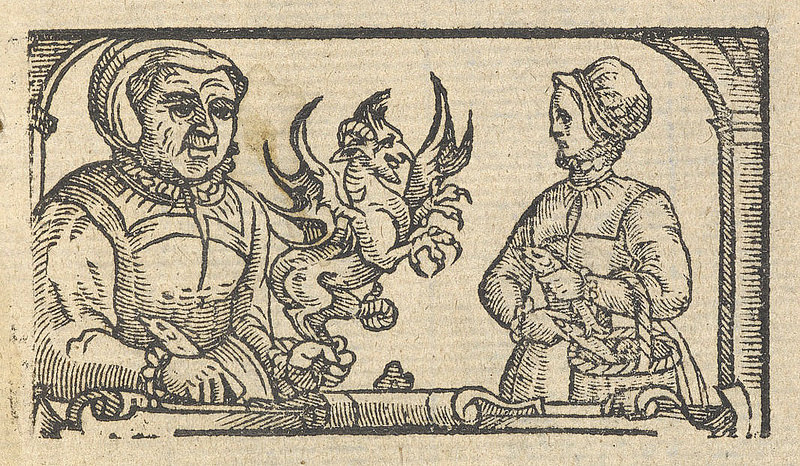
a witch, writing at a table and holding a demon in her left hand, while another woman carries a basket of fish and looks on nervously

The world is a cruel and capricious place, over which we have very little power. The power we do have hurts us, it seems, almost as often as it helps. Witchcraft is an attempt to seize control of your own fate by whatever means necessary.

You can use witchcraft to try to make something happen even if it is totally outside of your control. To do so, you need to be able to see, hear, smell, touch or name whatever you want to bewitch, at least in part. You also need one or more of the following:

  • Will. You are willing to burn for this. This is automatic if you're using witchcraft to save your own life or that of someone you love, but otherwise this calls for a Will roll. This is what the Witching skill is; it is the skill of making yourself want something badly enough.
  • Words. You know powerful words to say, specifically for this purpose. Words are usually fairly specific, but it's simply a matter of learning them, either from a teacher or from magical writings.
  • Ways. You have an efficacious ingredient (usually some animal part, herb or mineral, but sometimes a more complex preparation) and know that is suited to the task at hand.

Roll 1d6 for each of these that you have. If the highest die is a 6, the witching works immediately and completely. If it is a 4 or 5, choose one of those. Otherwise, it accomplishes nothing.

When bewitching beings sensible to speech, witchcraft can accomplish one of two things. It can either curse their body and mind with some sort of disease, or it can mesmerize them for as long as the witch is able to continue muttering the witching under their breath. One mesmerized will take no action other than those commanded by the witch, but each command requires the witch to succeed in a Will attack against their mental resistence.

There are prices to be paid for witchcraft. If doubles were rolled, the Referee interprets the stated intent of a witching in bad faith, if possible. For every 1 rolled, the witch loses nerve or takes damage equal to the number of dice rolled. If triples were rolled, the witching lets something demonic into the world:

TripleDemon
1s1d6 wisps. If the damage from the witching critically injures you, one of them seizes your body as a ketev.
2s2d6 mournful shades of the dead.
3sAn unbound imp, cruel and evil-tempered.
4sA wraith that knows your name and can wear your likeness as it rides away, intent on mischief.
5sA wraith whose name you hear as it slips into the world, to bind them with if you catch them again.
6sA bound familiar, unquestioningly loyal to you til death.

Monday, February 8, 2021

de modulii magicii

This is a thinky post and modest proposal about modularity in TTRPG design.

Since modularity can mean a lot of things to a lot of people, I'll be specific. I am not talking (at least not directly) about the role that discrete packages play in character customization; I am talking about the more general organizational principle of giving a unique name to a particular rule and referring to it at need elsewhere in the text.

When a rulebook describes a number of statuses that can affect a character's combat options: blinded, dazed, deafened, prone, surprised, stunned and so on, and then elsewhere gives players and enemies the option to blind, daze, deafen, knock prone, surprise and stun one another, that's an example of modularity. Modularity is a strategy for sacrificing some amount of clarity (the consequences of stunning a foe may not be explained in the same place in the text as the source of the condition) for to make the rules more consistent (all abilities that stun foes achieve the same effect) and concise (it is not necessary to quote a modular rule everywhere it is referenced). The cost in clarity can be offset by choosing descriptive names for the modular rules so that readers' expectations about what applies to stunned characters map well onto what the actual rules provide for those situations.

A place where modularity is particularly useful is in magical effects. By nature, magical affects are at least somewhat contrary to the readers' expectations and, if precise boundaries of the effect are needed, a lot of text may be the result. Delta has a whole series of posts analyzing the rules texts of spells from Chainmail through 3E; it's evident at a glance that spells have accumulated more and more text as time goes on and the attempt is made to nail down exactly what such and such a piece of magic can do.

Whether you like detailed spells descriptions or vague ones, is not practical to quote the full text of a spell description every time it is referenced. As such, the rules are full of effects defined in reference to specific spells. An unscientific survey of a pretty orthodox old school magic item list had 10-40% (depending on category) of magic item listings specifically referencing a spell effect. Excluding scrolls (which are mostly spell scrolls), potions are next most likely to reference spell effects, followed by wands, miscellaneous items and finally rings. Monster abilities in early editions and their imitators seem much less likely to reference spell effects; however 3/3.5E can't get enough of monster abilities directly referencing spell effects, between traditional spellcasting, spell-like abilities and the very confusing situation of "supernatural" (and sometimes "extraordinary") abilities that duplicate spell effects without certain features of spells such as the possibility to be interrupted or dispelled.

Honestly, I think 3/3.5E is pushing in the right design direction there, even if they did it in the messiest possible way. Nevertheless, I'd wager few people have the system mastery to accurately tell you off hand the differences between a spell, spell-like ability, supernatural ability and an extraordinary ability. And even fewer would be able to accurately guess the effects of an unfamiliar spell from its name. In 4E, the designers pulled hard in the opposite direction by removing the modularity from spells (and prayers and maneuvers and psionic powers) entirely: all abilities got siloed to the class or monster type that granted them where they are described in full. In particular, this means that while the information is conveniently organized for the DM running the encounter, the economics of space and how many unique abilities a DM can actually keep in mind while running the encounter suddenly place pretty hard limits on how intricate monsters can be.

Rather than continue talking about the historical vicissitudes of spell modularity, I will instead make a modest proposal:

Modest Proposal

Keep magical causes and magical effects separate:

  • A magical effect (wonder) should be listed under a descriptive name and any limitations that are not obvious spelled out (for example, that the wonder of move earth can shift loose earth and its vegetation, but not stone).
  • A magical cause could be a spell that can be learned, a consumable preparation, an artifact or a natural ability of a magical creature. The description of a cause should name the wonder should spell out any important limitations on its use (costs, concentration, durations, number of targets, ranges, time to activate and so forth).

Different ways of working the same wonder can be made to feel very different if, for example, different costs are demanded from a holy person and a necromancer to bring about the same healing of a broken body. The details of the wonder equip a ref to rule on its applications and edge cases, while the details of the causes are able to be more diegetic and flavorful without sacrificing modularity for that.

A book of wonders could be used by a referee both as an at-the-table reference for whatever magic is in play but also as a source for describing new wizarding traditions (by selecting a set of wonders and describing that tradition's means of causing each), artifacts or creatures. If the rules texts were sufficiently concise, a deck of cards bearing wonder descriptions could be physically handed out to players when they become able to use them.
Tuesday, January 12, 2021

a freeform magic system

A piece of magic is constructed of terms which either name entities to be effected or adjure them with certain commands. A single piece can incorporate many terms to achieve greater effects---though this increases the complexity of the magic---but all magic must contain a name and an adjuration.

Ex: a magician wishes his foes to become lost in the mists, and constructs a spell that names the mists and adjures them to confound. If he wished only his foes to be lost and others to be to pass normally, he could add another term naming his foes.

The base complexity of a piece of magic depends on the magician's mastery of the adjurations involved. These ratings range from 5 (a fifth-rate magician) to 1 (a first-rate one). To this, add the complexity of the naming.

Using a genuine name the complexity varies depending on what is being named: self (0), a bodiless spirit (1), another person (2), other living beings (3), a place or insensate thing (4). One can also name entities present without knowing their names. This has a complexity of 4 for a person, 3 for a living thing, 2 for an insensate one and 1 for a bodiless spirit. If many individuals or an undifferentiated mass are named, increase this by one (by two if some present entities of the same kind are to be excluded).

Ex: the magician is a second-rate confounder, so the base complexity of this spell is 2, and the magician names mists which are close at hand (insensate 2 + 1 for a mass 2), so the complexity of the broad spell of confusion is 5.

To work magic, one needs magical power. Magicians use their own power, tap into an artifact's or call on the power of others. Roll a d6 for each power invoked (re-roll 6s, adding 5 each time) and total them. Sources of power are tapped if their die was re-rolled in working the magic.

Ex: if the magician used only his own power, he would need to roll a 6. He chooses to invoke the Hoary Hosts of Hoggoth, rolling a 1 and 7, for a total of 8, which is more than enough but taps the Hoary Hosts of Hoggoth, so he will not be able to call upon it again for some time.

If the total is greater than the complexity for the magic, it takes effect as intended. Otherwise, the ref may drop terms from it or modify the entities named to create a different effect.

Ex: if the magician had rolled a 2 and a 3, that would not have sufficient for the magic. If another subject could have been named for 1 complexity, the ref could do so. However, they decide that no other subject makes sense and the magic simply does not take hold.