Friday, July 10, 2026

2W2P: combat, injury and recovery

Being an elaboration and expansion on my previous post synthesizing Marcia's B's thoughts on worker placement and the dice assignment mechanic of GHOST/echo.

general skill

This section supersedes the relevant parts of the original post. When counting the people participating in a task, consider their skill. The levels of skill are unskilled, competent (counts as one), experienced (counts as two) and specialized (counts as 4). At the GM's discretion, any character may be considered competent in a task that does not require special training.

Generally, competency requires a season's supervised practice, experience requires a year's practice and specialization requires four years' practice. Up to half of these requirements may be replaced by two times as much formal instruction. Self-study and unsupervised practice takes three times as long as supervised practice, if the information is available to the character.

A competent character may supervise one student, an experienced one three and a specialized one six. While supervising, a character may handle on only as much work on their own as the least-skilled of their students. However, for each period of work, a supervisor may add one die to any one roll made by one of their students. 

fighting skill 

Fighting skill is tracked more closely than other kinds. Each fighter is categorized by the number of life-or-death fights they have participated in; do not count drunken brawls, angry punching matches or sport fights; only fights where at least one side is trying to kill or maim.

  • Green (none): 2 per 3 fighters + 1 for 2 remaining.
  • Fresh (1-2 fights): 1 per fighter
  • Tested (3-5 fights): 3 per 2 fighters + 1 for 1 remaining.
  • Seasoned (6-9 fights): 2 per fighter
  • Veteran (10-14 fights): 3 per fighter
  • Hero (15+ fights): 4 per fighter 

illustration (from osprey publishing) of a viking era melee

melee

In hand to hand fighting, group fighters into "fronts" based on whether they are separated from or able to help one another. Each fighter contributes dice to their side of a front. Every 5 or 6 rolled is a felling hit and every 3 or 4 is a wounding hit. The other side decides which fighters take them.

A side may choose (before rolling) to roll some of their dice defensively; each 5 or 6 stops one hit of any kind and each 3 or 4 either stops a wounding hit or turns a felling hit into a wounding one. The side rolls an additional 1-2 dice for defense if everyone on the front has effective body and/or head protection.

For those in their physical prime, the third wounding blow is a felling blow. For everyone else, the second wounding blow is a felling blow. 

injury

A character who takes a felling blow cannot fight or move quickly. A character who takes one or more wounding blows fights one category worse than their experience level for each one.

Felling wounds and one out of every three other wounds must be re-set before they can be recovered; the GM should determine this secretly for non-felling wounds. Examination by an experienced surgeon or any specialized healer is needed to tell if a non-felling wound needs re-set. After a failed roll to recover a wound, any competent healer can identify that it needs re-set.

On the day that they took a blow, a character (and anyone treating them) rolls against the risk of infection; each wound has a separate risk. Beginning on the following day, each infection is a risk of dying. Examination by an experienced physician or any specialized healer can identify an infection the day after it sets in; any competent healer can identify one two days afterwards.  

recovery

A felled character (and anyone treating them) must roll against the risk of dying on the day they are wounded and each day until the risk is removed. Each infection is a separate risk of dying.

A character with wounds (and anyone treating them) rolls with the goal of recovering from a wound after each day without even light activity or after three days without strenuous activity. Recovering from each wound is a separate goal; however, if fewer dice are rolled than there are goals, the opportunity to recover from any leftover wounds is not lost. 

an engraving of a seated man having some sort of chest injury treated by a surgeon

healers

To contribute even 'inexperienced' treatment, one must have a month of supervised practice or a season of instruction. 'Experienced' healers have two seasons of supervised practice or two years of instruction, and specialized healers have at least three years of supervised practice and two of instruction.

While some healers practice several, nursing, physic and surgery (these terms are going to be inaccurate, just relax about it please) are distinct skills: 

  • Someone who is personally present with a patient while they recover is a nurse.
    A competent nurse may care for three patients at a time, an experienced one five and a specialized one eight. 
  • Someone who binds wounds and sets bones is a surgeon (bone-setter, medic).
    A competent surgeon may treat two wounds or examine three patients in an hour. An experienced one may do three and a specialized one five.
  • Someone who treats infections and non-traumatic ills is a physician (herbal, pharmacist).
    A competent physician may examine three patients or compound medicines for two patients in an hour. An experienced one may do three, and a specialized one five.

If a nurse is practicing other healing skills, they cannot at the same time give patients the benefit of their nursing but they may still supervise other nurses.

Friday, July 3, 2026

2 Workers 2 Placement

Update: see my 2w2p tag for all posts on this framework.

Or, "how to play an RPG as if it were a cooperative worker-placement board game." This (sub?)system is in response to Marcia B's worker placement manifesto, which I endorse. It inspired me in a specific way that I realized probably can't be communicated effectively in a couple of sentences so here it is as a whole post.

I have some additional thoughts about how to flesh out this mechanical skeleton (specifically, to use it to replace the overloaded die in the enchantingly fractal structure of Brendan S.'s Hazard System) but in the interest of actually getting a post out there I think this is good enough. Drawing the rest of the owl is left as an exercise to the reader.

the board game "pandemic"


structure of play

The GM describes a situation, and the players ask questions and decide what their characters are going to do. The GM identifies what tasks are being attempted, what their goals are and communicates what the risks are for each. The players make a final decision of which characters are on which task.

For each task, dice are rolled and its outcome settled. The GM describes the new situation and the cycle resumes.

before rolling

Find out the number of (six-sided) dice based on the number of people on a task: 1 die for an individual, 2 dice for 2-3 people, 3 dice for 4-6 people, 4 dice for 7-10, and so on. People with experience count as double their number and specialists count triple.

If task uses some scarce resource, there is a risk of using it up. At the GM's discretion, the players may declare that they are using up a scarce resource before rolling to roll one extra die.

after rolling

Once rolled, the players must assign individual dice to goals and risks: each roll of 5-6 achieves a goal or removes a risk and each roll of 3-4 advances a goal or avoids/delays a risk. If no die of 3+ can be assigned to it, whatever the risk threatens happens and whatever opportunity there was for the goal is lost.

Perceptive readers will note that this is more or less the dice mechanic from GHOST/echo, which I have previously riffed/elaborated upon.

Unless the GM says otherwise, no risk may be delayed more than twice, but advancing the same goal three times achieves it.

complications

To increase the difficulty of a given goal, divide that goal into multiple steps which are each treated as their own goals. The opportunity to work on a later step should not be lost as long as an early step is being advanced.

Similarly, risks can be heightened by splitting them into multiple risks; a simple way to do this would be to treat the same consequence for each participant as a separate risk.

Wednesday, November 26, 2025

an agricultural procedure

Everyone must eat. Settled peoples get the majority of their sustenance from crops they grow.

Twelve bushels of grain and pulse (supplemented by animal products and foraged or garden vegetables) sustains a working or pregnant adult for a year. Ten bushels sustains a child or idler.

On up to two fewer bushels per year, or without supplemental foods, one must make a DC 15 roll or lose a random month of work to illness. For every six points the roll fails by, another month is lost.  

Thursday, March 27, 2025

a small parcel of wizardries

It's long been a contention of mine that D&D has too many spells. One responsible factor is that there is a need for every school of magic to have a meaningful choice of spells at every level, of which there are probably too many.

Abandoning that pattern, I set myself some constraints. First, there would be five orders of magic. Second, each order would contain fewer spells than the one before it. Third, the first order should have a number of spells it is easy to roll on a random table for.

One 5th-level spell being a natural minimum, I settled on thirty-five spells in total, eleven of which (entries on a 2d6 table) would be first level. To achieve this compression, I also used up-casting for more powerful effects and the splitting out of certain effects into feats or properties of items only.

On the Fourth Day Comes the Astrologer from His Crumbling Old Tower

Friday, September 13, 2024

whither 3e's skills?

As the title may suggest, this is a weird companion piece to my earlier examination of the origins of the skill system in D&D 2000. Instead of looking backwards, I am now looking forward from D&D 2000 to how three iterations on it would attempt to lump and categorize the let's say 50ish individual skills they inherit from it and what I can possibly learn from them.

Ready? Too bad.

the iconic characters from d20 modern

Sunday, July 7, 2024

stop me if you've heard this before

Sometimes, the Ref may ask for a roll of the dice. The most common type of roll is a d20 roll.
The \gm sets a difficulty class (DC) and whoever is making the choice rolls the die and adds a modifier. If the total is at least equal to the DC, the actor gets what they want. Otherwise, they may fail or need to pay some price to succeed.

If a roll is a contest between two characters, the DC is equal 9+ the total modifier of the target. Otherwise, see below for guidelines on setting DCs.


What is this?

Basically I'm pretty set on a lot of the specific mechanics for my 3e-derived game. Here I'm trying to stretch myself and present only the stuff that's not about character creation, on account of that being the section of the ruleset I have a tendency to work too hard on without drawing the rest of the owl.

The form of what follows, presenting DCs by task rather than by skill (haven't included a skill list in here, but it will be much less granular than these categories) follows the first D&D Next playtest packet. The actual numbers are largely based on a d20ification of this analysis of the hidden d6 skill system of OSE/BX.

Thursday, February 1, 2024

hexcuse me

 ...for the title of this post.

Anyway, I'm looking at a lot of hexes to stock and the best hex stocking procedure I have found so far is probably Luke Gearing's Hexfill one, although I also like a lot about Welsh Piper's Hex-based Campaign Design. But, I'm also constitutionally incapable of using something unmodified, so here's my spin on it.

My priorities are to have a procedure that takes into account the geography of the area being keyed, and also produces a more settled map than the procedures linked above.

Begin with a map of atlas (18mi) hexes subdivided into travel (6mi) hexes with terrain and roads marked.

For each travel hex, determine its difficulty (= hours of travel): open country (3), hills or woods (4), wooded hills (5), broken country (6). A road reduces difficulty by 1. Then, roll 1d6:

  • If the roll is a 1, there's something weird (see below). 
  • If the roll more than 1 and less than the difficulty of the hex, it's empty.
    • Roll a d20. If it is less than the d6 roll, there is a ruin of some prior settlement or structure.
  • If the roll is at least equal to the difficulty of the hex, it contains: (2) a city, (3) a town, (4) 3d2 villages, (5) 2d2 villages, (6) a camp, fastness or inn.
    • Camps and inns are abandoned 2-in-6, fastnesses 1-in-6

If something weird is indicated, roll 2d6 for its nature. If a Power is indicated, roll 2d6 again for that:

Roll Nature Power
2 Old Ones yet dwells here Nothing remains
3 Holds a vivid memory of the distant past No more than a hum or a few sparks
4 A student of Power dwells here Red (energy, heat and strength)
5 Strong medicines may be found here Orange (industry and motion)
6 A place of attractive Power Yellow (communication, illusion)
7 Works of the Old Ones, purposes now unknown Green (growth and healing)
8 A place of repulsive Power Blue (air and water)
9 Intelligible lore of the Old Ones Indigo (protection, force)
10 Roll twice Violet (domination, transformation)
11 Roll twice Forces poisonous to draw upon
12 Roll twice A malign intelligence possesses the seeker

Replace 'Old Ones' with whatever fantastical civilization dwelt here before the current peoples if you like.

Now, for each atlas hex, count 1 for every village, 2 for every town and 4 for every city. If a roll of 2d6 plus the number of weird hexes is greater than this sum, a monster lairs somewhere within it.

Friday, January 19, 2024

ADEPT: a modest proposal

Are you reinventing RuneQuest or Traveller this time? You fool. You rube. You absolute buffoon. I am reinventing HârnMaster.

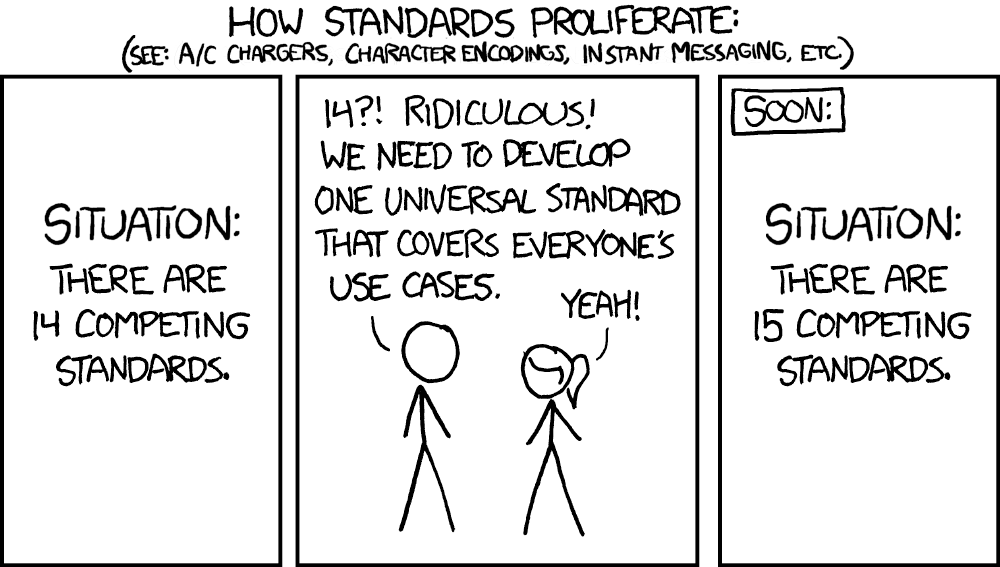
the xkcd comic about how standards proliferate
xkcd: Standards

Listen. Everyone hates the six-score array. It sucks, and the history of non-D&D RPGs is practically a history of variants of the array and its uses. There are plenty of theoretical issues to raise with the standard six. However, here are three problems only the worst pedant would have with it:

  • The canonical order of the abilities is not alphabetical.
  • Two abilities share an initial letter.
  • There is no mnemonic device for the abilities.

I propose to solve these (and really, only these) problems with the ADEPT array:

Sunday, January 7, 2024

3eish: combat

Blogger ate a draft of this post and I'm not pleased about it. I realize I've posted ideas along these lines before, but here are the versions I like the best now.

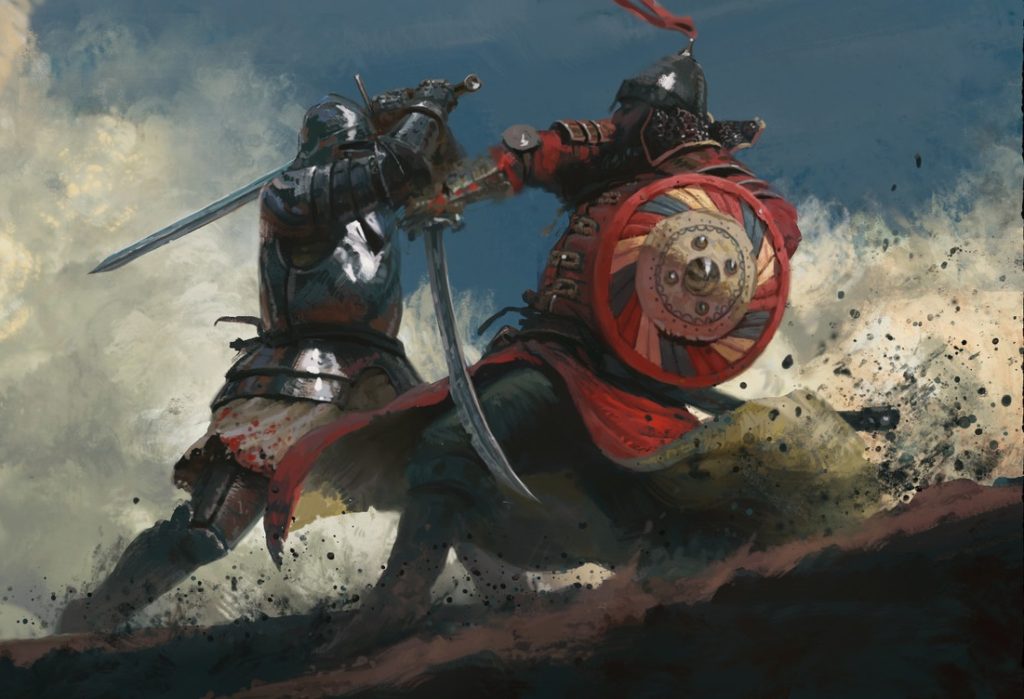
two warriors in armor fighting
Artist: Simon Gocal

Action

Surprised figures do not move or act during the first round that they join combat. Otherwise, the adventurers and their enemies move and act in alternate phases:

  1. Enemies move
  2. Adventurers move & act
  3. Enemies act
  4. Attacks are resolved

A figure's movement ends if they enter the reach of a foe that can act. If they start within its reach, their movement is limited to one inch.

A figure's movement depends on the load they are carrying. A burdened figure may move twice their Size (in inches, scale TBD), one in heavy kit may move three times their Size and one in light kit may move four times their Size. If a burdened figure moves more than their Size, on an unburdened one twice their Size, they may not act.

A figure may drop what they are holding, or drop into a kneel (-1 Size) or to the ground (-2 Size) freely. Instead of movement, a figure may:

  • Concentrate on magic
  • Draw or stow an item
  • Open or close a door
  • Stand from a kneel
  • Take aim

Or similar things; otherwise, these are all actions. Standing from the ground allows only one inch of movement and no other actions.

Attacking

An attacker states their aim, for example, draw out, disarm, push back, restrain, seize, throw or wound. Then, they make their roll and add +1 for every 4HP they currently have. Subtract 4 if they are fighting in an awkward or unfamiliar manner. Then apply situational modifiers:

  • In hand-to-hand, apply the attacker's Strength modifier. Add +2 if the target was attacked by another this round.
  • Fighting at reach, apply the attacker's Dexterity modifier. Add +2 if the target entered the attacker's reach this round.
  • Shooting at range, apply the attacker's Intelligence modifier. Add +2 if the target has not moved this round.

Attacks at range are resolved first, followed by attacks at reach in descending order of reach and finally by hand-to-hand attacks.

An attack succeeds if the modified roll is at least equal to the target's defense. This has two components. A figure's dodge is 3 plus their Wisdom modifier. A figure's protection is 3, plus one for every layers of armor, source of cover or increment of the target's Size (in inches) between the attacker and target.

  • When taking cover or other defensive action, defense is dodge + three times protection.
  • Otherwise, when able to act, defense is dodge + two times protection.
  • Otherwise, defense is two times protection.

If the attack is successful, the attacker rolls damage based on their own Size. 

Example Size Die Type
cat 0 d2
fairy, monkey 1 d2
dog, elf 2 d4
deer, man 3 d6
horse, thark 4 d8
ogre, rhinoceros 5 d10
elephant, giant 6 d12
dragon 7 d20

The target may choose to either lose that many HP (if they have that many) or accept the aim of the attack.

Odd attack rolls fail against targets that are concealed from their attackers. If the target is totally concealed, the attacker must have some way of discerning their exact position before attempting an attack in the first place.

Wounding

When a figure is wounded, the severity of the wound depends on how much the damage exceeds their current HP. For these purposes, subtract 2 from the damage of bare fists or feet. A wounded figure makes a saving throw, adding their Constitution modifier.

Excess Wound DC Success Failure
2 or less Light 12 Fine Unconscious
3 to 5 Serious 15 Unconscious Dying
6 or more Critical 18 Dying Dead

A dying character will die if their wound is not treated within a few minutes. An unconscious character may make another save within a few minutes to come to, otherwise they remain out for a few hours.

Saturday, January 6, 2024

3eish: what's a level

Theoryposting, maybe I'll get to the point of concrete details by the end of this post, maybe I won't.

Artist: Tennis Cramer

So, my goal of 3eish is to make something that feels like 3e to me, while also keeping it light enough to hold the whole thing in mind and play fast and easy. Can't get rid of levels without it starting to feel like something else entirely so it's worth asking: what's a level. In 3e there are a couple clear answers:

  • One HD.
  • 1, 3/4 or 1/2 a point of BAB
  • 8, 6, 4, 2 + Int skill points
  • 1/2 or 1/3 a point of each saving throw
  • 1/4 of an one-point improvement to an ability score (1/8 of a one-point improvement to its modifier)
  • 1/3 of a feat and some class features
  • various scaling on spells you cast

There are some rationalizations that suggest themselves, like making attack bonus or saving throws a part of the skill system, but I've been down most of those design roads at this point and most of them wind up reinventing RuneQuest. So instead I'm going to reinvent True20; a level is a feat and one HD and everything else falls out of that.

Let's nail that down somewhat:

  • As in the base rules, the benchmark for a boring feat is that it applies +2 on two different kinds of rolls. 
    • Boring feats (that only add bonuses to rolls) are now called skills and can be taken multiple times. This replace the skill list and save progressions; if a character does not have any skills that apply to a saving roll, they use 1/3 their level as a bonus.
    • Obviously not all feats are boring ones. The ones that grant more interesting abilities can generally only be taken once.
  • Each feat specifies an amount of HP (2, 3 or 4) gained when you take it. If you're proficient with it, add +1 to an attack roll for every 4HP you currently have. If you're not proficient, apply a -3 penalty.
    • Abilities for combat add 4HP.
    • Skills and miscellaneous abilities add 3HP.
    • Magic abilities adds 2HP.

You may notice there's no real purpose left for classes. That's probably for the best, let's lose them. Carve out their interesting bits into feats and leave the rest.

One-feat character creation is probably too bare to be fun. Instead we'll have two-feat character creation (truly, I have a dizzying intellect). There's a special set of feats called backgrounds, and you pick two of them to start. Your starting HP is 4 if both of them have experience with violence, 3 if one does and 2 otherwise.

The 3e PHB had 7 races and 11 classes, so for parity with its 77 combinations a pool of backgrounds would need...a pool of 14 backgrounds (14 choose 2 is 91, fourteen more combinations for a pool with three fewer elements). Now that's of course not the full range of customization of a 1st level 3e character but it's close enough for my purposes.

Tuesday, January 2, 2024

the great humanoid relative size survey

comparative height chart of 5e races
Artist: Jay Robinson

There has been some interest in the purple OSR discord about what the relative sizes of various fantasy humanoids should be. I decided to make a quick survey asking people to size them on a scale from 0-10 with humans at 5 and send it around, and managed to collect 79 responses at the time of writing (though I exclude the response at 12/12/2023 14:44:45 from analysis as an outlier).

I'm just gonna do what seems most obvious to me and look at numerical averages, plus or minus one standard deviation:

Name Avg Stdev Minus Plus Dev Geq Man
Hobbit 2.68 0.64 2.04 3.32 -3.63
Fairy 0.76 1.19 -0.43 1.95 -3.56
Goblin 2.76 0.7 2.06 3.46 -3.2
Gnome 2.25 1.01 1.24 3.26 -2.72
Dwarf 3.5 0.71 2.79 4.21 -2.11
Kobold 2.58 1.25 1.33 3.83 -1.94
Ratfolk 3.26 1.07 2.19 4.33 -1.63
Faun 3.99 1.15 2.84 5.14 -0.88
Nymph 4.36 1.21 3.15 5.57 -0.53
Morlock 4.43 1.14 3.29 5.57 -0.5
Hobgoblin 4.72 1.2 3.52 5.92 -0.23
Half-elf 5 0.37 4.63 5.37 0
Human 5 0 5 5 0
Different Elf 5.11 1.66 3.45 6.77 0.07
Elf 5.16 0.97 4.19 6.13 0.16
Gnoll 5.43 1.33 4.1 6.76 0.32
Merfolk 5.33 0.78 4.55 6.11 0.42
Lizardfolk 5.5 0.93 4.57 6.43 0.54
Half-orc 5.54 0.65 4.89 6.19 0.83
Orc 5.94 0.72 5.22 6.66 1.31
Wolfman 6.05 0.78 5.27 6.83 1.35
Bugbear 6.65 1.22 5.43 7.87 1.35
Troll 7.64 0.86 6.78 8.5 3.07
Ogre 7.8 0.82 6.98 8.62 3.41
Ent 9.17 0.88 8.29 10.05 4.74

Dev Geq Man means the number of standard deviations between the average response and 5, the size of a human being. Now, let's just make a couple of observations:

  • About 72% of respondents indicated that Elves are human-sized or larger.
  • Trolls, Ogres and Ents are very large, three or four standard deviations above puny humans. Orcs, Wolfmen and Bugbears are somewhat large, at least one standard deviation above man.
  • Hobbits, Fairies and Goblins are very small, three standard deviations below humans. Note that there's also a strong consensus that fairies are smaller, but goblins are about the same size as hobbits. Gnomes, Dwarves, Kobolds and Ratfolk are also small, one or two standard deviations below humans.
  • Fauns, Nymphs, Morlocks, Hobgoblins, Half-elves, Elves, Different Elves, Gnolls, Merfolk, Lizardfolk and Half-orcs are all on average within one standard deviation of humans.
  • There is the least consensus on the size of Different Elves, which is unsurprising as that category is kind of just a joke about how many kinds of elves there are. Seventy-five percent of they 68 respondents who gave a size for "Elf, but Different (TM)" gave a size equal to or greater than they gave for Elf. They are followed, in uncertainty, by Kobolds, Bugbears, Nymphs, Fauns, Morlocks and Ratfolk.

Now, there is considerable overlap between most of these categories if standard deviations are included. Some of the categories that do not overlap (that is, their averages differ by at least the sum of their standard deviations) are:

  • Fairies are smaller than all but Gnomes and Kobolds.
  • Goblins are smaller than Hobgoblins.
  • Orcs are smaller than Trolls, but not necessarily smaller than Bugbears.
  • Ogres and Ents are larger than all but Bugbears and Trolls.

I don't think there are any great mysteries being revealed here, but I hope you enjoyed reading it. Please note that while I may have majored in math, I never took a statistics class. If you have a better handle on analyzing this kind of data, please try your hand at it.

Thursday, December 28, 2023

cultural proficiencies: a modest proposal

The idea here is that "martial weapons" refers to the type of weapons used by the warriors of a given culture rather than just "weapons that are good."


Everyone can add their base attack bonus/proficiency bonus to attacks with a crossbow (2H 1d8, loading), dagger (2d4 in a grapple, 1d4 otherwise) or one-handed tool (1d6) such as a cleaver, hammer, hand axe, etc.


Fighters are proficient with the weapons of their culture. Other martial classes may have specific weapon groups associated with them. You can learn a group (or a specific exotic weapon) as a feat if you have a teacher.

  • Northern men: battle-axe (1H 1d8 or 2H 1d10), saex (1H 1d8) and thrown hand-axe.
  • Paladins and Eastern men: mace (1H 1d8), thrusting spear and arming sword (both 1H 1d8 or 2H 1d10).
  • Southern men: thrown or thrusting spear (1H/thrown 1d8 or 2H 1d10) and gladius (1H 1d8).
  • Elves, Rangers and Western men: self bow (2H 1d8), thrusting sword (1H, 1d8 finesse).
  • Dwarves: battle-axe and war-hammer (both 1H 1d8 or 2H 1d10). 
  • Barbarians and Goblins: mace, saber (both 1H 1d8) and composite bow (2H 1d8 ranged).

Attacks with these weapons are not usually penalized if you are not proficient. Attacks with exotic weapons are at a -3 penalty for the non-proficient.

Friday, December 22, 2023

spirit masters

Being psionics rules, because I've been reading the Saga of the Pliocene Exile and realized some specific debts that the 3e Psionics Handbook owes to it.

These assume you're using a standard six-attribute score array and that modifiers are on the "one-third score minus 3" schedule, and might need adjusted if you're using the WotC "half score minus 5" schedule.

a smiling man's face surrounded by a glowing halo in front of a starfield
Artist: Stephen Fabian, cover of The Adversary by Julian May

The human spirit is capable of marvelous things when properly disciplined. Masters speak of five awakened faculties, each of which has several modes.

  • Spirit Manifestation of energy, illusions and even substance. Associated with Dexterity.
  • Spirit Transportation of creatures and objects. Associated with Constitution.
  • Spirit Probing of other minds and spirits. Associated with Intelligence.
  • Spirit Discernment beings, surroundings or thoughts without the use of the senses. Associated with Wisdom.
  • Spirit Binding the bodily and spiritual faculties of others. Associated with Charisma.

Spirit Masters (HP, saves & advancement as magic-users) are always awakened, but any character has a chance to be equal to the sum of their attribute penalties in 20. Awakened characters start with two modes they are able to use. Masters learn an additional mode for every odd-numbered level they have.

Using spirit powers is taxing. Each use of a power costs energy (= encumbrance slots until next night's rest, or 1d4HP if no slots remain); however Spirit Masters have reserves of energy equal to their level to use each day without fatiguing themselves. Characters can only use modes in faculties if they have a positive bonus in its associated attribute. Furthermore, they cannot spend more energy in any mode than their their bonus in its associated attribute or half their Spirit Master level, whichever is higher.

Mental Contact

A spirit or awakened character can make mental contact with an intelligent being by touching it, making eye contact or speaking its name in its hearing. Characters in mental contact may bespeak one another, mind-to-mind, even if they do not share a language. Most creatures cannot bespeak anything that they believe to be false.

Being in mental contact is not without risks. All binding and probing modes require mental contact. Awakened characters with these modes are aware of all attempts to make contact with them while they are conscious, and can use them to refuse contact. 

To force contact, an awakened character must roll 1d20 + the attribute bonus of their mode + energy used on it and reach a target number based on the type of mode they are using and the mode of defense chosen:

  • Defensive binding walls off the mind behind a fortress-like wall. A probe must beat a 9, binding a 12 and discernment a 15.
  • Defensive discernment allows the mind to drift on the wind, evading contact. A binding must beat a 9, discernment a 12 and probe a 15.
  • Defensive probing leaves nothing to hold on to in an empty mind. A discernment must beat a 9, probe a 12 and binding a 15.

The aggressor always spends their energy, but the defender only does if they repel contact. 

If contact is made, characters still get a will save (vs spells) to resist the effect of a hostile mode. Awakened characters who make the roll may break contact.

Mode Descriptions

Unless otherwise noted, modes last for minutes equal to the associated attribute.

Binding Modes

  • Disable (1) — target cannot use a language, limb or sense of your choice for a few minutes.
  • Coerce (2, requires Disable) — target cannot take any action or speak any words (your choice which) except the one you designate as long as you maintain concentration. They may choose to remain still/silent.
  • Lock (2, requires Disable) — target cannot use any awakened faculties.
  • Puppet (2/3, requires Coerce) — your spirit enters an otherwise inanimate/living body which you control as if it were your own. Until you return to your own body by touching it, it will lose 1HP every sunset or sunrise.
  • Drain (*) — the target loses 2d4 HP and you gain the total, minus one, in energy until sunset or sunrise. If the target saves or fends off contact, you lose 2 energy instead.

Discernment Modes

  • Mass Sense (1) — extends through a few dozen yards through open air, a yard of earth a or an inch of stone or wood. As long as you concentrate, you are aware of the placement, shapes and sizes of all solid bodies therein.
    • Every additional point of energy you are able to spend on discernment powers doubles these ranges.
  • Mind Sense (1) — as mass sense, but instead gives awareness of minds and whatever most occupies their attention. Mental contact may be made with all, some or none of them, at your discretion.
  • Project (1/2/3, requires Mass or Mind Sense) — your sense of presence travels from your body as a disembodied spirit, up to 2/5/18 miles. Until you find and return to your body, you may travel through open air at the speed of thought, but 
    • your body lies unconscious at takes 1 point of damage with every sunrise and sunset.
    • you do not regain any energy.
    • may only pass a threshold if the house is abandoned or you have slept within.
  • Consult (2) — you reveal whether a single question can be definitely answered. 
  • Divine (2d4) — finds a short, true answer to a single question. If the question has no definite answer, you instead take the energy cost in damage.

Manifestation Modes 

  • Bolt (1+) — throws an arc of energy at one nearby target, dealing 2d6 damage for each point of energy. A reflex save [vs breath] halves the damage.
  • Glamor (1) — creates sense-displays for anyone in mental contact with you. While you concentrate, these otherworldly sensations are limited only by your imagination.
  • Radiance (1/2/3) — a soft glow provides light (as twilight) and heat for 5/10/20 nearby people until the next sunrise or sunset. You may gather it together into a bright blaze that cooks food for (or deals 1d6 damage/round to) that many people over 2d4 rounds, though this ends the effect.
  • Figment (2, requires Glamor) — creates an independent phantom for any two senses of your choice. Unlike a Glamor, this mode does not require mental contact or concentration, and the phantom can be detected by ordinary recording equipment.
  • Substance (3+, requires Figment and a transport mode) — creates up to sixteen pounds of earth, stone or water, four pounds of horn, leather or wood, one pound of base metal or four ounces of precious metal for every point of energy spent, which evaporates with sunrise or sunset. Creatures who consume the substance take no ill effect but their hunger or thirst returns when it disappears.
  • Construct (3, requires Figment and a probing mode) — you create a phantom, perceptible to all senses and recording devices. Until sunrise or sunset, it will follow up to three instructions you give it, which can be conditional or to be carried out in sequence. The phantom can move as fast as a bird through the open air, but cannot cross a threshold unless the house is abandoned or you have slept therein. 
a woman stands with a spear, eyes glowing as a implike shape takes form in the air before her
Artist: Sam Wood, Manifesting a Metacreativity Power

Probing Modes

  • Search (1/2) — if a a particular conscious/unconscious memory that you describe exists within the target's mind, you may re-experience it together.
  • Publish (1) — you place a memory or set of memories at the forefront of your mind, so that anyone who could make mental contact with you (even if they have not) can examine it.
  • Redact (2, requires Search) — submerges a conscious memory into the target's unconscious. When given a strong trigger of the memory, they may make a will save (vs spells) to regain it.
  • Balance (1/2/3) — neutralizes one emotion/wound/disease affecting the character. Balancing emotions calms the target and may allow a reaction to be rerolled. Balancing a wound or disease allows recovery as an additional day of rest would.
  • Program (+1 to any a binding mode) — you program up to three triggering situations to activate in those situations. For a number of days equal to your Intelligence, if those situations occur, the target is affected by the mode.
  • Subtlety (+1) — the target of your mode believes its effects are natural or come from within, rather than being a foreign influence, if they fail their save.

Transportation Modes

  • Float (1+) — makes a total mass you designate of about your bodyweight float lazily through the air at your command within a few dozen yards as long as you concentrate on it. Each additional point of energy doubles the range and increases the mass eightfold.
  • Impulse (1+) — something up to an eighth of your bodyweight a few dozen yards (and half as high into the air). Each additional point of energy increases the mass you can move eightfold; smaller masses fly commensurately farther, but take (and deal, to whatever they strike) damage as from a Bolt of the excess energy.
  • Atmosphere (1/2) — stills/creates winds for a few dozen yards around you as long as you concentrate on it. Keeps the rain off, if you wish to.
    • As with Mass/Mind Sense, every additional point of energy that you are able to spend on this power doubles its range for the same cost.
  • Support (Float +1) — rather than floating through the air, creatures in mental contact with you can run through the air as though solid ground existed wherever they wished to step.
  • Forceful (+1) — the target loses 1 (more) energy whether or not they make their save or fend off contact.

a golden figure levitates over an army of fantastically armored warriors
Artist: Michael Whelan, cover of The Golden Torc by Julian May
Mental Concert

Awakened characters may pool their faculties and act in concert. To form a concert, the characters must between them use the Mind Sense discernment, Drain binding and Balance probing modes. Everyone in mental contact with them may pool all the energy they have to contribute and place it in the hands of one character who acts as conductor. Then increase that pool by one-third. After the concert, reduce the pool by a quarter and redistribute remaining energy to the characters as the conductor wishes.

Total up the maximum energy each character in the concert could spend on each faculty; for every time that this doubles the conductor's allowance (or if the conductor has none for that faculty), increase their allowance by 1 for the duration of the concert.

three adventurers stand, manifesting a swirling vortex of colorful energy above their heads
Artist: Wayne Reynolds, Metaconcert

Monday, December 18, 2023

talent, time and tools

Being a universal 2d6 resolution mechanic and some extra bits.

An attempt succeeds if a roll of 2d6 is at least equal to the required target number:

  • You have an appropriate talent, time and tool: 5
  • You are missing one of those: 6
  • You are missing two of those: 7
  • You have none of those: 8

A roll of 10+ (regardless of target number) is a clean success. A particularly stressful situation may require a clean success to avoid costs or complications.

Talents

Create a character by giving them 2-3 traits or skills and however many talents your Referee finds appropriate. 

If you don't start with a talent you must:

  • Practice for a season with a skilled teacher or three seasons on your own for the archery, climbing, thievery or any weaponry talents.
  • Slay three armed foes by your own hand for the fighting talent.
  • Become initiated into the inner mysteries of a cult for its ritual talent.
  • Survive ten days in the bush without aid or supplies for the wilderness talent for those environs.

Combat

Talent. The fighting talent is for hand-to-hand or hand weapons and the archery talent for bows. No talent is required for crossbows or guns. Weaponry talents do not affect the target number of attacks, but they allow the attacker to use any special properties of the weapon.

Time. You have time if the target is surprised. 

Tools. Close weapons for hand-to-hand and non-close weapons otherwise.

An armed attacker gets +1 to their roll if their target is unarmed. A character with a longer weapon than their opponent starts with a +1 advantage to their attacks, but a clean success seizes the advantage from one's target (or seizes it back).

In hand-to-hand, a clean success damages, disarms, pins or throws one's target. Otherwise, success merely holds them. A held character may do any of those to their opponent with a clean success. Otherwise, success reverses the hold. Any success by the holding character may damage, disarm, pin or throw the other.

Magic Rituals

Magic rituals are done with one roll but involve a sequence of steps. Some might require all of the following, and some only one or two:

  1. Guarding the space
  2. Guarding the magician
  3. Opening the way
  4. Fixing the terms
  5. Closing the way
  6. Purifying the magician
  7. Purifying the space

Talent. Each cult has its own path of rituals, any its ritual magic talent counts for any ritual on that path. Anyone with such a talent is aware of the presence of other talented magicians and of powerful spirits, and may address them mind-to-mind.

Time. Rituals of 1-2 steps take 10 minutes, minus one for every time the size of the group of magicians doubles. Each additional step doubles the time required.

Tools. Guarding or purifying magicians requires oils or potions for each. Guarding or purifying the space require candles, diagrams or smoke to fill it. Opening the way requires an arcane connection to the recipient of the power. Fixing the terms requires a symbol of what is to be done. Closing the way requires a symbolic weapon.

If the power invoked by a ritual is an intelligent spirit, a clean success is needed to avoid some additional price being demanded. Offering a sacrifice adds +1 to a ritual roll to deal with a spirit, or +2 if the sacrifice is extremely dear.


one roll, one choice

 FMC Basic does away with ability scores (quite rightly!), but you might still want something of the sort. But we're doing one roll, one choice. 

Roll 1d20:

  1. strong, fast, tough
  2. strong, fast, smart
  3. strong, fast, wise
  4. strong, fast, charming
  5. strong, tough, smart
  6. strong, tough, wise
  7. strong, tough, charming
  8. strong, smart, wise
  9. strong, smart, charming
  10. strong, wise, charming
  11. fast, tough, smart
  12. fast, tough, wise
  13. fast, tough, charming
  14. fast, smart, wise
  15. fast, smart, charming
  16. fast, wise, charming
  17. tough, smart, wise
  18. tough, smart, charming
  19. tough, wise, charming
  20. smart, wise, charming
Keep two; the other becomes a flaw. 
  • Strong characters deal +1 physical damage. Weak characters can't tempt fate to force doors, jump gaps, or the like.
  • Fast characters get +1 on attack rolls. Clumsy characters can't tempt fate to go before their foes.
  • Tough characters get +2 HP. Sickly characters can't tempt fate to resist poison, avoid disease or the like.
  • Smart characters get +1 capacity. Dull characters have -1 capacity.
  • Wise characters get +1 defense if they are not surprised. Foolish characters are still surprised if their party tempted fate to avoid it.
  • Charming characters can re-roll a negotiation roll; if it changes from negative to affirmative there will be some additional quid pro quo. Off-putting characters must tempt fate to avoid making a bad impression when meeting someone new.

Tuesday, November 21, 2023

heralds and little guys for FMC basic


I absolutely love FMC Basic by Marcia B. It's as beautiful for everything it leaves on the cutting room floor as everything that it includes. That said, here's a cleric and two demi-humans it intentionally omitted.

Friday, November 10, 2023

fantastic journeys, powered by BIRG

This is a hack of TFT and, to a lesser extent, GURPS. The main novelties are in the readiness/experience rules and in the injury and recovery rules. It's not quite complete, there's no list of skills or special abilities, but I think it's enough to share. Use your favorite list of skills and make up abilities if you want.

Characters have three attributes:

  • Dexterity (DX), used for physical rolls
  • Strength (ST), used for endurance and overpowering
  • Wits (WT), used for mental rolls.
Human characters have a minimum of 8 in each attribute.

Characters succeed at difficult tasks if a roll of 4d is less than or equal to their adjusted attribute. If they have a skill specific to the task, they roll 3d instead. A roll of 4 or less always succeeds, even if the attribute is adjusted to lower than this.

If two characters are directly opposed, they both make rolls. If both would succeed, the character with the higher roll does. On an exact tie, or if both fail, they are in a deadlock.

Wednesday, November 8, 2023

a brief "history" of d&d, 1980-2000

(This post is fiction and not history.)

Dave Arneson's 1980 lawsuit goes to court, and Arneson is awarded not only great deal of back royalties but some damages as well. The legal battle and debt compound TSR's other financial problems and and the fledgeling company go bankrupt in late 1982. Moldvay's Basic Set is published late, and Cook's Expert Set never is.

Gygax and the Blumes spend 1983 unsuccessfully shopping the company around for a buyout. Arneson, as one of TSR's creditors, negotiates for Cook and his unpublished expert materials to be released to his company, Adventure Games.

When the "Dungeons and Dragons" trademark lapses in 1984, grimoire games, desperate to sell to a wider audience, republishes its Arduin material as Grimoire Dungeons and Dragons, not as "the Arduin Adventure." The game is a success and saves the company from bankruptcy.

Monday, February 6, 2023

towards a medieval "brown stone" game

Note: this is not an earnest attempt to recreate any game that was played in the Twin Cities in 1971. It is just something that I threw together based on one explanation I have seen of the (poor quality and contradictory) evidence of how combat in that game worked.

These are incomplete, I basically just wrote and edited until I ran out of steam but I think it'd be enough to start playing. 

I didn't include any Referee's guidance for timekeeping or reactions or things like that, just do your best I guess.

Rules Brief for Players

The game is about a companies of adventurers going on expeditions into strange mazes and uncanny places to find their secrets and treasures. These expeditions are dangerous; adventurers may well die. If they survive, however, their fame and power will grow...

Advice:

  • If you don't know what to do, ask questions.
  • Tell the others what you want to do.
  • The Referee won't lie to you, but they may not tell you everything.
  • There aren't rules for everything. If you make a good play, you won't need to roll any dice.
  • If you fight, someone will get hurt. It could very well be you.

Adventurers usually go on expedition in large companies, to have the advantage of numbers. Each player can have a few different characters in the company.