Wednesday, March 31, 2021

a linguistic anthropology of fantasy folk

The nice thing about fantasy races is that they give character creation choices with a good degree of granularity and comprehensibility and are a neat way to pull folkloric material into your game. The bad thing about them is that they mean that race science (that is, the false belief that races as understood by society correspond to biologically distinct types of human beings) is true in your fantasy world.

Honestly, the bad part is bad enough to completely sink the goodness of the good part.

This is another in my ongoing struggle to formulate different fantasy folk in a way that isn't race science, but emphasizing the ways that real people saw themselves and others, particularly before the race-scientific idea became prominent in the modern era.

The problem with making things nuanced is that also makes them complicated; race science is conceptually pretty straightforward, which makes it very game-able. Trying to embed fantasy folk in a realistically nuanced web of relationships with each other also buries the conceptual clarity of a player looking at the list of options and saying, "I'm going to play an elf, that means I live in the woods and don't particularly like dwarfs." One runs the risk of overloading the player with world-building, particularly if one chooses to foreground linguistic groups which are among the more salient in-universe distinctions between peoples.

I'm far from a solution to this, but my current idea is to use somewhat-transparent names for languages (or groups of languages) wherever possible, and doing as little "hard" worldbuilding as possible to keep things relatively setting-neutral, while still keeping things complex enough to stop collapsing into the fail state of race science. It's a tall order, let's see how I do.

When making a character, you must choose a people for them to belong to (or at least stem from). A people is defined by a language, a way of life and an alignment, all of which affect how they see themselves and the world.

To make this your own, you only have to identify the peoples in your setting, their languages, ways of life and alignments. You may choose to give every people a distinct ethnonym; I'm not doing this so as not to overload a player with unfamiliar names. Instead, I'm going to organize peoples by language family, grouping setting languages together into four groups (middling, rhuno-buggish, sylvene and foreigner), the first three of which correspond to actual language families. Each family contains a number of peoples with different ways of life and dramatically different outlooks on the world and their place in it.

Monday, March 15, 2021

"correcting" weapon vs armor type from chainmail

Delta recently wrote an excellent post analyzing the origin of the Greyhawk/AD&D weapon vs armor type table and concluding (rightly, in my view) that it is fundamentally flawed. I just wanted to offer a few follow-up analyses of ways that one could try to "correct" the modifiers in there.

Putting the tables below the break.

Friday, March 12, 2021

some game economics for the ancient world

Before launching into a long post about economics of the ancient world, let's put the exciting part at the top, the random treasure hoard generator. These are going to be significantly smaller than typical fantasy adventure hoards, but I've tried to callibrate them to generate the kidns of hoards people actually find from the bronze and iron ages:

Now, for the less flashy stuff. Before we can really talk about economics, let's establish some units of measurement. These are going to be largely based on historical units of mesopotamia and the eastern mediterannean in antiquity. My sources are kind of all over the place on these so I'm not going to be citing much, but the system I'm giving here hews pretty close to the coins and measures used in Talmudic literature.

A talent (kikar, if you prefer) weighs sixty pounds (maneh), each of which is fifty weights (shekel) of about eight and a half grams; this makes a pound of about 425 grams rather than the 453.59 of the avoirdupois pound, but that's close enough to use the familiar word in my book. A wet measure or dry measure are both a unit of capacity approximately equal to 144 medium-sized eggs (about nine quarts).

goods and their prices

The basic unit of money is a weight of silver. Although actual prices vary by place and season, most people will say that a silverweight should buy:

Wednesday, March 10, 2021

solo dungeoning experiment

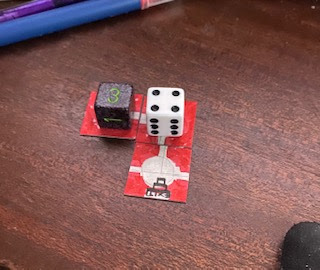
I have done very little actual dungeon crawling in my gaming career. I have also done basically no solo gaming, so I was inspired to try to get a feel for both things in a more practical and less theoretical way. So, I made myself some dungeon tiles:

I decided to fill in the empty spaces red after I took this. Passages (round) have about a 1 in four chance of traps and a 3-in-8 chance of being the sometime abode of monsters. Most of the treasure (triangles) is in the larger chambers (square) which are much more likely to contain monsters. And I adopted a probably absurdly basic dungeon crawling procedure:

  • For every new tile, roll two distinct dice. If there's a random chance of something bad, that's keyed off the darker die. If there's a random chance of something good, it's keyed off the lighter die. Doubles mean wandering monster.
  • If part of a larger chamber is drawn, draw more chamber pieces until the chamber is complete. If there are multiple keyed things in the chamber check separately for each.
  • When a monster is indicated, roll a die: 1-2, their strength is 1 per monster, 3-5 it's 2 per monster and 6 it's 3. Another die indicates number, divided by strength (round up).
  • In a fight, every 2 companions or 1 fighter adds a die. Monsters roll their total strength in dice. Every die hits on 2-in-6 and a hit figure can save on 2-in-6 or die. If you want to escape from the fight roll your opponent's strength or better on two dice.
  • A triggered trap hits one figure, who can save or die.
  • If you find the magic fountain, you can wish. Roll a game of craps; if you win, you get your wish and if you lose a water demon (1x4, takes two hits to kill) attacks you.

With that established, I set about dungeon crawling. We set out with two fighters and four companions. Not all of us would escape the dangers of the dungeon.

  1. From the exit we went North to an empty passage.
  2. West, we encountered wandering monsters (1x3) whom we defeated without a loss.

  3. North, the passage was trapped but we evaded it.
  4. North, an empty passage.
  5. North, a chamber opened before us with monsters (2x3) but no treasure.
    We fled (6+ on 2d6) and escaped back down the passage, evading the trap again.
  6. Returning to the exit, we struck East, where a chamber opened again containing monsters (2x3) but no treasure. We chose to fight, took down one of them but lost three of our companions, then fled (4+ on 2d6).
  7. West of the exit is the only way left, where we lost our last companion to a trap. Foolishly, we pressed on.
  8. South, there was a chance of a monster but none was present.
  9. East, an empty passage.
  10. East...a magic fountain! We chose to wish, and were immediately rewarded. Being sentimental, we wished our friends back to life. Then, feeling confident again, we pressed on.
  11. Returning West and then South, we found monsters (2x2) lying in wait.
    We dispatched them with no losses.
  12. East, more monsters (4x1).
    We fought and defeated them, but they killed all our companions (who had only just been returned to life).
  13. South, empty passages.
  14. East, more of the same.
  15. East...a trap! Which killed one of our fighters.
  16. North, nothing.
  17. East, we found an alcove with a bit of unguarded treasure!
    Now all that remained was to evade the two traps encountered on the way over (which our last fighter did) and finally to escape the dungeon with a bit of loot (but five dead friends...)

I'm not sure what my reflections on this experiment should be. It was pretty fun, but in the future I probably wouldn't document with photos since that took me out of the game a fair bit. 

  • The combat worked, I think, but monsters are probably a bit too strong, perhaps monsters with 1/2 (companion), 1 and 2 strength would even things out somewhat. Probably also include a wizard who can toss +2 dice onto a round a limited number of times.
  • Using some sort of reaction or negotiation options rather than automatic hostility would be good too. 
  • Traps felt...ok? I liked the danger of knowing we had to backtrack past them, but losing party members to traps felt kind of arbitrary.
  • I liked the wish, although I had not decided when I included it what things could be wished ofr. Having more random magic in the game would be fun.

Wednesday, February 24, 2021

the earthwife and the termagant

Continuing to muck about with my GLOG/echo, I wrote two classes that tie in with the fair and fell ancestries. Gaining lots as an earthwife represents growing closer to the elemental world to the exclusiong of the civilized one, while gaining lots as a termagant represents gaining magical power at the cost of your social graces.

Both are three-level classes, and both have decreasing-dice mechanics inspired by The Oblidisideryptch's excellent druid. The termagant's abilities were lifted from Rise Up Comus's Dwarf class.

  • Earthwife (fair ancestral class)
    1. You cannot tolerate anything of base metal upon your person, but can speak heart-to-heart with any living thing. Plants and animals will attempt to do as you bid, though not contrarily to their natures. This roll has no goals; the dangers are not reaching what you cannot touch with your limbs, not reaching more than you could bear on your shoulders and not conveying more than flashes of raw sense information.
    2. You cannot tolerate spun fibers upon your person, but may speak heart-to-heart with earth and stone, which tell you what they know of old or bestir and rearrange themselves for you. When you speak with living things you may disregard one danger.
    3. You cannot use common nouns; though you may use or give proper nouns to specific things, you must otherwise describe whatever you refer to obliquely. You may speak heart-to-heart with bodies of water to learn nearly anything you wish to know or ask them to bar your enemies or save your friends. When you speak to earth and stone you may disregard one danger, and when you speak to living things you may disregard two.
  • Termagant (fell ancestral class)
    1. You gain two useful magic items chosen by the Referee. When slighted or wronged at all, you roll for the goals of not complaining, not demanding recompense and not holding a grudge. Keep a list of every grudge and strike names from the list only if they suffer a greater loss.
    2. Once in your life, you may withdraw from worldly affairs for a time and emerge with a powerful magic item you wrought. Work with the Referee to determine the nature of this item. When slighted or wronged, you may only roll for two goals.
    3. Magic, friendly or malign, can no longer affect you. If any of your hair is cut or dressed, you lose this protection until it grows knotted and tangled again. When slighted or wronged, you may only roll for one goal.

Monday, February 22, 2021

unified levels

In my opinion, one of the more interesting things D&D 3e did was treat monster HD/type somewhat like the classes for player characters. Understandably, this was closest to the surface when discussing the possibility of adventuring as a monster. Level adjustment meant that a monstrous character was treated as one or more levels higher than their class level for the purpose of how much experience they needed to reach the next level.

When Savage Species was written, that concept got significantly expanded by the inclusion of monster classes. One could start your career as a stripped-down version of a monster on par (in theory) with other level 1 characters, and gradually gain their more powerful and iconic abilities. However, this still needed a separate class for each monster type and it didn't expose the mechanical guts of how monsters and characters ticked.

What follows is an attempt to do unify monster and character building by giving each an "ordinary track" that governs more mundane advancement, here Nerve (aka Hit) Dice, and optional multi-classing into "extraordinary tracks" that grant special abilities.

A lizardman engaged in combat with a human warrior. David Sutherland (1977).

Tuesday, February 16, 2021

hazarding a tale

rule

Whenever a rogue is in dire enough straights, they can hazard a tale appropriate to their current peril. You may not hazard the same tale that someone else has already proved for themselves. After naming your tale, throw two dice:

  • A throw of 2,7 or 12 proves the tale is true. It becomes a permanent part of your character (retroactively if necessary) and they escape the peril.
  • A throw of 3 or 11 calls out your character for a liar and they'll just have to deal with the situation like everyone else.
  • Otherwise, the tale remains to be proven; record the throw next to the tale. The peril remains

While a tale remains to be proven, the Referee can occasionally put it to the test by rolling again; the tale is proven when the original throw is thrown again, but a throw of 7 before then calls it out for a lie.

A poker player tossing chips forwards. I know that this is a dice not a cards mechanic, ok, there just weren't good pictures of people shooting dice that made it clear what was going on.

why?

I have a great love for the way the Far Traveler and the Zouave inject a checkered past into a character. If I could find a fault with those classes it's that I'd like to have that sort of thing continue throughout their adventuring career. I wrote the mechanic for specifically roguish characters (it's what I'd use for the core mechanic of a rogue class), but in a more generally picaresque game it may make sense to have it open to all characters.

A list of example tall tales follows. It's not meant to be exhaustive, players are certainly welcome to make up new tales, but this should do to prime the pump and all these options would I think be interesting at the table:

Monday, February 15, 2021

what have i got in my pockets

I wrote this little generator for objects that a modern commuter or person in the street. It's based on a d100 table by d4 Caltrops. This generates everything but money and the item list skews towards the pre-portable-electronics era.


Thursday, February 11, 2021

Target 20 "Modern"

 This is by way of a companion post to my earlier post about "Target 20" Modern, since I've been chewing over some thinks about TTRPGs set in the "modern" era. The most direct way I can put the problem that's been eating at me is thus:

Now, one can probably argue the point that fantasy settings don't have capitalism; they certainly have much larger and more universal cash economies than were present in the historical periods they tend to be based on. However the players' characters are not generally expected to work for wages and pay rents. In a modern setting it would be extremely strange if the players' characters did not do these things.

d20 Modern's method of dealing with this problem was...not to? The d20 system's abstract mechanic of Wealth checks has very little to do with the actual mechanics of wage work and paying bills. WotC either didn't give the question much thought or they thought that representing capitalism with more fidelity would take away from the cinematic mood of the game. So, in cinematic fashion, our actual economic system is more or less not represented.

The same can be said for modern or universal games like GURPS that, in an effort not to bog down play with fiduciary details or require players to take up double-entry accounting, abstract everything away to fixed lifestyle costs that are deducted from your income.

I felt that a financial mechanic could make the game feel more grounded in the modern day. So, I've endeavored to create a mechanic to use wages and rents to mark the passage of in-game time, somewhat after the fashion of what is described in this excellent blog post, but with an emphasis on finances instead of noteworthy events. What follows is an economics system with only the bookkeeping elements (and those greatly simplified); you won't find any price lists for consumer goods and services.

Wednesday, February 10, 2021

a matrix of interconnected rooms

 In the essay "Figures, Doors and Passages," Robin Evans contrasts the Classical and Renaissance approach to dividing rooms into spaces with the Modern (post-19th century) ideas about the same. As the main example of the former, he discusses the Villa Madama: A floor plan and side view of the Villa Madama.

The first difference he points out from modern plans is that:

...the rooms have more than one door - some have two doors, many have three, others four - a feature which, since the early years of the nineteenth century, has been regarded as a fault in domestic buildings of whatever kind or size. Why? the answer was given at great length by Robert Kerr. In a characteristic warning he reminded readers of The Gentleman's House (1864) of the wretched inconvenience of thoroughfare rooms, which made domesticity and retirement unobtainable. The favored alternative was the terminal room, with only one strategically placed door into the rest of the house.

Yet exactly the opposite advice had been furnished by the Italian theorists who, following ancient precedent, thought that more doors in a room were preferable to fewer. Alberti, for instance, after drawing attention to the great variety and number of doors in Roman buildings, said, 'It is is also convenient to place the doors in such a Manner that they may lead to as many parts of the edifice as possible.' This was specifically recommended for public buildings, but applied also to domestic arrangements. It generally meant that there was a door wherever there was an adjoining room, making the house a matrix of discrete but thoroughly interconnected chambers. Raphael's plan [of the Villa Madama] exemplifies this, though it was in fact no more than ordinary practice at the time.

In modern design, enclosed spaces are distinguished between access spaces to be moved through but not occupied (elevators, passages, stairs) and those that are meant to be occupied but not moved through (rooms). However in earlier eras, even buildings large enough to be subdivided into many rooms (it is worth remembering that most buildings would contain few rooms; even a king might have no more than a hall, a private chamber for his family and a kitchen in his castle) would generally favor what Evans calls the "matrix of interconnected rooms."

This contrasts markedly with the kind of dungeon plan perhaps best exemplified by Castle Geryhawk, in which mostly-empty passages serve isolated terminal rooms to be stocked with various monsters or treasures:

A photograph of a hand-drawn map on grid paper. It is a maze of passages and rooms, but the doors almost entirely exist to link rooms with the passages that snake through the whole map, not rooms with one another.

The Greyhawk map is quite interesting because it demonstrates an extremely modern layout sensibility in an ostensibly medieval complex. The language Evans applies to William Morris's plan for the Red House at Bexley Heath applies perhaps more directly this dungeon than the house itself:

Yet his commitment to past practice only went so far. The morality of craft and beauty might transform the procedures of building and the appearance of the finished work, but medievalism did not percolat into the plan, which was categorically Victorian and utterly unlike anything built in the fourteenth or fifteenth centuries. Indeed the Red House illustrates the principles laid down by the bourgeois Robert Kerr better than Kerr's own plans: rooms never interconnect, never have more than one door and circulation is unified and distinct.

That may have been said to Morris's shame, but I don't mean it to shame the Castle or its designer. If anything, its plan is less typical of modern dungeons than the kind of dungeon plan perhaps best exemplified by (my beloved) Nethack, wherein corridors lead from specific rooms to specific other rooms, rather than forming a network of circulation for the whole level:

A screenshot of a Nethack dungeon level, showing a handful of rectangular rooms scattered about and connected by corridors.

However, I think embracing the matrix of interconnected rooms is a useful tool to keep in mind when designing dungeons or other structures because it naturally introduces a high degree of interconnectivity and makes chance encounters with the inhabitants of the dungeon likely throughout, not simply in their designated areas or when they take to wandering the halls. Here are a last few thoughts in the form of suggestions when drawing a dungeon plan:

  • When possible, place rooms that connect next to one another without an adjoining corridor.
  • Don't put an isolated room at the end of a corridor unless there's a particular reason for it to be separated from the others.
  • If many rooms lie on a single passage, consider making it a courtyard or loggia (above ground) or an atrium or other vertical space, perhaps with access to other levels (if below).